Dry food packaging looks simple from the outside. You put the product in a bag or a box and seal it. What’s complicated about that?
A lot, it turns out.
Dry foods fail on shelf more often than most food brand founders expect, and almost always for the same reasons. Moisture gets in and softens what should be crispy. Oxygen gets in and makes fat-containing products taste rancid. The seal fails at the corner of the pouch and the whole barrier calculation is irrelevant. The format looks perfect in the studio and falls apart when it goes through a mixed-pallet grocery delivery.
Here’s what you need to know before you brief a supplier for dry food packaging — and what you need to check before you approve a production run.
What ‘Dry’ Means for Packaging — And Why It Matters
The defining characteristic of dry food is low water activity — a measure of how much free water is available in the food for microbial growth and chemical reactions. Dry foods like cereals, pasta, rice, nuts, coffee, and biscuits have water activity levels typically below 0.7, and often much lower. This low water activity is what makes them shelf-stable without refrigeration.
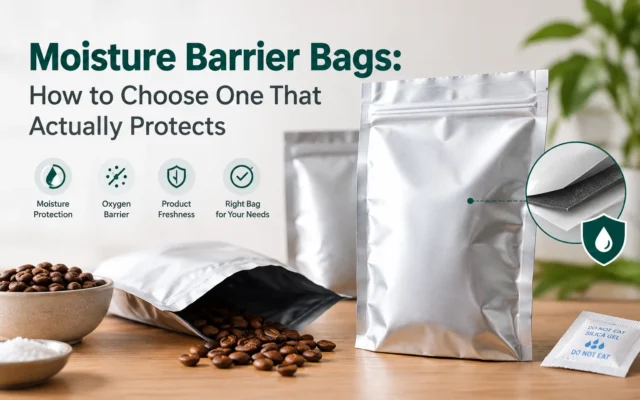
Your packaging’s job is to preserve that low water activity for the target shelf life. Which means your primary enemy is moisture — specifically, water vapour migrating from the external environment into the pack.
But that’s not the only threat. For fat-containing dry foods — nuts, crisps, coffee, chocolate, biscuits with significant butter content — oxygen is the second major threat. Oxygen causes lipid oxidation, which produces rancidity. The off-flavours from oxidised fat are detectable by consumers at very low concentrations, often weeks before you’d expect a product to fail based on its use-by date.
The Two Numbers You Need to Specify
Before you look at any material options for dry food packaging, you need two numbers. These numbers translate your shelf life and product requirements into a material specification that a supplier can actually quote against.
WVTR — Water Vapour Transmission Rate
Measured in grams per square metre per day (g/m²/day) at a specific temperature and relative humidity. This number tells you how much moisture can pass through the film per day. Lower is better for moisture-sensitive products.
As a starting point:
- Hygroscopic products (those that absorb moisture easily): target WVTR below 1 g/m²/day — includes coffee, salt, spices, icing sugar, powdered drinks
- Moderately moisture-sensitive products: target WVTR 1–5 g/m²/day — includes biscuits, crackers, cereals at typical shelf life targets
- Less sensitive products: WVTR below 10 g/m²/day is often adequate — includes pasta, rice, dried pulses
OTR — Oxygen Transmission Rate
Measured in cubic centimetres per square metre per day (cc/m²/day). This number tells you how much oxygen can pass through the film per day. Lower is better for oxygen-sensitive products.
As a starting point:
- High fat content, long shelf life (coffee, premium nuts, crisps with 12+ month target): target OTR below 1 cc/m²/day
- Moderate fat content, 6–12 month shelf life: target OTR below 10 cc/m²/day
- Low fat content, short shelf life: OTR below 50 cc/m²/day is often adequate
These are starting points, not specifications. Your actual requirement depends on your product’s specific fat content, water activity, pack headspace, and target shelf life. Always validate against your product under your actual distribution conditions.
The Main Packaging Formats for Dry Food
Stand-Up Pouches
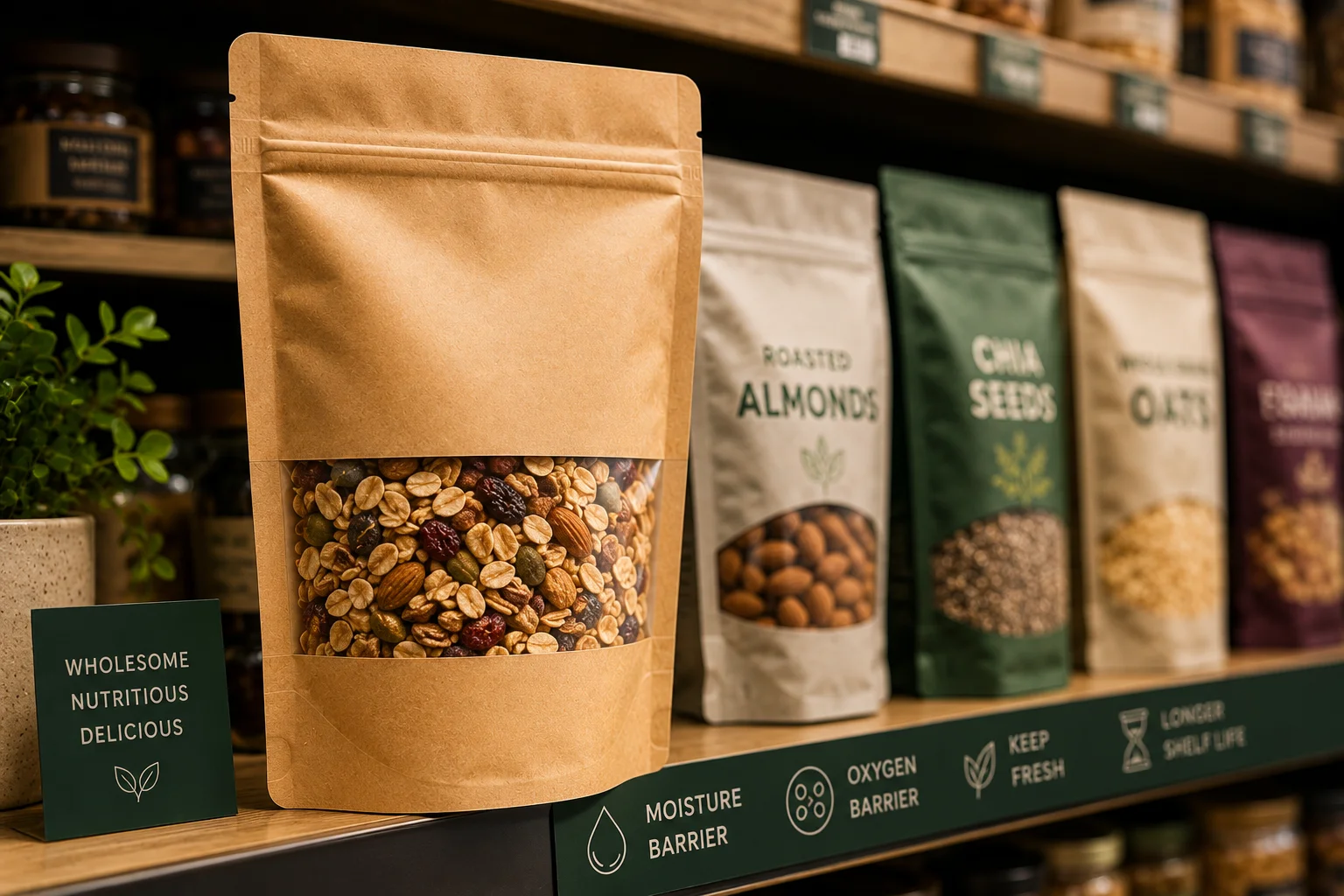
The default format for most ambient dry food brands. Stand-up pouches are used for coffee, tea, nuts, dried fruit, granola, snacks, protein powder, spices, pet food, and dozens of other dry food categories. They’re flexible, lightweight, printable, stand independently on shelf, and available across a very wide range of barrier specifications.
The barrier options range from basic uncoated PE film (suitable for very short shelf life or low-sensitivity products) to full foil laminate (absolute barrier, suitable for long shelf life and high-sensitivity products like coffee). In between are OPP, metallised OPP, PE/EVOH/PE, PET-based laminates, and paper-based alternatives.
The sustainability challenge: most stand-up pouches with meaningful barrier performance are multi-layer laminates — non-recyclable at kerbside in most markets. The sustainable alternative — mono-material PE with EVOH barrier — is recyclable through flexible film drop-off and provides adequate barrier for most ambient snack and dried food categories, though not for the highest-requirement applications like coffee.
Flow Wrap — Horizontal Form-Fill-Seal
The packaging format for individually-wrapped biscuits, confectionery bars, cereal bars, bakery items, and individually-wrapped snacks. A flat film is formed into a tube around the product, sealed along the back, and cut at each end.
Flow wrap is typically OPP (oriented polypropylene) for dry confectionery and biscuit applications — good moisture barrier, good clarity, heat-sealable, and at lower cost than more complex laminate structures. For products needing additional oxygen barrier, metalized OPP provides a step up.
The environmental consideration with flow wrap: it creates significant film waste per unit relative to the product size, especially for small items. If you’re wrapping individual biscuits, the packaging-to-product ratio by weight can be high. Worth reviewing whether a multipack format with less total film achieves the same shelf life.
Paper Bags and Sacks
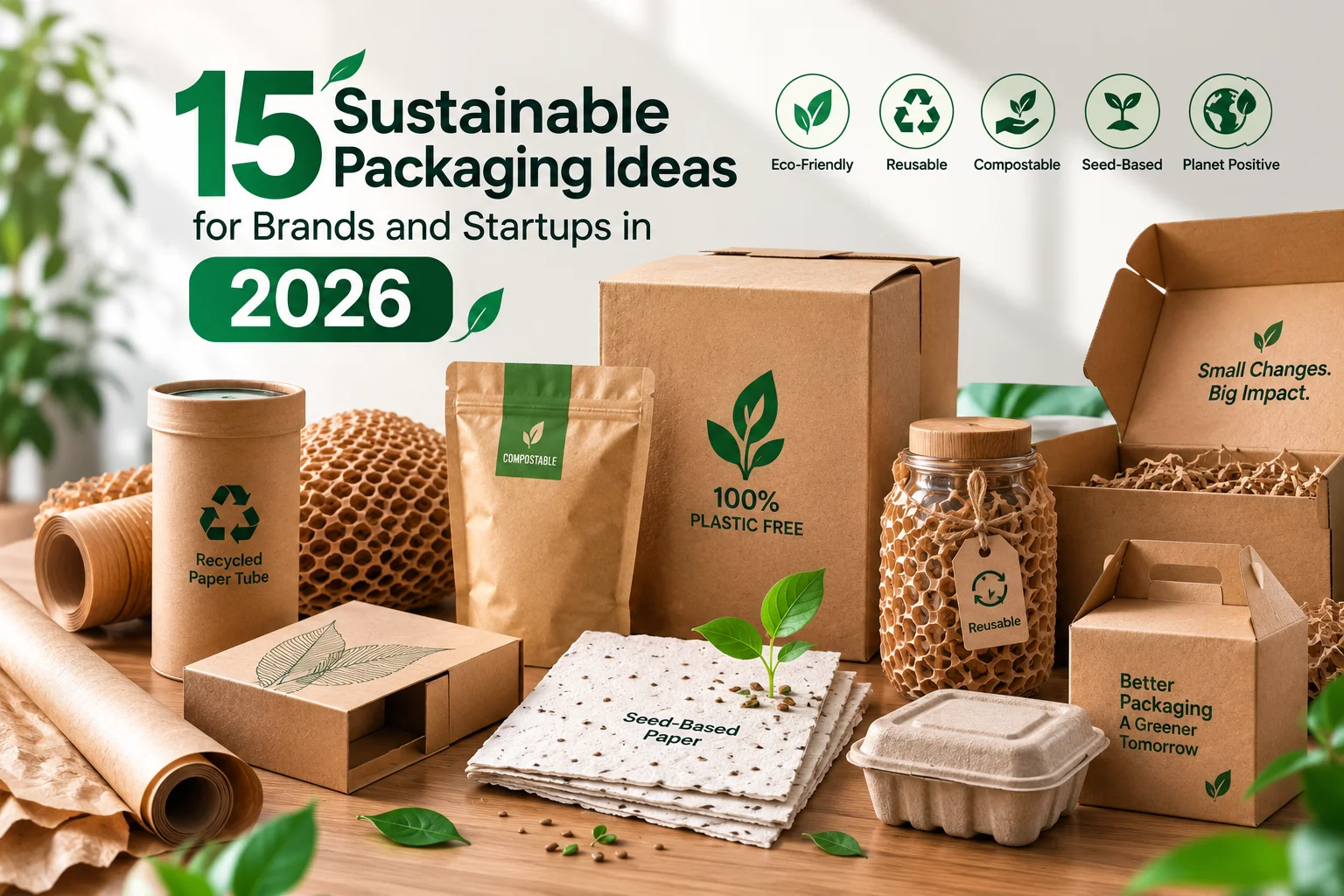
The traditional format for flour, sugar, rice, pasta, pulses, coffee in premium formats, and pet food in large sizes. Kraft paper bags are the most familiar — either unlined (for products where some moisture exchange is acceptable), PE-lined (good moisture barrier, not recyclable in paper streams due to the liner), or with a compostable liner (fully sustainable in theory, dependent on industrial composting infrastructure in practice).
Paper bags have had a renaissance in recent years as brands seek packaging that reads as natural and sustainable to consumers. The visual quality of natural unbleached kraft paper — the texture, the colour, the visible fibre — carries strong positive connotations for artisan and premium food brands.
The practical limitation: paper bags have lower barrier performance per gauge than plastic film. For long shelf life applications or products with high moisture or oxygen sensitivity, validate carefully before committing.
Rigid Cartons with Inner Film Liner
The standard format for cereals, muesli, dry pasta, biscuits in gifting formats, and many other dry grocery products. The outer paperboard carton provides structure, print surface, and retail presence. The inner film bag provides the actual barrier to moisture and oxygen.
The sustainability tension in this format is significant. The outer carton is typically FSC-certified board — recyclable with paper. The inner film liner is typically metallised film — non-recyclable. The consumer is left with a pack where the recyclable part and the non-recyclable part are attached to each other, making correct disposal difficult.
Fully recyclable alternatives exist: barrier-coated paper inner liners that are recyclable with paper, or unlined carton designs where the carton itself provides sufficient barrier for the product. Both require validation and may involve investment in new tooling or process changes at your co-packer.
Resealable Closures
Any dry food format — pouch, carton, bag — can incorporate a resealable closure. Zippers on pouches, resealable strips on cartons, tin-tie closures on paper bags. For products consumed over multiple occasions — coffee, snacks, cereals, spices — resealability directly affects product quality after opening and consumer satisfaction.
The commercial case: a consumer whose packaging keeps product fresher will use it more quickly, run out sooner, and repurchase sooner. For high-frequency categories, resealability is a retention mechanism as much as a product feature. A zipper adds $0.02–0.08 per unit. For most dry food categories, the commercial return is well in excess of the cost.
The Shelf Life Specification Framework
| Shelf life target | Primary threat | WVTR target | OTR target | Recommended format |
| Up to 3 months | Moisture | Below 5 g/m²/day | N/A | Simple PE pouch or kraft bag |
| 3–6 months | Moisture + oxygen | Below 2 g/m²/day | Below 30 cc/m²/day | OPP or metalized OPP flow wrap |
| 6–12 months | Oxygen + moisture | Below 1 g/m²/day | Below 10 cc/m²/day | PE/EVOH/PE mono or metalized laminate |
| 12–24 months | Oxygen (primary) | Below 1 g/m²/day | Below 1 cc/m²/day | Foil laminate or nitrogen-flushed foil pouch |
| 24+ months | Oxygen and moisture | Near zero | Near zero | Foil laminate + oxygen scavenger |
Three Mistakes That Cost Dry Food Brands the Most
Mistake 1: Specifying by material name rather than performance numbers.
‘I want a foil pouch’ is not a specification. Foil laminates vary enormously in actual barrier performance depending on the specific laminate structure, foil thickness, adhesive system, and seal conditions. Two suppliers quoting on ‘a foil pouch’ may be quoting on structures with radically different OTR performance.
Specify the OTR and WVTR you need. Ask each supplier to tell you how their proposed structure meets those numbers, and ask for test data to support it.
Mistake 2: Approving a pouch without testing seal integrity under production conditions.
The seal is where most dry food packaging failures happen. A beautiful film with excellent barrier performance becomes irrelevant the moment the seal at the corner of a gusset fails.
Seal integrity testing — leak testing with a vacuum dye test or pressure decay test on a statistically significant sample — should be mandatory before any new packaging format goes into production. It should be repeated on production samples, not just pre-production prototypes. And it should be done after the packaging has been subject to the temperature cycling and handling that represents your distribution conditions.
Mistake 3: Choosing a format that works in retail but fails in your DTC channel.
A stand-up pouch that stands perfectly on a retail shelf will collapse and potentially fail its seal if it’s placed into a postal box, dropped by a courier, and delivered to a consumer’s door. A rigid carton that looks premium on shelf may arrive damaged if it’s not specifically designed for direct-to-consumer transit.
If you’re selling through more than one channel, your packaging needs to perform in all of them. Either choose a format that works in all channels, or design different packaging for different channels.
Key Takeaways
- Define your target WVTR and OTR numbers before you talk to any supplier — specify performance requirements, not material names
- Seal integrity is where most dry food packaging fails, not the barrier film itself — test it under production conditions and distribution stress, not just in pre-production
- Mono-material PE pouches with EVOH barrier are the most commercially viable sustainable upgrade for most ambient dry food categories — validate barrier against your actual shelf life target
- If you’re selling through retail and DTC, test your packaging in both channels — what works on a retail shelf may not survive postal delivery