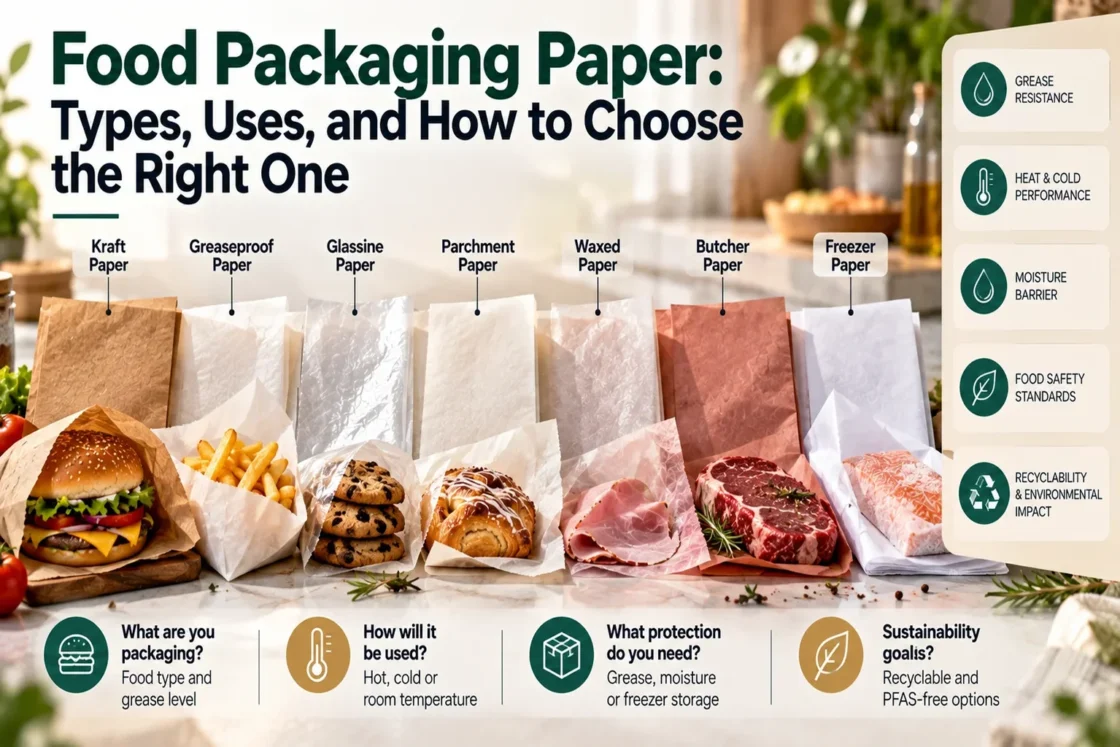
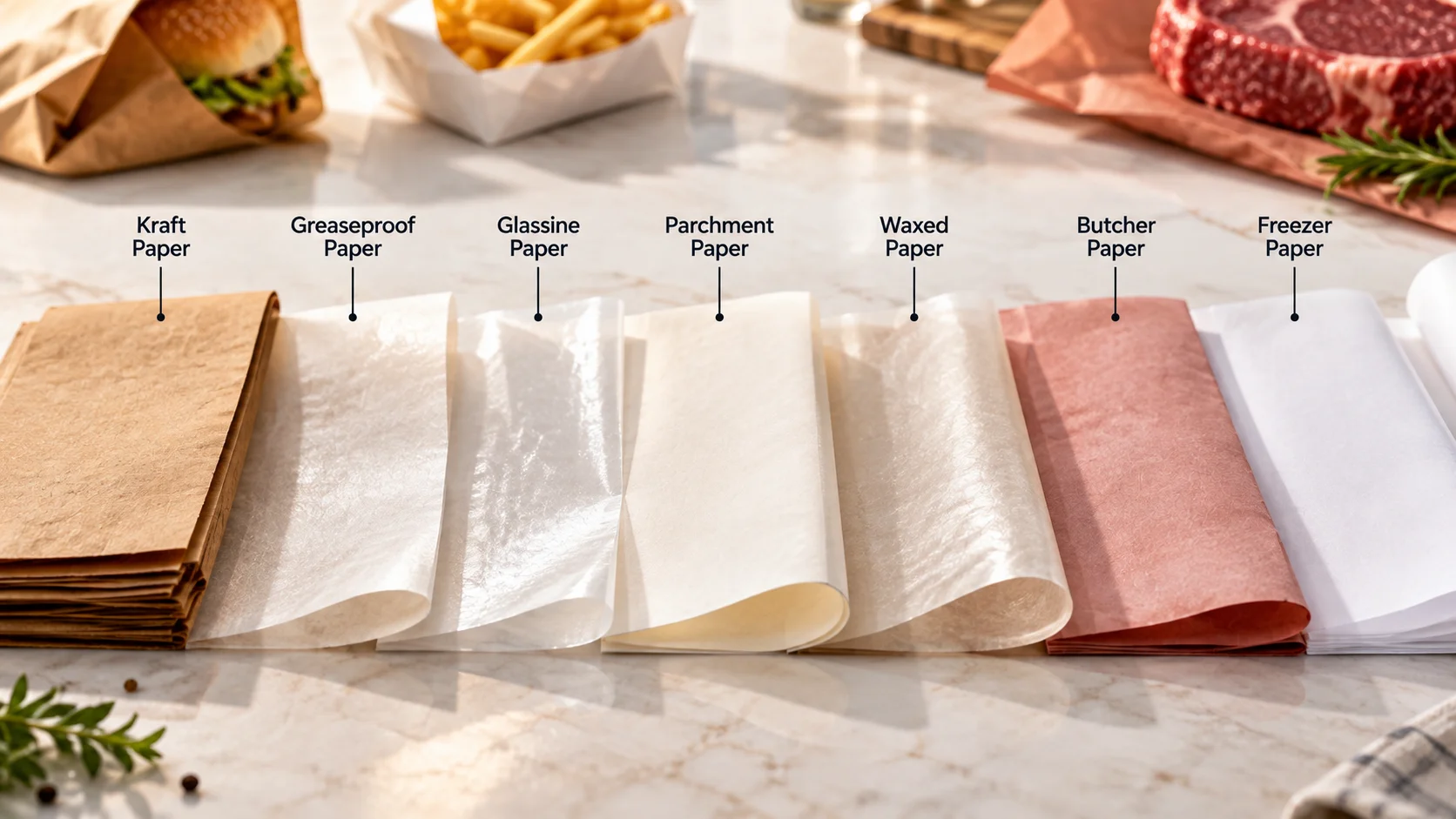
Food packaging paper is not one material but a whole family of papers, and each member behaves very differently once it meets grease, moisture, heat or time. Kraft, greaseproof, grease-resistant, glassine, parchment, waxed, butcher, freezer and coated board papers all look fairly similar on a sample table, yet they solve completely different problems on a food line.
That difference is where most of the trouble starts. A brand tells its supplier that it wants to move to paper, the supplier hears a general request rather than a specification, and the first production run arrives as a wrap that soaks through with oil before the customer has even left the counter. Nobody did anything obviously wrong, but the brand and the supplier were picturing two different papers the whole time.
This guide walks through the main types of food packaging paper in plain language, explains what each one is actually good at, and shows where each one fails. It also covers the rules that now shape this category, including the PFAS restrictions in the United States and Europe, along with the recycling and compostability claims that you can and cannot safely print on a wrapper. By the end you should be able to write a brief that your supplier reads exactly the way you meant it.
The short version
Choose food packaging paper by looking at three things about your product: how much fat it contains, how much moisture it carries, and how long it will stay wrapped before somebody eats it. Plain kraft works well for dry foods, greaseproof and grease-resistant papers handle oily foods for a limited time, and coated papers or boards take over when moisture, freezing or long storage enter the picture.
Whatever grade you pick, ask your supplier for written confirmation that it contains no intentionally added PFAS, and keep your recycling claim specific enough that a customer knows exactly what to do with the wrapper once the food is gone.
Why paper means something different to everyone in the room
When a food brand says it wants paper packaging, it usually means it wants something that looks natural, feels lighter on the environment and tells customers the company is paying attention. When a packaging supplier hears the same request, the first thing it wants to know is which grade, at what weight, with what treatment or coating, and for which food. Those two conversations can run side by side for weeks without either side noticing that they are not actually talking about the same thing.
The main types of food packaging paper
Kraft paper
Kraft paper is the workhorse of food packaging and the grade most people picture when they think of a paper bag. It is made using the kraft pulping process, which keeps the wood fibers long and strong, and the result is a tough, tear-resistant paper that comes in unbleached natural brown or bleached white.
Kraft is an excellent choice for dry foods, including bread, rolls, dry bakery items, flour, sugar, coffee beans in an outer bag, and grocery takeaway bags. Self-opening sack bags, which the trade calls SOS bags, are almost always made from kraft because they need to stand upright, hold their shape and carry real weight without splitting.
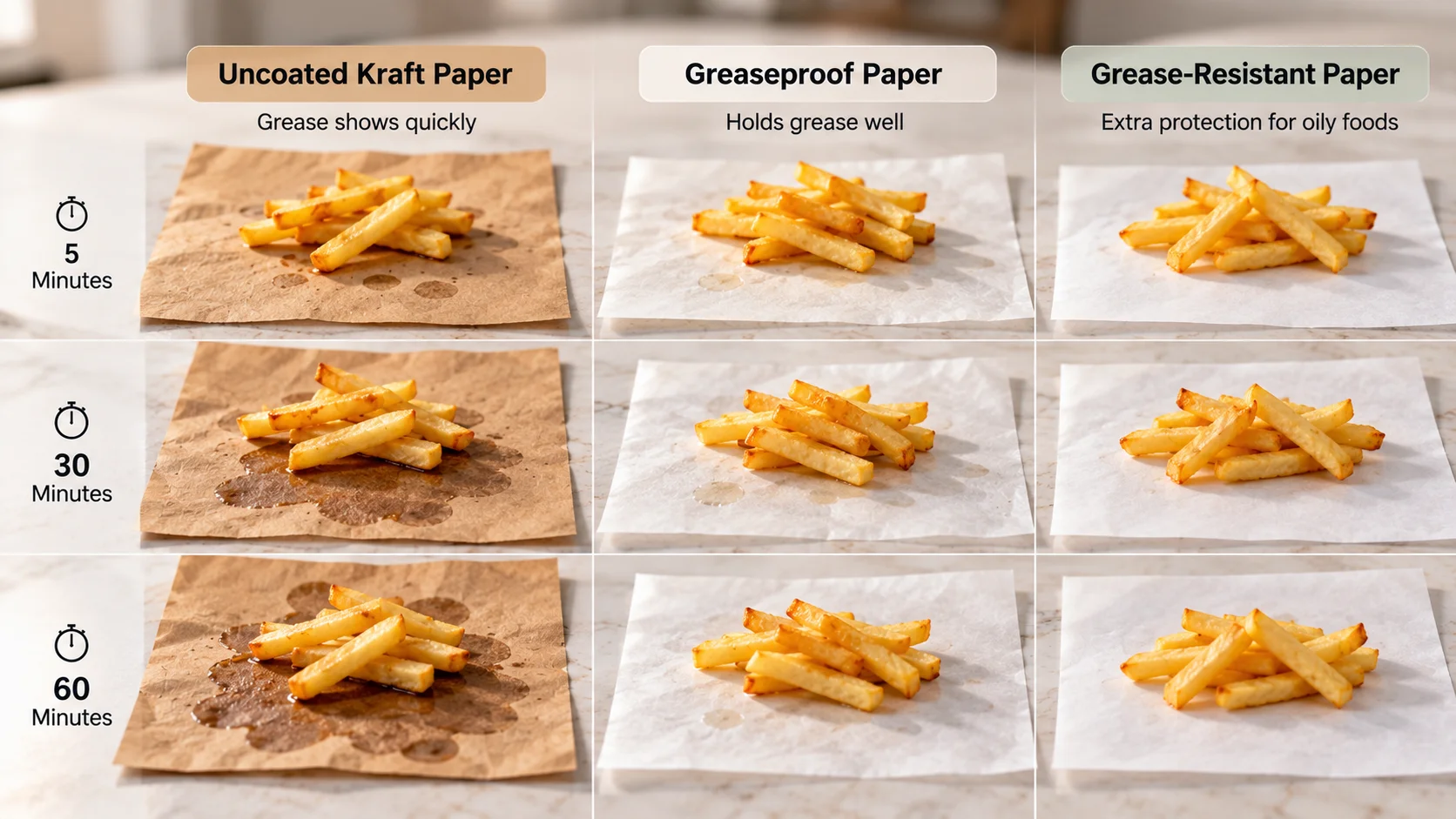
Where kraft struggles is with anything greasy, oily or wet. Plain uncoated kraft has no barrier at all, so oil moves through it within minutes and moisture weakens it quickly, which makes it a poor match for fried food, buttery pastries or anything with sauce. If you love the kraft look but need grease resistance, ask for a grease-resistant kraft grade rather than the standard sheet.
- Typical weight is around 50 to 120 gsm for bags and about 70 to 90 gsm for general wrapping paper.
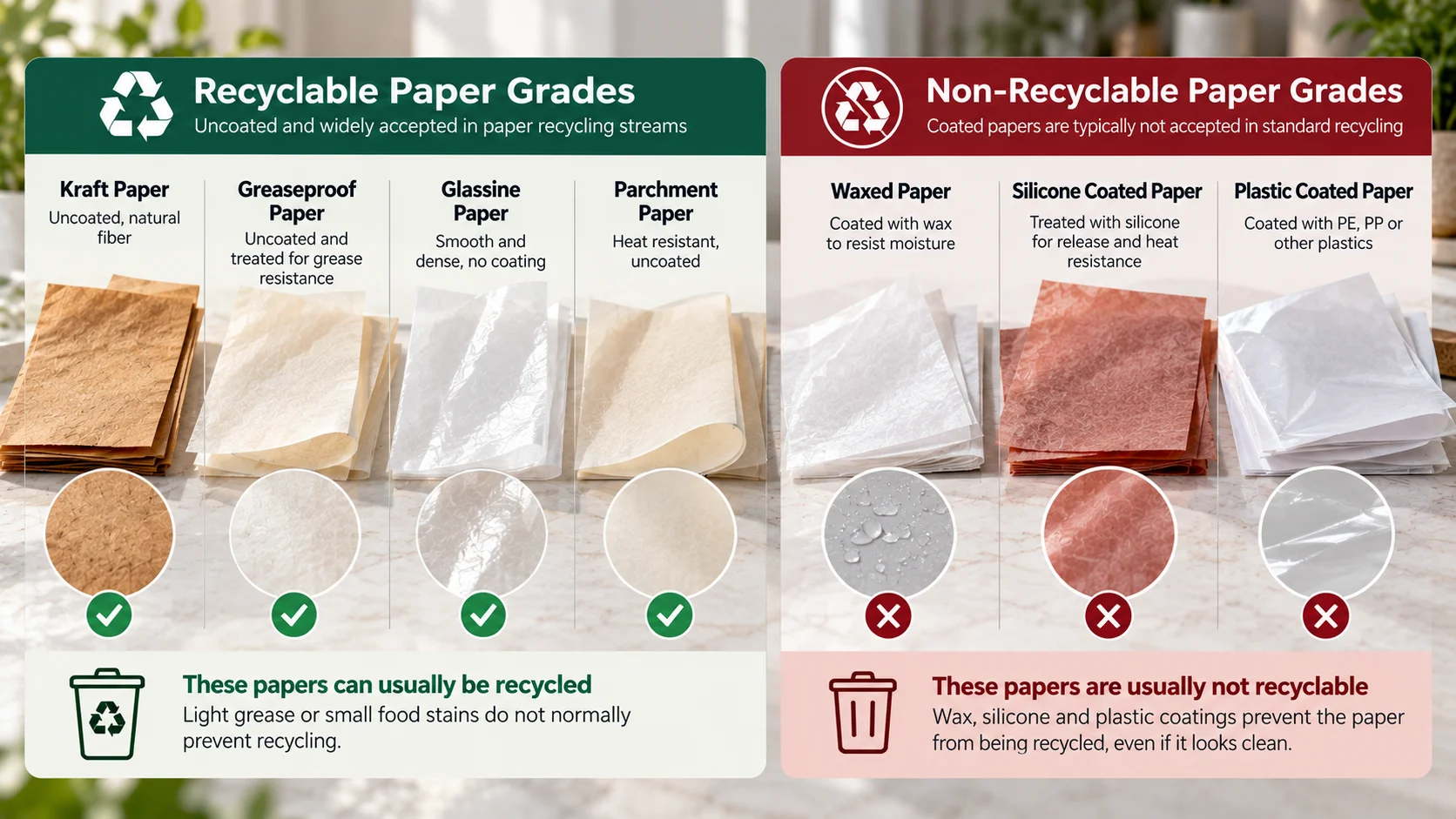
- Uncoated kraft is widely accepted in curbside paper recycling when it is reasonably free of food.
- It sits among the lowest-cost options in the food paper family, which makes it an easy default for dry goods.
Greaseproof paper
Greaseproof paper resists oil because of how it is made rather than because of a coating. The pulp is refined so heavily that the fibers pack into a very dense sheet with almost no open pathways, so grease has a hard time working its way through. Because the protection comes from the fiber structure, a genuine greaseproof paper can deliver good grease resistance without any added chemistry on the surface.
This grade works well for foods that are wrapped and eaten fairly quickly, such as pastries, cookies, deli items, sandwiches with buttery fillings and bakery bags for croissants or donuts.
Greaseproof paper slows grease down rather than stopping it forever, so a very oily product left wrapped for hours will eventually show through, and because it resists grease rather than water, wet or steamy foods can still weaken it.
- Typical weight is around 30 to 60 gsm, with lighter sheets used for interleaving and heavier ones for bags.
- Because it usually has no added coating, it is generally recyclable with paper when it is not heavily soiled.
- It is best suited to short holding times, usually minutes to a few hours rather than days.
Grease-resistant paper
Grease-resistant paper, often shortened to GRP, is a more heavily engineered grade built for tougher food service conditions. It pairs a suitable base paper with a surface treatment or barrier coating so that it holds up against oil for longer and under more pressure than standard greaseproof paper. It has become the go-to specification for burger wraps, fries sleeves, fried chicken liners, food truck wraps and quick service bags.
For many years, the chemistry that gave these papers their grease resistance relied on PFAS, the group of fluorinated chemicals often called forever chemicals. That approach is now effectively over in the United States and restricted in Europe, which is covered in detail further down this guide. Modern grease-resistant papers use fluorine-free alternatives, and the practical point for buyers is simple: always ask for a PFAS-free grade in writing and keep that confirmation on file.
- Typical weight is around 35 to 70 gsm depending on the application and the level of protection needed.
- Recyclability depends on the specific barrier coating, so confirm the end-of-life position with your supplier for the exact grade.
- Expect to pay more than you would for plain kraft, since the added performance comes from extra processing or coating.
Glassine
Glassine is a smooth, glossy and slightly translucent paper made from heavily refined pulp that is then run through a supercalender, which is a stack of polished rollers that press the sheet under heat and pressure. That process gives glassine its shine and its natural resistance to air, grease and moisture, all without relying on a plastic layer.
You will see glassine used as small bags for baked goods and candy, as interleaving sheets between layers of chocolates or cookies, and as inner bags for dry foods that need a little more protection than kraft offers. Its translucent look gives a clean, premium feel, and many brands choose it because customers can see a hint of the product through the paper.
Parchment paper
Parchment paper, sometimes called baking paper, handles heat much better than most other food papers. Traditional vegetable parchment is made by briefly treating the paper so that its surface fibers fuse into a tough, grease-resistant layer, while most household and commercial baking papers also carry a silicone coating that gives them their nonstick surface and heat resistance.
Parchment is the right material for baking, oven cooking, and any product that goes into packaging while still hot, and it also works well for premium wraps where the food needs to release cleanly from the paper. The silicone coating that makes it so useful in the oven also makes it hard for paper mills to recycle, so most silicone-coated parchment ends up in the trash or, in some programs, in the compost.
Waxed paper
Waxed paper is one of the oldest food wraps still in everyday use, and it has a look and feel that many heritage and deli brands love. The base paper is coated with wax, traditionally a paraffin wax derived from petroleum, although plant-based waxes such as soy and carnauba have become more common in recent years. The wax gives the paper moisture resistance, some grease resistance and that distinctive slightly cloudy finish.
The main drawback is end of life. Most paper recycling programs do not accept waxed paper, because the wax interferes with the repulping process and contaminates the recovered fiber. Plant-based waxed papers may be accepted in some industrial composting programs, but that depends on the exact product and the local facility, so a brand that makes sustainability a central promise should think carefully before choosing this grade.
Butcher paper
Butcher paper is a heavier, stronger paper originally developed for wrapping meat at the counter, and it is usually made from kraft or a kraft-like base. It commonly runs from around 65 to 120 gsm, which in American terms is roughly 40 to 75 pounds, and it is strong enough to hold heavy cuts, large sandwiches and bulky deli orders without tearing.
It comes in both uncoated and coated versions, and the difference matters a lot. The uncoated pink or peach butcher paper made famous by Texas barbecue pitmasters lets steam escape while it protects the meat, which helps keep bark crisp rather than soggy. Coated or treated butcher papers resist moisture and blood better and suit fresh meat and fish at the counter.
Freezer paper
Freezer paper is a heavy paper with a thin plastic coating, usually polyethylene, on one side. The coated side faces the food and blocks moisture and air, which protects meat and fish from freezer burn, while the uncoated side faces outward and takes writing or a printed label easily.
Coated paperboard
When food packaging needs structure as well as a paper look, the conversation moves from paper to paperboard. Coated board is much heavier than wrapping paper, usually somewhere between about 180 and 400 gsm, and it forms the cartons, trays, sleeves and boxes you see on grocery and food service shelves.
You will commonly hear three types mentioned: solid bleached sulfate board, or SBS, which is bright white virgin board used for premium cartons, coated unbleached kraft board, or CUK, which is very strong and common for frozen food cartons, and coated recycled board, or CRB, which usually holds food that is wrapped separately inside, such as cereal in an inner bag.
The clay coating on these boards is there mainly for print quality, and a clay-coated board without a plastic or foil layer is generally recyclable with other paper. Boards that are laminated with polyethylene or foil for moisture and grease protection are a different case, so check the full structure rather than the board grade alone.
How the main types compare side by side
| Paper type | Grease resistance | Moisture resistance | Heat tolerance | Typical curbside recycling |
|---|---|---|---|---|
| Uncoated kraft | Low | Low | Moderate | Usually accepted when clean |
| Greaseproof | Good for short holding times | Low | Moderate | Usually accepted when not heavily soiled |
| Grease-resistant (GRP) | High | Low to moderate | Moderate | Depends on the coating |
| Glassine | Good | Moderate | Moderate | Often accepted if uncoated |
| Silicone parchment | High | Moderate | High, oven safe | Generally not accepted |
| Waxed paper | Moderate | Good | Low | Generally not accepted |
| Butcher paper | Moderate | Moderate, higher if coated | Moderate | Uncoated often accepted |
| Freezer paper | Good | High | Low | Generally not accepted |
Matching the paper to your food
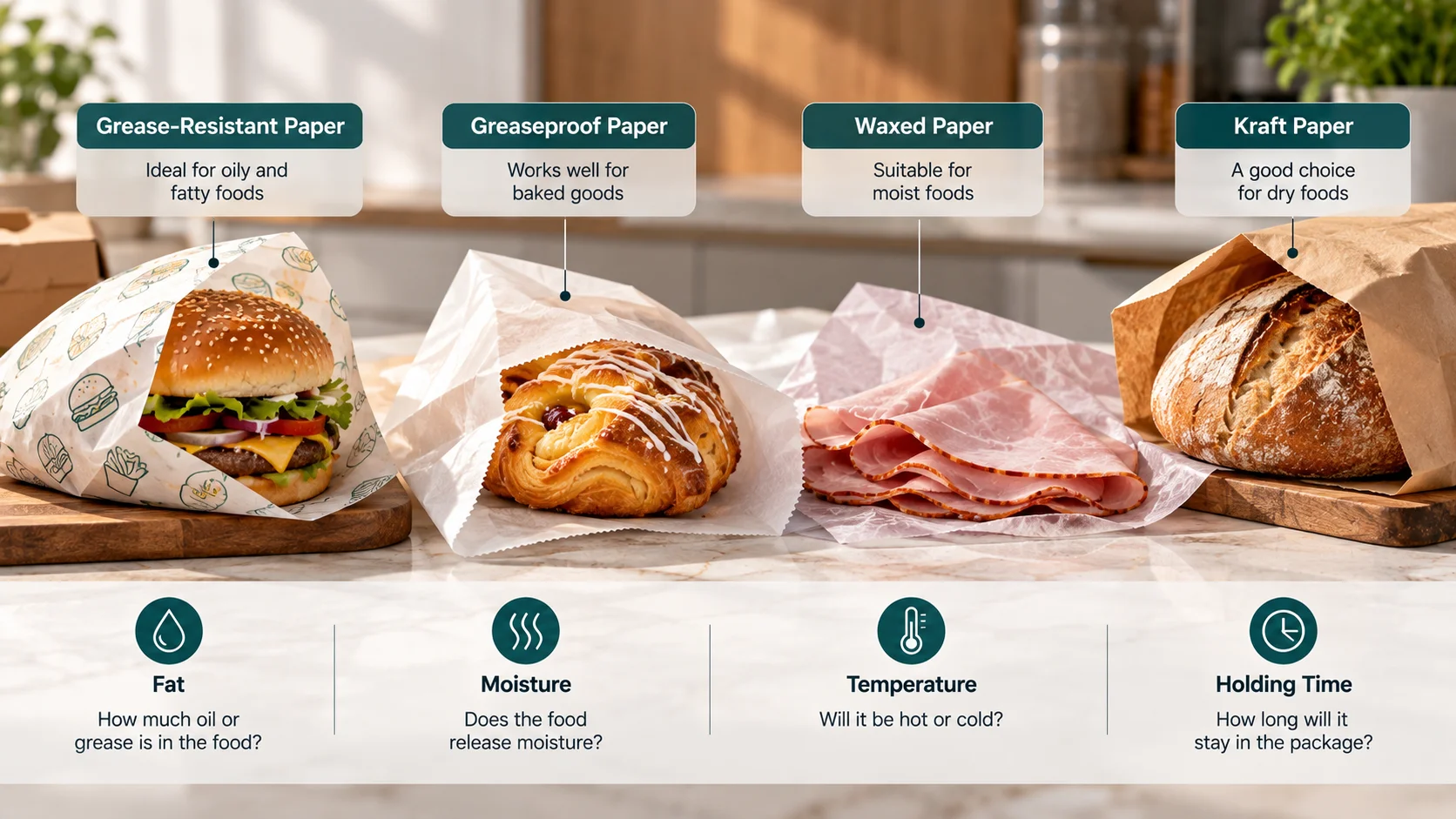
- How much fat does the food contain?
- Dry bread barely touches the paper, while a fried chicken sandwich pushes oil into it constantly, so the higher the fat content, the more you need greaseproof, grease-resistant or coated grades.
- How much moisture does it carry?
- Sauces, fresh produce, raw meat and steamy hot food all bring water into contact with the paper, and grease resistance alone does not help with that.
- How hot is it when it gets packed?
- Food wrapped straight off the grill creates steam that weakens many papers and softens wax, and oven use calls for parchment rather than anything waxed or plastic coated.
- How long will it stay wrapped?
- Dwell time, which is the gap between wrapping and eating, is the factor most often overlooked, since a burger eaten in ten minutes needs far less protection than a sandwich that sits in a cooler for two days.
- How will it be stored and handled?
- A wrap that works perfectly at the counter may fail in a delivery bag that sits in a warm car for half an hour, so think about refrigeration, freezing, stacking and delivery as well.
| Application | Recommended paper | Key specification point | Recycling outlook |
|---|---|---|---|
| Dry bakery bags and bread wrap | Kraft or bleached kraft | About 50 to 80 gsm, uncoated | Usually recyclable when clean |
| Burger and sandwich wraps | PFAS-free grease-resistant paper | About 35 to 60 gsm, written PFAS-free confirmation | Check the coating with your supplier |
| Pastry and donut bags | Greaseproof or glassine | Holding time of a few hours or less | Often recyclable if not heavily soiled |
| Fries and fried food sleeves | PFAS-free grease-resistant paper or board | High grease resistance under heat | Check the coating with your supplier |
| Deli meat and cheese wrap | Waxed paper, coated deli paper or specialty cheese paper | Moisture control for cold storage | Waxed and coated grades usually not recyclable |
| Barbecue and smoked meats | Uncoated butcher paper | About 65 to 120 gsm, food-grade, unwaxed | Uncoated grades often recyclable when clean |
| Frozen meat and fish | Freezer paper | Polyethylene coating on the food side | Usually not recyclable |
The PFAS question every food brand needs to settle
PFAS, short for per- and polyfluoroalkyl substances, are a large group of fluorinated chemicals that resist oil, water and stains extremely well. That performance made them attractive for grease-resistant food packaging for decades, but the same chemical stability means they break down very slowly in the environment and can build up in the body. Regulators on both sides of the Atlantic have now acted on food packaging specifically, and any brand using grease-resistant paper needs to know where things stand.
The federal picture in the United States
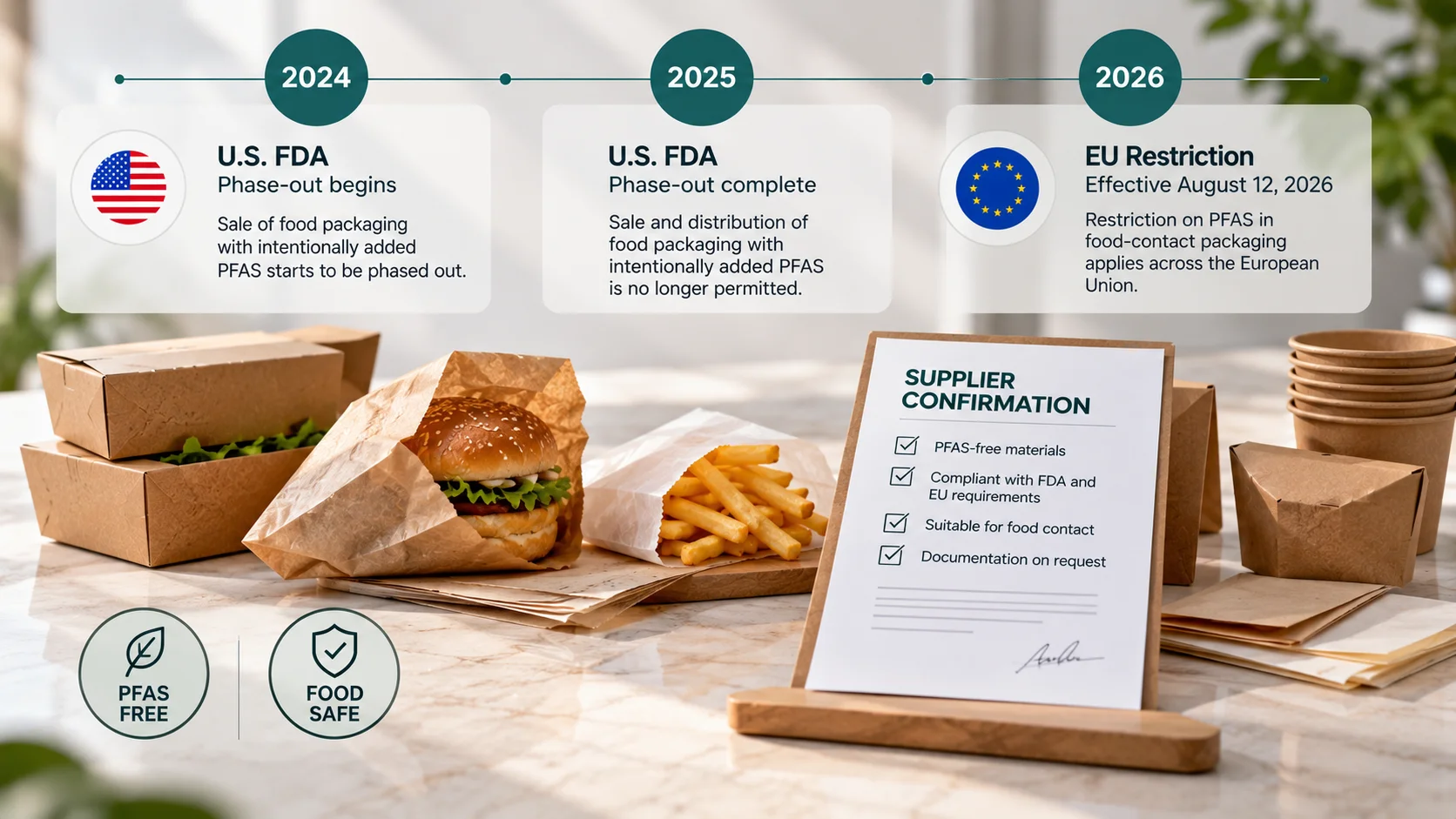
In the United States, the Food and Drug Administration worked with manufacturers over several years to phase out PFAS-based grease-proofing agents for paper and paperboard. In February 2024, the agency announced that these substances were no longer being sold by manufacturers for food contact use in the U.S. market. In January 2025 it followed up by declaring 35 food contact notifications for PFAS grease-proofers no longer effective, which means those authorizations have been withdrawn, and it set a June 30, 2025 compliance date for certain paper packaging made before the change.
In practical terms, a reputable U.S. supplier should no longer be offering grease-resistant paper built on PFAS chemistry. That does not remove the need to check, particularly if you import packaging, buy from a new supplier, or still have older stock sitting in a warehouse.
State laws that go further
Many states have passed their own laws on PFAS in food packaging, and several of them go further than the federal action because they ban intentionally added PFAS rather than relying on voluntary phase-outs. Some of these laws cover all food packaging, as in Connecticut, Minnesota, Rhode Island and Vermont, while others focus on paper-based or plant-fiber packaging, as in California, Colorado, Hawaii and Maryland. New York, Washington and Maine have their own rules as well, with Washington phasing in product categories over time and Maine enforcing restrictions on a list of plant-fiber food packaging categories from May 2026.
Because this area changes every legislative session, the safest approach for a brand that sells across state lines is to specify packaging with no intentionally added PFAS everywhere, rather than trying to manage different grades for different states.
The European Union
For brands that export to Europe, the rules became much stricter in August 2026. The EU Packaging and Packaging Waste Regulation, known as the PPWR, has banned PFAS in food-contact packaging above set limits since August 12, 2026. The limits are 25 parts per billion for any individual PFAS, 250 parts per billion for the sum of targeted PFAS, and 50 parts per million for total PFAS including polymeric forms, and the restriction applies to packaging placed on the EU market after that date even if it was manufactured earlier.
What to ask your supplier
Ask for a signed statement that the grade contains no intentionally added PFAS, the name of the barrier technology used instead, and any total fluorine or PFAS test results the mill holds. If you ship to Europe, ask specifically whether the paper has been tested against the PPWR limits, because a general PFAS-free claim is no longer enough for many European customers.
Food safety compliance beyond PFAS
PFAS gets most of the headlines, but it is only one part of making sure a paper is safe for food contact. In the United States, paper and paperboard that touch food are covered by FDA food contact regulations, with separate rules for papers that contact aqueous and fatty foods and for those that contact dry foods. The distinction matters because a paper that is perfectly acceptable for dry bread may not be approved for greasy or wet foods.
Reputable suppliers can provide a letter of guarantee or a compliance letter stating that the paper and any coatings meet the relevant FDA requirements for your intended use. Ask for that letter at the start of the project and make sure it names the specific food type and conditions, such as hot fill, frozen storage or oven use, rather than offering a general statement that the paper is food safe.
The recycling reality for food packaging paper
Paper has a strong reputation for recyclability, but food packaging is more complicated, because the same wrapper that starts life as clean paper ends it covered in grease or sauce, and because many food papers carry coatings that recycling mills cannot easily handle.
Food residue is less of a problem than most people think
The best-known example is the pizza box, which many people still throw in the trash because they assume grease ruins it for recycling. A 2020 study by WestRock, which was later endorsed by the American Forest and Paper Association, found that the typical levels of grease and cheese on used pizza boxes do not harm the recycling process, and the industry now asks consumers to remove leftover food and recycle the box. Local programs still set their own rules, however, so acceptance varies from one community to the next.
Coatings are the bigger issue
Where food papers really run into trouble is with their coatings. Wax, silicone and polyethylene layers do not break down in the pulper the way fiber does, so they either contaminate the recovered material or have to be screened out, and many programs simply refuse these grades altogether. That is why waxed paper, freezer paper and silicone parchment are usually not accepted in curbside paper recycling, however much they may look like ordinary paper to a customer.
How to word a recycling claim
A vague claim such as recyclable packaging on a greasy burger wrap is likely to mislead customers and may expose your brand to criticism or legal risk. The Federal Trade Commission’s Green Guides say that an unqualified recyclable claim should only be made when recycling facilities are available to a substantial majority of the people where the product is sold, which the FTC describes as about 60 percent. Where that is not true, the claim needs to be qualified so that customers understand the limits.
California has pushed further with SB 343, sometimes called the Truth in Recycling law, which restricts the chasing arrows symbol and recyclable claims unless a material meets strict statewide collection and processing criteria. Its compliance date was October 4, 2026, but a federal court preliminarily blocked enforcement of the law in July 2026 while a legal challenge continues.
In most cases, the most honest and useful wording for an uncoated food paper is something close to recyclable with paper when free of food, ideally followed by a short note to check local guidelines. That wording is specific, it tells the customer exactly what to do, and it holds up far better than a broad eco-friendly promise that says nothing practical at all.
Compostable food papers and what the label really means
Some food papers are sold as compostable, particularly uncoated grades and those with plant-based waxes or certified compostable barrier coatings. Compostability can be a genuinely good fit for food packaging, because a wrapper that ends up covered in food can go into the same bin as the food scraps in communities that collect them.
The catch is that most compostable claims refer to industrial composting, which runs hotter and more consistently than a backyard pile, and access to industrial composting varies widely across the United States. If you plan to use a compostable claim, look for independent certification, such as approval from the Biodegradable Products Institute, which tests coated papers against recognized standards like ASTM D6868. Pair the claim with clear wording about where the item should go, because a compostable wrapper that ends up in a recycling bin can still cause contamination.
How to specify food packaging paper for your supplier
A clear written brief is the single best way to make sure the paper that arrives matches the paper you had in mind. It does not need to be long, but it should cover the points below so that your supplier does not have to guess.
- Describe the food in detail, including its fat content, moisture level, temperature when packed and how long it will stay wrapped before it is eaten.
- State how the packaging will be stored and handled, such as at room temperature, refrigerated, frozen, stacked, delivered or held in a heated cabinet.
- Ask for the paper type, weight in gsm or basis weight, and the exact coating or treatment the supplier proposes to use.
- Request written confirmation of no intentionally added PFAS and, if you export to Europe, test results against the PPWR limits.
- Ask for an FDA compliance letter that covers your specific food type and conditions of use.
- Test real samples with your real food under real conditions, including the longest holding time you expect, before approving a full production run.
Four mistakes that keep appearing
Choosing paper for its look instead of its job is the most common problem, especially with kraft. Brown kraft looks natural and appealing, but uncoated kraft wrapped around a greasy sandwich will show oil through within minutes, which sends the opposite message to the one the brand intended.
Testing with the wrong food or the wrong timing produces approvals that fall apart in real service. A wrap tested with a cold sample for five minutes tells you very little about how it will cope with a hot, saucy product that sits in a delivery bag for half an hour.
Accepting a verbal PFAS-free promise leaves a brand exposed if a regulator, retailer or journalist later asks for proof. A written statement from the supplier, and test results where they are needed, cost very little to collect and are extremely valuable to have on file.
Printing a broad recyclable claim on a coated wrap can mislead customers and create regulatory risk at the same time. If the grade is waxed, silicone coated or poly coated, the claim needs to reflect what really happens to that material rather than what customers might hope happens.
Questions people ask about food packaging paper
What is the best paper for wrapping greasy food?
For greasy foods eaten fairly quickly, such as burgers, fries and fried chicken, a PFAS-free grease-resistant paper is usually the best choice. For pastries and baked goods with a shorter holding time, a good greaseproof paper or glassine is often enough, and it may be easier to recycle.
Can waxed paper be recycled?
Most curbside paper recycling programs do not accept waxed paper, because the wax interferes with the recycling process. Some plant-based waxed papers can be composted in industrial facilities, but that depends on the specific product and whether a local facility accepts it.
Do I still need to worry about PFAS if I buy packaging in the United States?
The FDA has confirmed that PFAS-based grease-proofing agents are no longer sold for food packaging in the U.S. market, which greatly reduces the risk. It is still wise to get written confirmation from your supplier, particularly for imported packaging, older stock, and any product sold into states with their own PFAS laws or exported to Europe.
Where to go from here
Start with the food rather than the paper, because the fat, moisture, temperature and holding time of your product decide which grades can do the job at all. Once you have narrowed the list to papers that can handle those conditions, you can weigh cost, appearance and end-of-life options among the grades that remain.
Keep a written PFAS-free confirmation and an FDA compliance letter on file for every grade you buy, test each paper with your real product for the longest holding time you expect, and word your recycling claim so that customers know exactly what to do with the wrapper once the food is gone.