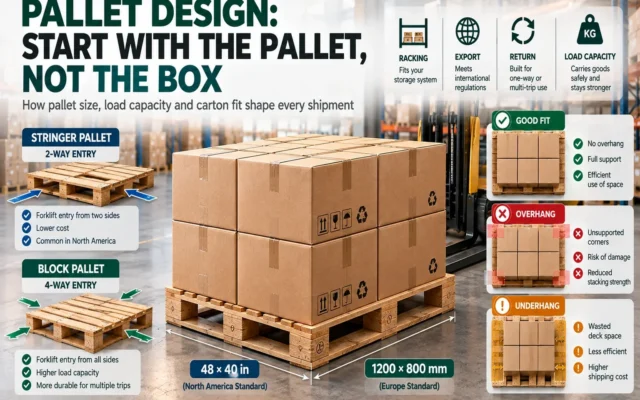
A standard 53 foot trailer holds twenty six standard pallets on the floor in a straight pattern, and rotating some of them can lift that to around thirty. Nobody can give you one number, because space and weight are two separate limits. A heavy shipment runs out of weight long before it runs out of floor.
That second limit catches people out with remarkable consistency year after year. A trailer that looks half empty can already be at its legal weight, and loading one more pallet becomes a compliance problem rather than a packing problem.
This guide gives you the floor counts for the vehicles you are most likely to use, explains how rotating pallets recovers wasted width, and shows when double stacking is realistic. It then covers the weight ceiling, because knowing which limit you hit first is what makes a loading plan work.
The short version
Work out both limits before you plan a load rather than just one of them. Divide the usable floor space by your pallet footprint to get the space limit, then divide the usable payload by your gross weight per pallet to get the weight limit.
Whichever of those two numbers comes out lower is the answer for that shipment. Dense products almost always hit the weight limit first, while light bulky products fill the floor while the vehicle is still well under its payload.

The two limits, and why you need both
Two things constrain every loaded vehicle at the same time, and the lower of the two decides what actually ships. Working out only one of them produces a plan that fails at the weighbridge or leaves money on the table.
The space limit
Space is the simpler of the two to calculate because it depends on measurements you already have. Take the usable floor area of the vehicle, then work out how many pallet footprints fit inside it.
Height matters here as well, because a trailer tall enough for two layers doubles the count without needing any more floor. Whether you can use that height depends entirely on your product rather than on the vehicle.
The weight limit
Weight is where the math surprises people, because the allowance is smaller than the headline figure suggests. A vehicle has a maximum total weight that includes the tractor, the trailer, the fuel and the driver before you load a single pallet.
What remains after all of that is the usable payload, and that is the number your shipment has to fit inside. Ask your carrier for the payload rather than the gross vehicle weight, because the difference between the two is substantial.
Working out which one binds
Run both calculations and compare the two answers directly against each other. Divide the usable payload by your gross weight per pallet, then compare that figure against how many pallets physically fit on the floor.
The lower of those two numbers is your real capacity for that particular product. It is worth repeating this exercise whenever the product changes, because a packaging change can move a shipment from one binding limit to the other.
Vehicle and container dimensions
Before any count makes sense you need the internal measurements of the equipment you actually use. The figures below cover the common types, and exact dimensions vary between manufacturers and between individual units.
| Equipment | Internal length | Internal width | Internal height |
|---|---|---|---|
| 53 foot dry van | About 52.5 feet or 16.0 meters | About 99 inches or 2.50 meters | About 110 inches or 2.79 meters |
| 48 foot dry van | About 47.5 feet or 14.5 meters | About 99 inches or 2.50 meters | About 108 inches or 2.74 meters |
| 20 foot container | About 5.9 meters or 19.4 feet | About 2.35 meters or 7.7 feet | About 2.39 meters or 7.8 feet |
| 40 foot container | About 12.0 meters or 39.5 feet | About 2.35 meters or 7.7 feet | About 2.39 meters or 7.8 feet |
| 40 foot high cube | About 12.0 meters or 39.5 feet | About 2.35 meters or 7.7 feet | About 2.70 meters or 8.9 feet |
Confirm the exact internal dimensions for the specific equipment your carrier is booking rather than working from this table alone. Trailers differ between fleets, and container specifications vary between shipping lines in ways that change a tight loading plan.
One figure in that table does a good deal more work than all the others. The internal width of a road trailer sits at roughly 99 inches, and that single measurement decides almost everything about how pallets arrange themselves on the floor.
Straight loading, and the baseline numbers
Straight loading means every pallet faces the same direction, with rows running down the length of the vehicle. It is the simplest pattern to build and it is where every loading plan starts.
How the width decides the pattern
A standard North American pallet measures 48 by 40 inches, and a trailer offers roughly 99 inches of internal width. Placing two pallets side by side with their 40 inch sides across the trailer uses 80 inches and leaves about 19 inches unused.
Turning them so the 48 inch side runs across the trailer uses 96 inches of the 99 available, which wastes far less width. The trade off is that each row then consumes 40 inches of length instead of 48, which changes how many rows fit.
The resulting counts
| Vehicle | Straight pattern | Rotated pattern | Note |
|---|---|---|---|
| 53 foot trailer | 26 pallets | Up to 30 with pinwheeling | Thirteen rows of two in the straight pattern |
| 48 foot trailer | 24 pallets | Up to 26 with pinwheeling | Twelve rows of two in the straight pattern |
| 20 foot container | 9 to 10 pallets | Rarely improves the count | Container width leaves little room to rearrange |
| 40 foot container | 20 to 21 pallets | Rarely improves the count | Roughly double the 20 foot figure |
Those figures assume the pallets themselves measure exactly to specification and that nothing overhangs the edges. A load where cartons project past the pallet edge takes more room than the pallet footprint suggests, and the count drops accordingly.

Pinwheeling, and how it recovers wasted width
Pinwheeling means rotating some pallets ninety degrees so that the pattern alternates between orientations down the trailer. It looks untidy on paper and it uses the available width a good deal better.
How the pattern works
The idea is to mix rows rather than repeat one arrangement all the way down. Some sections carry two pallets side by side in one orientation, while others carry three pallets turned the other way.
Three pallets placed with their 40 inch dimension across the trailer would need 120 inches, which does not fit. Placing them with the 48 inch side across the width needs 96 inches, which does fit within the roughly 99 inches available.
Alternating between these arrangements down the length of the trailer squeezes more pallets into the same floor. A 53 foot trailer that holds twenty six in a straight pattern can carry twenty eight to thirty once pinwheeled.
What pinwheeling costs you
The gain from pinwheeling is real, and it does not come to you free. A pinwheeled load takes longer to build because the loader has to follow a pattern rather than repeat one movement.
Stability also needs a good deal more attention in a pinwheeled load. Pallets in mixed orientations do not brace each other the way a uniform block does, so voids between pallets need filling with airbags or load bars.
Unloading takes longer as well, and the receiving warehouse will not expect the pattern. Tell your customer when a load is pinwheeled so that their team plans for it rather than discovering it at the door.
When it is worth doing
Pinwheeling earns its extra effort on long lanes where the freight cost per shipment is high. Adding four pallets to a full truckload can reduce the number of trucks you need across a year by a meaningful margin.
It earns much less on short local runs where the loading labor costs more than the saved freight. Work out the value on your own lane before adopting it as a standing practice.

Double stacking, and when it is realistic
Placing a second layer of pallets on top of the first doubles the count without needing any extra floor. Whether you can do it depends on four separate things, and all four have to work out.
The four conditions
- The vehicle has to offer enough internal height for two loaded pallets plus a working clearance for the forklift.
- Your cartons need enough compression strength to carry the weight of a full pallet sitting on top of them.
- The load has to present a flat and stable top surface for the upper pallet to rest on.
- The total weight of two layers has to stay inside the usable payload of the vehicle.
That second condition stops most double stacking attempts before they even begin. Corrugated cartons carry their strength in the vertical corners, and asking the bottom layer to support several hundred kilograms exceeds what the board can do.
Making it work
Several approaches will let a load double stack when it otherwise could not. Stronger board in the bottom layer raises the compression strength, though it also raises the packaging cost on every unit.
Load bars or a decking system can carry the upper layer independently so that the lower cartons take no weight at all. This costs equipment and handling time rather than packaging, which suits some operations better.
A pallet converter or stacking frame does the same job in a different way by transferring the upper weight down to the trailer floor. Whichever route you choose, work it out before the shipment rather than at the dock.
The honest assessment
Double stacking works well for light products in strong packaging and works badly for heavy products in economical packaging. If your pallets are already close to the weight limit, the conversation is over before it starts because the payload has no room for a second layer.
The weight ceiling, and why it usually arrives first
Road vehicles operate under legal weight limits that cover the whole combination rather than the cargo alone. Understanding how little of that total is available for freight changes how you plan a load.
How the allowance shrinks
A legal maximum gross weight applies to the tractor, the trailer, the fuel, the driver and the cargo added together. In the United States the federal limit on the interstate system sits at eighty thousand pounds for most combinations.
The tractor and trailer between them account for a large share of that figure before you load anything. What remains for cargo falls somewhere between forty two thousand and forty five thousand pounds depending on the equipment.
Limits differ between countries and between road classes, and regulators revise them from time to time. Confirm the usable payload for your own lane and your own carrier rather than working from a general figure.
Doing the math
Divide the usable payload by the gross weight of one loaded pallet to find how many pallets the weight limit permits. Compare that figure against the twenty six or thirty that fit on the floor.
The pattern that emerges here is remarkably consistent across whole product categories. Dense products such as liquids, glass, metal goods and printed paper reach the weight ceiling with the trailer still visibly part empty. Light products such as textiles and empty packaging do the opposite and fill the floor while the payload still has room to spare.
What to do when weight binds first
When the weight limit arrives before the space limit, adding pallets is not an option and reducing weight becomes the only lever. Lighter pallets help, and so does removing packaging weight that is not doing protective work.
Some operations solve it differently by mixing dense and light products in the same load. That blending brings the average density into a range where you reach both limits at roughly the same point.

The height dimension, which most plans ignore
Floor counts get all the attention while the vertical dimension quietly decides how much of the vehicle you actually use. A trailer is a box rather than a floor, and paying for the whole box while filling part of it is a common way to lose money.
Cube utilization
Cube utilization describes how much of the total internal volume your load occupies. Twenty six pallets loaded to half the available height use only half the cube, even though the floor looks completely full.
Calculating it is straightforward once you have all four numbers in front of you. Multiply the loaded pallet footprint by its loaded height, multiply that by the number of pallets, then divide the result by the internal volume of the vehicle.
A low figure tells you there is room above the load that you are paying for and not using. Whether you can do anything about it depends on the product, and knowing the number at least makes the question visible.
Building taller pallets
Adding another layer of cartons to each pallet raises the cube utilization without changing the floor count at all. The limits are your carton compression strength, your stability once wrapped, and the receiving height limit at the far end.
Compression strength is the first of those three limits to run out. Every layer you add increases the weight resting on the bottom cartons, and corrugated board has a definite ceiling on what it can carry over time.
Ask your customers for their maximum receiving height before building taller pallets. A load that arrives too tall for their door has to come apart and go back together, which costs far more than the space it saved.
Containers behave differently from trailers
Sea containers share the same two limits and apply them with quite different numbers. The narrower internal width in particular changes which loading patterns remain possible at all.
Width is the main difference
A container offers roughly 2.35 meters of internal width against roughly 2.50 meters in a road trailer. That difference of fifteen centimeters sounds small and it removes most of the room that pinwheeling relies on.
The practical result is that container loading patterns tend to be simpler than trailer patterns. Two pallets across is the arrangement, and rotating pallets rarely produces the gain it produces on the road.
Weight limits in containers
Containers carry their own maximum payload, and the container door carries that figure alongside the tare weight. Road limits then apply separately once the container travels by truck to or from the port.
A container can therefore be legally loaded for sea and still be too heavy for the road journey at either end. Check both limits when planning an international shipment rather than assuming the container rating settles the question.
The high cube option
A high cube container adds roughly thirty centimeters of internal height over a standard one. That extra height sometimes makes a second layer possible where a standard container could not accommodate it.
The extra height costs very little on most lanes and it is worth asking about whenever your product stacks well. Confirm that the receiving side can handle the taller unit before committing to it.
Floor loading, and when it beats pallets entirely
Floor loading means stacking cartons directly into the vehicle without any pallets at all. It recovers both the floor space and the weight that pallets consume, and it changes the handling picture completely.
What you gain
Removing pallets removes their height, which frees up room for another layer of cartons in many loads. It also removes their weight, which matters a great deal when the weight limit is the binding constraint.
The combined effect of both gains can be substantial on a full trailer. Operations that switch to floor loading report fitting significantly more product into the same vehicle.
What you give up
Loading and unloading both become manual operations that take a good deal longer than moving pallets with a forklift. That labor cost lands at both ends of the journey rather than just at yours.
Damage risk also rises because handlers move cartons individually and stack them without the protection a pallet provides. Products that survive palletized transport well can fare worse when floor loaded.
Where it makes sense
Floor loading suits high value dense products on long lanes where the freight saving outweighs the labor cost. It also suits situations where the receiving end has the staff to unload by hand.
It rarely suits operations shipping to many destinations or to customers with automated receiving. Ask your customer before assuming they can accept a floor loaded shipment, because many modern warehouses simply cannot.

Less than truckload, where the rules change again
Everything above assumes you are filling a whole vehicle, which is only one way freight moves. A great deal of shipping happens as less than truckload, where your pallets share a trailer with freight from other companies.
You are buying a position rather than a vehicle
In a less than truckload shipment you pay for the space and weight your pallets occupy rather than for the trailer. The carrier fills the remaining room with other shipments, and your rate reflects your share.
That single difference completely changes what you should be optimizing for here. Fitting more pallets into a vehicle stops being the goal, and making each individual pallet as efficient as possible becomes the thing that saves money.
Pallet height matters more than you expect
Carriers moving mixed freight routinely stack shipments on top of each other to use the trailer height. A carrier can class a pallet built with no room above it as non stackable, which costs a good deal more.
Ask your carrier what height threshold they work to before finalizing a pallet build. Building to just under that figure can move a shipment into a cheaper handling category without changing anything else.
Density drives the rate
Less than truckload pricing depends heavily on how dense your shipment is, because density describes how much of the vehicle your goods tie up. A light pallet occupying a full position costs the carrier the same room as a heavy one.
Reducing the footprint or the height of a pallet therefore has a direct effect on the rate you pay. That is a different lever from the one full truckload shipping rewards, and it is worth knowing which mode you are optimizing for.
Putting the loading plan into a document
A loading calculation done once and remembered by one person disappears the moment that person changes role. Writing it down turns it into something the whole operation can use.
What the document should contain
- The pallet footprint and the loaded height, measured on a real finished pallet rather than calculated.
- The gross weight of one loaded pallet including the pallet, the cartons and all the wrapping.
- The number of pallets per vehicle for each type of equipment you regularly use.
- The loading pattern itself, stating clearly whether it is straight or pinwheeled.
- Whether the load can be double stacked, and what condition has to hold for that to apply.
- Which limit binds first for this product, so that the next person does not repeat the analysis.
That last line is the one people leave out and it is the most useful of the set. Knowing that a product is weight limited rather than space limited immediately tells somebody which lever to pull when they need more capacity.
Keeping it current
Review the document whenever the product changes, the packaging changes or the pallet supplier changes. Any one of those three can move the weight or the footprint enough to invalidate the counts.
Share it with your carrier as well rather than keeping it internal. A carrier planning a load from accurate figures builds a better plan than one working from an estimate somebody gave over the phone.
Five mistakes that waste vehicle space
Planning only the space limit produces a loading plan that fails at the weighbridge. Both calculations take two minutes, and doing only one of them leaves you guessing about the constraint that actually binds.
Allowing cartons to overhang the pallet edge costs floor space on every position in the vehicle. Overhang also weakens the stack, so the same mistake damages both your capacity and your product.
Assuming you can load a trailer to its gross weight rating ignores everything the vehicle itself weighs. Ask for the usable payload, which is a a good deal smaller number than the headline figure.
Ignoring how the weight sits along the vehicle creates an axle problem even when the total is legal. Heavy pallets concentrated at one end can put a single axle over its limit while the combination stays under its overall ceiling.
Treating pinwheeling as free overlooks the extra loading time and the void filling it needs. It pays well on long lanes and it can cost more than it saves on short ones.
Questions people ask about truck loading
How many pallets fit in a 53 foot trailer?
A 53 foot trailer holds twenty six standard 48 by 40 inch pallets on the floor in a straight pattern, arranged as thirteen rows of two. Pinwheeling can lift that to roughly twenty eight or thirty, and double stacking doubles whichever floor figure applies when the product and the payload both allow it.
How many pallets fit in a 40 foot container?
A 40 foot container takes twenty to twenty one standard pallets on the floor, or around twenty three to twenty five Euro pallets. The narrower internal width compared with a road trailer limits how much rearranging can improve those numbers.
Can I always double stack to fit more?
Only when four conditions all hold at once, and the carton compression strength is the one that fails. Your packaging has to carry the weight of a full pallet above it and the load needs a flat top surface. On top of that the vehicle needs the internal height, and the payload needs room for all the extra weight.
Why does my trailer look half empty when it is full?
Because the shipment reached the weight limit before it reached the space limit, which happens routinely with dense products. Liquids, glass, metal goods and printed paper all fill the payload while leaving visible room in the vehicle.
Is pinwheeling worth the extra work?
It depends almost entirely on the length of the lane and the freight cost per shipment. Four extra pallets on a long haul can be worth a great deal, while the same four on a short local run rarely cover the extra loading labor.
Should I switch to floor loading?
Floor loading works when the freight saving outweighs the manual handling cost at both ends of the journey. Ask your receiving customers first, because many automated warehouses cannot accept a shipment that arrives without pallets.
Where to go from here
Both limits in this guide depend on figures that come from elsewhere in your specification. The space limit needs an accurate pallet footprint and the weight limit needs an accurate gross weight per pallet.
Our guide to pallet weight and what freight quotes use covers how to establish that figure properly. Standard pallet dimensions by region covers the footprints that drive the floor count. If you are still choosing a platform for a new product, the article on what a pallet is explains how construction affects both numbers at once.