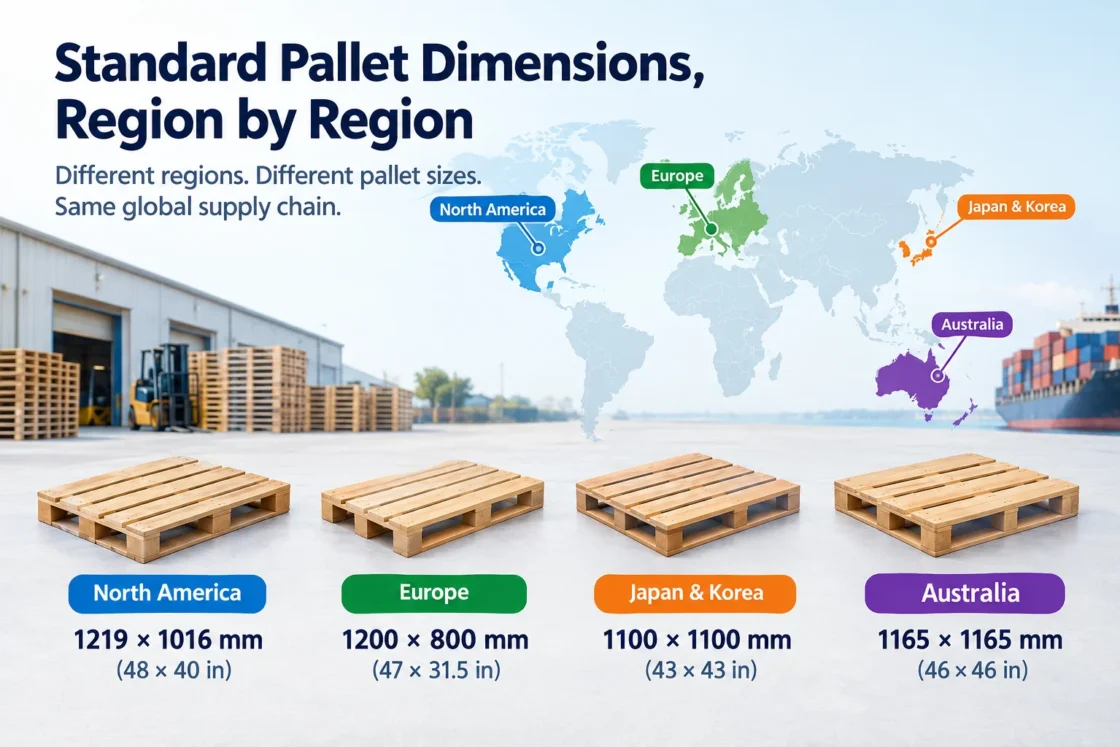
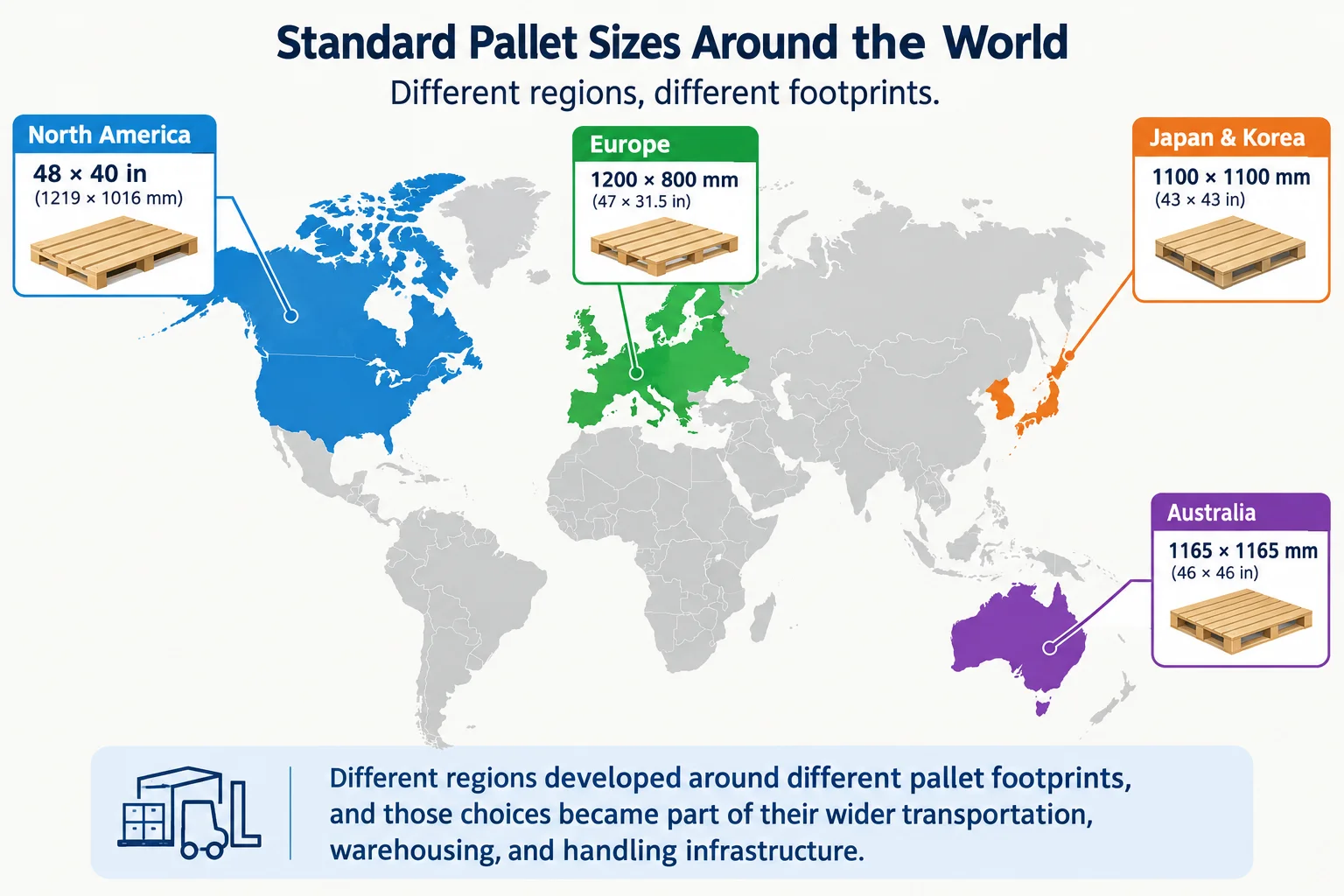
There is no single pallet size that works as the global standard. North America primarily uses a 48 by 40 inch platform, much of Europe relies on 1200 by 800 millimeters, and several other sizes remain widely used across Asia and Australia.
That difference creates far more logistical trouble than most people expect it to. A carton pattern that fills one pallet efficiently will leave significant gaps on another, and those empty spaces add up across every truckload, container and warehouse position.
This guide covers the pallet sizes you are most likely to encounter and explains where each one is used. It also shows what happens when a shipment crosses from one regional standard into another. By the end you will know which platform to design around, and you will be able to spot an export problem before it turns into a cost.
The short version
Design around the pallet used in the market where your products will be sold rather than automatically using the platform common at your manufacturing site. In North America, that generally means 48 by 40 inches; in Europe, 1200 by 800 millimeters is widely used; and Japan and South Korea commonly work with 1100 by 1100 millimeters.
If you sell across several regions, you have two practical options: choose a carton size that performs reasonably well on more than one platform, or use different carton sizes for different markets. A single compromise size can sometimes work, but forcing one carton to fit every pallet standard may create unnecessary space loss across multiple markets.
Why no single world standard ever emerged
The question comes up in almost every international sourcing or logistics conversation, and the answer starts with history. Pallets developed around local transportation and handling systems long before global trade created a strong reason to standardize them.
Handling equipment appeared in different markets at different times, so each region developed platforms that worked with the machinery already in place. Warehouse doorways, rail cars, truck beds, forklifts, and storage systems all had established dimensions, which meant pallet sizes naturally evolved around those constraints.
By the time international shipping had grown enough to make a common pallet size attractive, regional supply chains already contained millions of pallets, racks, trucks, and handling systems built around existing dimensions. Replacing that infrastructure would have required enormous investment, so regional standards remained in place.
Instead of replacing those systems with one universal platform, international standards recognize several established pallet footprints. For businesses, that means the practical question is not simply which pallet size is standard, but which standard applies to the market, customer, warehouse, and transportation system involved in the shipment.
The sizes that matter, region by region
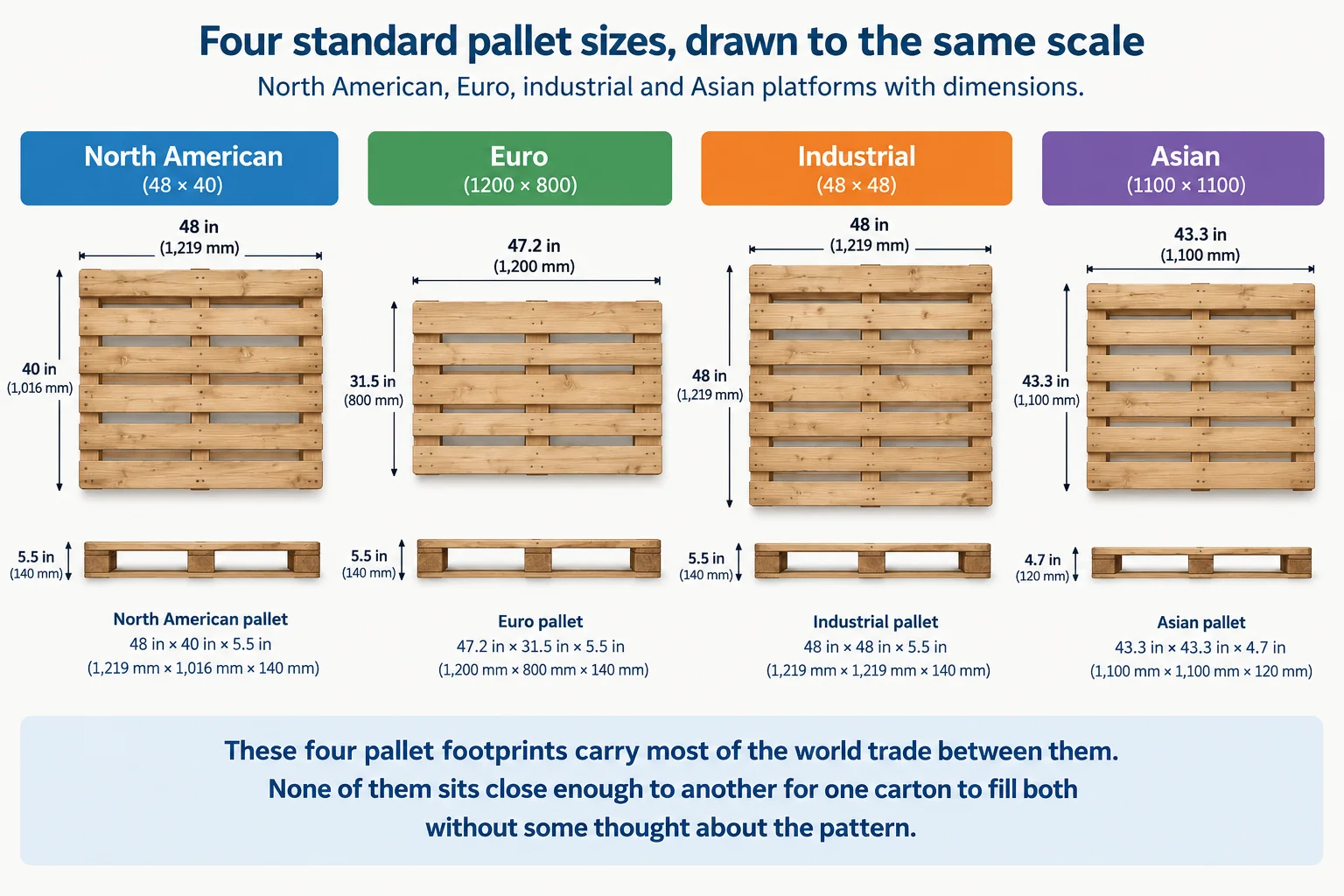
The table below covers the pallet footprints you are most likely to encounter in international distribution. These are nominal dimensions, so an actual pallet may measure slightly differently because of manufacturing tolerances, wear, repairs, or environmental conditions.
| Size in millimeters | Size in inches | Common name | Where it dominates |
|---|---|---|---|
| 1219 x 1016 | 48 x 40 | GMA pallet, North American standard | United States, Canada and much of Latin America |
| 1200 x 800 | 47.2 x 31.5 | Euro pallet, EPAL or EUR1 | Most of the European Union, especially retail distribution |
| 1200 x 1000 | 47.2 x 39.4 | Industrial pallet, EUR2 | Europe for heavy industry and widely across parts of Asia |
| 1100 x 1100 | 43.3 x 43.3 | Asian standard pallet | Japan, South Korea and parts of Southeast Asia |
| 1165 x 1165 | 45.9 x 45.9 | Australian standard pallet | Australia and New Zealand |
| 1067 x 1067 | 42 x 42 | Square pallet | Parts of North America and Asia for specific goods |
North America and the 48 by 40 platform
The North American platform measures 48 by 40 inches, or approximately 1219 by 1016 millimeters. You will often hear it called a GMA pallet, a name associated with the grocery industry that has since become common across general distribution as well.
This platform is almost always built as a stringer pallet, which means it opens fully along two sides and carries notched openings on the other two. That difference decides which directions a forklift can approach from, so it is worth confirming before a load is planned. If you are designing cartons for distribution in the United States, treating 48 by 40 inches as the starting point makes sense unless your customer or logistics provider specifies another platform.
Europe and the Euro pallet family
Europe uses several pallet footprints, but the 1200 by 800 millimeter Euro pallet plays a major role in retail and general distribution. It is manufactured to a controlled specification, which allows pallets within the exchange system to be handled and exchanged more consistently between companies.
That exchange system is the main reason the specification matters as much as it does. A pallet that meets the required standards can move through a shared pool, while pallets that fail inspection may be removed from circulation. Consistent construction therefore matters just as much to the system as the footprint itself does.
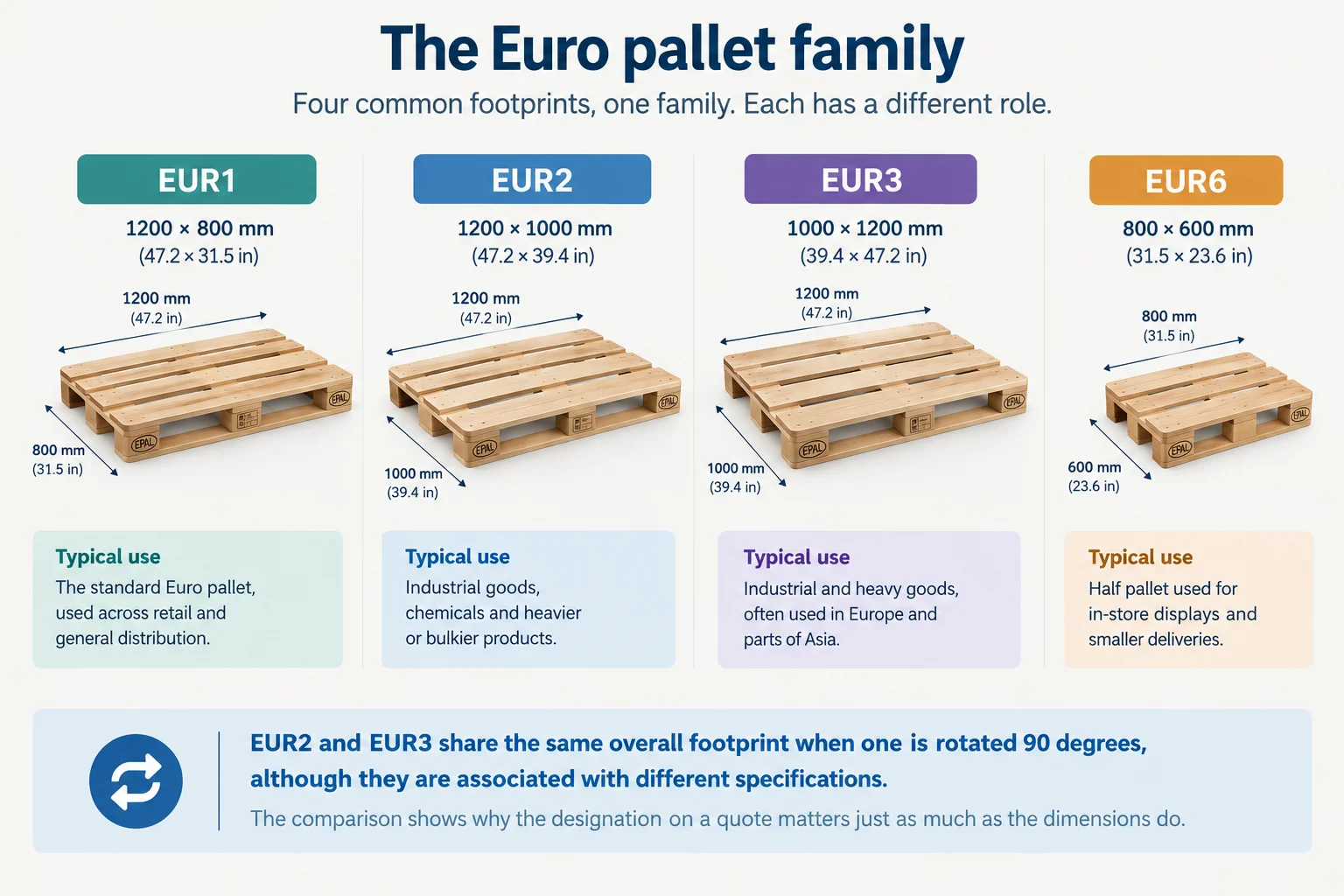
| Designation | Size in millimeters | Typical use |
|---|---|---|
| EUR1 | 1200 x 800 | The standard Euro pallet, used across retail and general distribution |
| EUR2 | 1200 x 1000 | Industrial goods, chemicals and heavier or bulkier products |
| EUR3 | 1000 x 1200 | The same footprint as EUR2 when rotated, although it follows a different specification |
| EUR6 | 800 x 600 | Half pallet used for in-store displays and smaller deliveries |
Asia and the square platform
Japan and South Korea commonly use a square platform measuring 1100 by 1100 millimeters. The square footprint offers one practical advantage: rotating the pallet by 90 degrees does not change the amount of floor space it occupies.
That flexibility can help when loading containers or developing layer patterns because the pallet maintains the same footprint regardless of its orientation. The trade-off is that a square platform does not always align efficiently with the rectangular pallet sizes common in Europe and North America.
Across other parts of Asia the picture turns out to be a good deal more varied. The 1200 by 1000 millimeter industrial footprint also appears widely, particularly in supply chains connected to international manufacturing and export markets.
Australia and the 1165 platform
Australia commonly uses a square pallet measuring 1165 by 1165 millimeters. The size was chosen to suit the internal width of the rail wagons in use when the standard was set, and that established footprint still shapes domestic distribution today.
For exporters entering Australia, the local pallet system can become an important logistics consideration. When goods arrive on a different platform, they may need to move onto a locally compatible pallet before entering the domestic distribution network, creating an additional handling step and potentially increasing costs.
What the international standard actually says
An international standard for pallet dimensions does exist, but it does not select one footprint as the universal winner. Instead, it recognizes several established sizes that already play important roles in different markets.
The six recognized footprints are 1200 by 1000, 1200 by 800, 1219 by 1016, 1140 by 1140, 1100 by 1100, and 1067 by 1067 millimeters. Together, these dimensions cover several major regional standards along with a smaller number of specialized platforms.
That approach makes more sense when you consider how deeply pallet dimensions are connected to existing logistics infrastructure. Rather than forcing every region to replace equipment and handling systems built around established platforms, the standard recognizes multiple footprints. For businesses, it is better to view the list as a set of recognized options rather than as a recommendation to use one universal size.
Smaller platforms and display pallets
Full-size pallets are not always the most practical option, particularly in retail environments where products need to move in smaller quantities. Several smaller formats work alongside full-size platforms, with each one addressing a different distribution or merchandising need.
- Half pallet
- A half pallet uses roughly half the footprint of a full pallet, with common formats including 800 by 600 millimeters in Europe and 48 by 20 inches in North America. Retailers favor these smaller platforms because a half pallet fits into a store aisle without blocking it for shoppers.
- Quarter pallet
- Around 600 by 400 millimeters, quarter pallets work well for smaller promotional quantities and compact retail displays. Because employees may need to move them within a store, the overall load has to remain practical to handle.
- Display pallet
- A display pallet combines a pallet with a printed cardboard surround, turning the shipping unit into a retail display. Because the pallet and display work as one system, the cartons or products inside must fit both the pallet footprint and the finished display dimensions.
- Nestable pallet
- Nestable pallets are often made from molded plastic or pressed wood and include a design that allows empty pallets to stack inside one another. This reduces the space required to return or store empty pallets, which can be valuable in systems where pallets regularly travel back to a distribution point.
Half pallets deserve particular attention because they can change the economics of smaller deliveries. Two half pallets can occupy approximately the same floor area as one full pallet, while allowing a distributor to move smaller quantities across more product lines. That flexibility makes them particularly useful anywhere retail distribution involves many small deliveries.
Height and weight, which nobody agrees on either
The pallet footprint only tells you how much floor space the platform occupies. It does not tell you how tall or heavy the finished load can be, because those limits usually come from the warehouse, transportation equipment, product packaging, and customer requirements around it.
Three separate things set the ceiling and the lowest of them wins every time. Your racking has a clear height between beams and your trailer or container has a usable internal height. On top of both, your cartons have a compression strength that limits how much weight the bottom layer can carry.
Retailers may also impose their own limits because their receiving doors, storage equipment, or store-level handling systems cannot accommodate taller loads. Ask each major customer for its maximum pallet height in writing, because discovering the restriction when the shipment reaches the receiving dock can force the load to be broken down and rebuilt.
Weight limits work in exactly the same layered way that height limits do. The pallet has a load rating, the truck has transportation limits, the warehouse may have handling restrictions, and the product itself may determine how much weight the bottom cartons can support. Design around the lowest applicable limit rather than relying only on the published rating of the pallet itself.
How close a real pallet comes to the nominal size
Every pallet dimension quoted in a specification is a nominal measurement, which means it describes the intended size rather than guaranteeing that every physical pallet will measure exactly the same. In practice, materials, manufacturing, repairs, use, and storage conditions can all affect the final dimensions.
Manufacturing tolerance
Pallet manufacturers work within tolerances, just as box manufacturers do. Timber itself varies, boards can move during assembly, and the nailing process can introduce small differences between individual pallets.
For that reason, build some practical tolerance into your layer pattern instead of designing it to work only when every pallet measures exactly at the nominal dimensions. A pattern that leaves no margin can become difficult to load when the physical platform varies slightly from the specification.
What use does to a pallet
A used pallet may have been dropped, lifted by forklifts, restacked, repaired, and exposed to repeated handling. Over time, boards can splinter, corners can become damaged, and replacement pieces may sit slightly above or outside the original profile.
Those changes may seem minor, but they can matter when your carton pattern already sits close to the edge. A repaired or damaged pallet can reduce the practical margin you had when the pattern was designed around a new platform.
Moisture and the seasons
Wood absorbs and releases moisture as environmental conditions change, so a pallet stored outdoors during a wet period may measure differently from one kept inside a controlled warehouse.
The dimensional change usually does not justify redesigning an entire pallet pattern, but it can explain why a physical measurement does not exactly match the nominal specification. Before assuming a supplier supplied the wrong size, consider how and where the pallet was stored.
How pallet size interacts with racking
Warehouse racking is built around a pallet footprint, which is what makes a pallet choice so difficult to reverse later. Switching to a different platform in an existing warehouse can affect beam spacing, storage capacity, clearances, and the number of pallets that fit into each bay.
Beam spacing and overhang
Pallets in a rack sit on two horizontal beams with nothing supporting the middle of the deck at all. The spacing between those beams therefore has to work with the pallet dimensions and the way the load is distributed.
Overhang inside a rack creates a different concern from overhang on an open pallet. A load that extends beyond the beams may be vulnerable to forklift contact or interference with the storage level above, which can create both product damage and handling problems.
How many fit across a bay
Rack bays are commonly designed to hold two or three pallets side by side, depending on the system and pallet dimensions. Moving to a wider platform can reduce the number of positions available in each bay, and losing even one position across a large warehouse can significantly reduce storage capacity.
If you are considering a different pallet footprint, calculate the effect on your existing rack positions before making the change. The cost of the pallet itself may be small compared with the storage capacity that a different footprint can remove.
Writing pallet dimensions into a specification
Once you have chosen a pallet platform, record that decision in a specification that everybody involved reads the same way. A clear written specification prevents the warehouse, packaging supplier, customer, and freight team from making different assumptions about the load.
When a product crosses between metric and imperial markets, state the footprint in both millimeters and inches. For example, writing 1219 by 1016 millimeters alongside 48 by 40 inches gives the receiving team an exact reference instead of leaving someone to round the conversion.
Record the entry type along with the dimensions because two-way and four-way entry are not interchangeable in every warehouse or handling system. Include the required load rating and specify whether the rating applies to static, dynamic, or racking conditions.
Finally, document the layer pattern instead of leaving it for the next person to calculate from scratch. Record how many cases fit on each layer, how the cases are oriented, and how many layers make a complete pallet. A few lines in the specification can save repeated calculations and prevent inconsistent loading instructions later.
What happens when two standards meet
International shipping is where pallet dimensions stop being a packaging detail and start affecting real logistics costs. Once a shipment moves into a market that uses a different platform, the carton pattern, warehouse handling process, and container utilization can all change.
The carton no longer fits
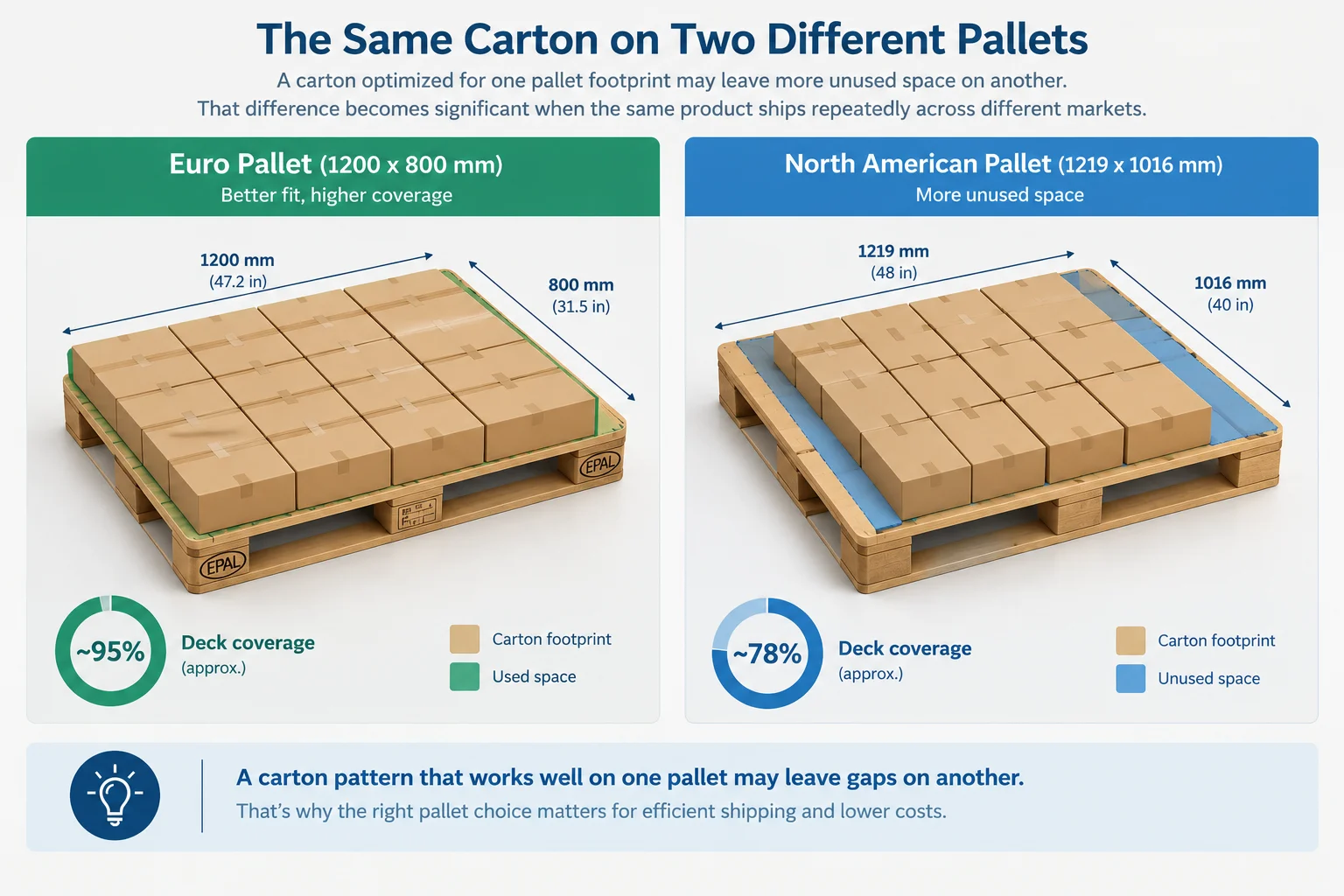
A carton pattern designed around a 1200 by 800 millimeter platform will not automatically transfer to a 1219 by 1016 millimeter platform with the same level of efficiency. The footprints differ in both directions, so the pattern that works well at the origin may leave unused deck space at the destination.
The difference becomes easier to understand when you calculate the actual coverage. A pattern that covered a Euro pallet completely will often cover only around eighty percent of a North American pallet. That leaves a fifth of the deck space traveling empty on every single load into that market. Across hundreds of shipments, that unused space can become a meaningful freight and storage cost.
Somebody has to transfer the goods
When a shipment arrives on a platform that does not suit the receiving network, the receiving operation may need to restack the goods onto local pallets. That additional handling takes labor, creates another point where products can be damaged, and adds time to the receiving process.
Determine who pays for that transfer before the first shipment rather than waiting until the first invoice arrives. Freight and handling responsibilities are easier to negotiate before the shipment moves than after an unexpected cost appears.
The container loads differently
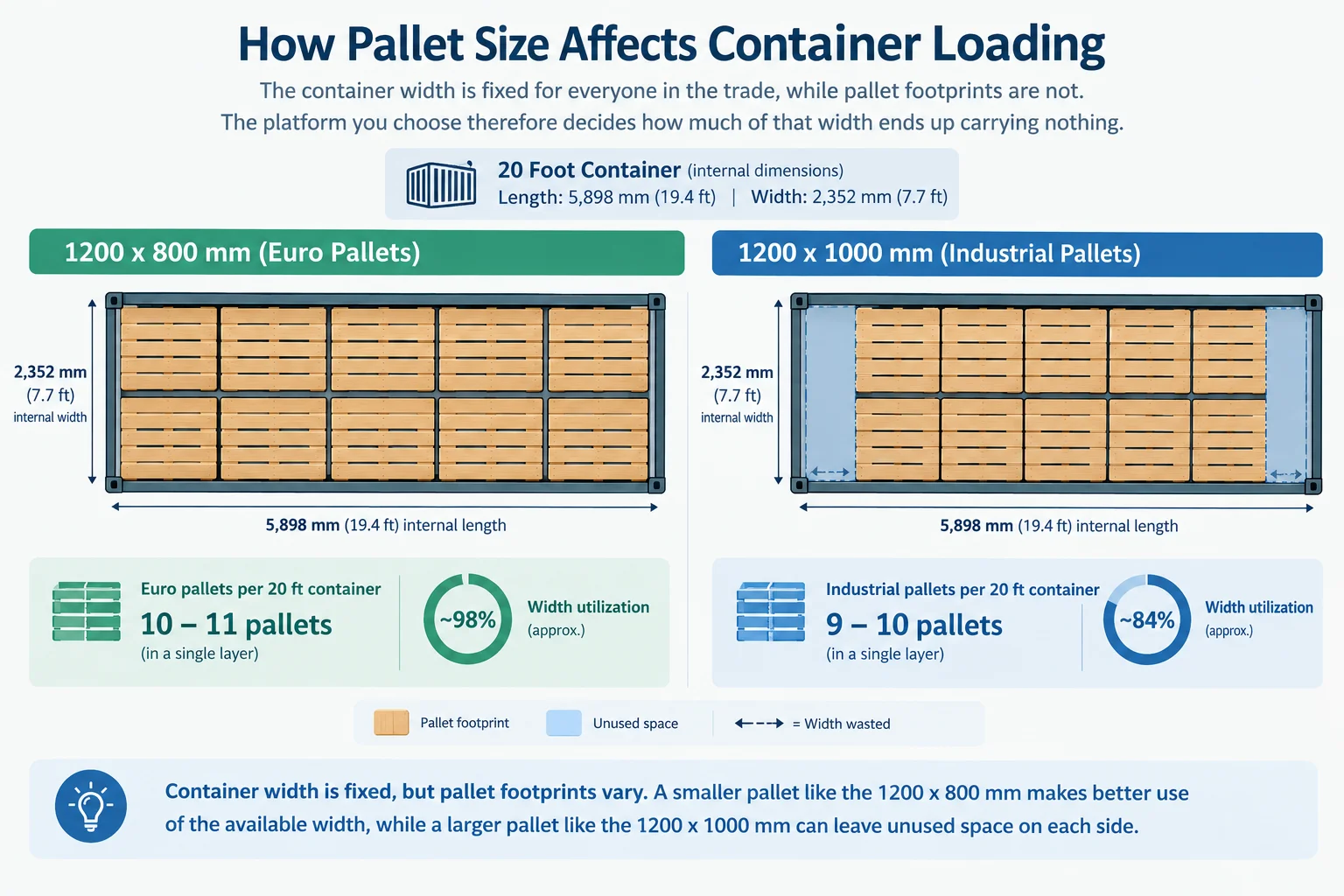
Shipping containers have fixed internal dimensions, and different pallet footprints use that available space in different ways. A pallet arrangement that leaves a large unused strip along the container floor reduces the amount of product you move. The container itself still costs exactly the same to book either way.
How each platform loads into a container
Sea containers come in several standard lengths, but their internal width remains relatively consistent within each container type. That fixed width is one reason pallet dimensions matter so much when you plan international shipments.
A typical 20 foot container provides an internal floor of roughly 5.9 meters by 2.35 meters, while a 40 foot container provides roughly twice the length at a similar width. Exact dimensions vary by container type and manufacturer, so confirm the specifications for the equipment your freight provider is actually booking.
| Pallet size | 20 foot container | 40 foot container | Note |
|---|---|---|---|
| 1200 x 800 | Around 10 to 11 | Around 23 to 25 | Loads efficiently in many container layouts because the narrower dimension works well with the available width |
| 1200 x 1000 | Around 9 to 10 | Around 20 to 21 | Fewer pallets may fit, but each pallet can carry more product depending on the carton pattern |
| 1219 x 1016 | Around 9 to 10 | Around 20 to 21 | Its footprint behaves similarly to the industrial size because the dimensions are relatively close |
| 1100 x 1100 | Around 10 | Around 20 | The square footprint allows rotation without changing the amount of floor space occupied |
Use these figures as planning estimates rather than guaranteed container capacities. The final count depends on pallet orientation, loading pattern, container construction, internal obstructions, weight restrictions, and whether stacking is permitted. Your freight forwarder can confirm the actual configuration for a specific shipment.
More importantly, pallet count alone does not tell you how efficiently a shipment uses the container. What you are ultimately paying to transport is product volume and weight, so a container holding fewer pallets can sometimes move more product when each pallet is packed more effectively.
Choosing the platform to design around
Choosing a pallet size becomes much easier when you work through the decision in a consistent order. Start with the destination market, then check the requirements imposed by the customer, warehouse, carton pattern, and freight system.
- Identify the market where the goods will actually be sold, because that market determines which pallet systems the receiving network is built around.
- Ask your largest customer which platform they receive on, since major retailers and distributors may have specific requirements that override a general regional standard.
- Check whether the goods will be stored in racking and confirm that the platform you are considering works with the existing rack configuration.
- Calculate how your carton fills each candidate platform, testing different orientations and mixed patterns instead of relying on one arrangement.
- Compare the resulting coverage and identify where your cartons leave the least unused deck space while still maintaining a practical loading margin.
- Confirm the final choice with your freight and warehouse teams, because they may know about local handling requirements that are not obvious from the pallet dimensions alone.
The principle behind all six steps is straightforward: design for the destination rather than automatically designing around the origin. The pallet ultimately has to work in the warehouse that receives the shipment, not just in the facility that loads it.
Working out coverage for your own carton
Coverage tells you how much of the available pallet deck your cases actually occupy, making it one of the most useful measurements when comparing pallet footprints. The calculation is straightforward, and it gives you a practical way to compare different loading patterns before you commit to a carton size.
The calculation
- Multiply the pallet length by the pallet width to calculate the total deck area.
- Multiply the outside length of one carton by its outside width to calculate the footprint of a single case.
- Determine how many cases fit on one layer, testing both orientations and any practical mixed patterns.
- Multiply the carton footprint by the number of cases on the layer to calculate the area occupied by that layer.
- Divide the covered area by the total pallet deck area and multiply by 100 to express the result as a percentage.
Run the calculation for every pallet footprint you are considering, and the comparison will show where the carton performs most efficiently. For example, a carton pattern that reaches 95 percent coverage on one platform but only 78 percent on another creates a clear difference in how much deck space each shipment uses.
What a good number looks like
Coverage above 90 percent can be a strong result for many regular rectangular cases, while a result below 80 percent deserves another look because a substantial portion of the available deck would remain unused.
Maximum coverage should not become the only goal you are chasing here. A pattern that reaches 99 percent may leave almost no practical room for pallet tolerances, carton variation, or real-world handling. A slightly lower theoretical coverage can produce a more reliable and easier-to-load pallet.
Five mistakes that keep appearing
Assuming the pallet at the factory is the pallet at the customer causes one of the most common problems. A manufacturing site may use the platform that is inexpensive and readily available locally, while the receiving warehouse follows a completely different pallet system.
Converting inches to millimeters and then rounding too aggressively can introduce errors that accumulate across a complete layer. The North American platform is approximately 1219 by 1016 millimeters rather than a neat 1200 by 1000, so treating the two footprints as interchangeable can change the way cartons fit.
Designing one carton for every market may sound efficient, but a compromise carton can create unnecessary space loss in several regions. Depending on freight volume and packaging costs, separate carton sizes may make more sense than forcing one design to work everywhere.
Ignoring the height limit can leave you with a layer pattern that works perfectly on paper but cannot pass through a receiving door or fit inside the storage system at the other end. Confirm the maximum pallet height with every major customer before the packaging design is finalized.
Forgetting who pays for restacking can turn a predictable logistics expense into a dispute. Decide how transfer and repalletizing costs will be handled before the first shipment moves.
Questions people ask about pallet sizes
What is the most common pallet size in the world?
Two of the most widely encountered footprints are the North American 48 by 40 inch platform and the European 1200 by 800 millimeter platform. Which one appears most common depends on how you measure pallet use, since unit counts, shipment volume, tonnage, and the number of countries using a particular size can produce different results.
Are Euro pallets and standard pallets the same thing?
They are two different things and the words get used loosely all the time. The term Euro pallet specifically refers to the 1200 by 800 millimeter platform associated with the relevant exchange specification, while the phrase standard pallet can simply mean the pallet size commonly used in a particular market. The context therefore matters a great deal whenever somebody describes a pallet as standard.
Can I put a Euro pallet into a North American rack?
It may be physically possible, but that does not mean the arrangement will use the rack efficiently or meet its operating requirements. A Euro pallet is narrower than a North American 48 by 40 platform, so the available support and clearances may differ. Check the rack design and ask the warehouse team before assuming the smaller platform will work safely.
How tall can a loaded pallet be?
There is no universal maximum height that applies across every shipment and every market. The practical limit depends on the warehouse racking, transportation equipment, carton strength, receiving requirements, and any customer-specific restrictions. Gather those limits together and design the load around the most restrictive one.
Why is the North American pallet measured in inches?
The 48 by 40 inch footprint developed within an industry that historically used imperial measurements, and the equipment and infrastructure built around it followed the same system. Its approximate metric equivalent is 1219 by 1016 millimeters, so replacing those figures with a rounded 1200 by 1000 can change the available loading space and affect carton patterns.
Should I use plastic pallets for export?
Plastic pallets can simplify some export processes because they do not fall under the same wood-treatment requirements that apply to solid wood pallets. Whether the higher purchase price makes sense depends on your shipment route, customer requirements, pallet ownership model, and whether you expect the pallets to return. Our guide to what a pallet is covers that trade-off in more detail.
Where to go from here
Settle the pallet platform before finalizing the carton whenever possible, because the pallet footprint is usually the less flexible part of the system. Once you know the platform you need to support, you can build the carton pattern around it and identify opportunities to reduce wasted space on every shipment.
The next step is working out the carton itself, now that the platform is settled. Our guide to how to measure a box explains the inside and outside measurement conventions that affect carton specifications and pallet patterns. If freight cost is the main reason you are evaluating pallet utilization, our article on pallet weight and what freight quotes use covers the other side of the calculation.