A pallet is a flat platform that lets a forklift pick up a whole stack of goods in one movement instead of handling each case by hand. It sounds like a simple piece of equipment, and it quietly decides the size of every box you will ever order.
If you design a box around the product first and then look for a pallet that fits, you are doing what most people do. That order is backwards, and it costs money on every shipment for as long as the box stays in use. Pallets come in fixed sizes that you cannot negotiate, while you can adjust a box by a few millimeters at no extra cost before anybody cuts tooling.
This guide explains what goes into a pallet and which types you will meet. It also covers how much weight each one carries, and how the pallet size works backward into the size of your carton. By the end you will be able to check a pallet pattern before you approve a box rather than discovering the problem afterward.
The short version
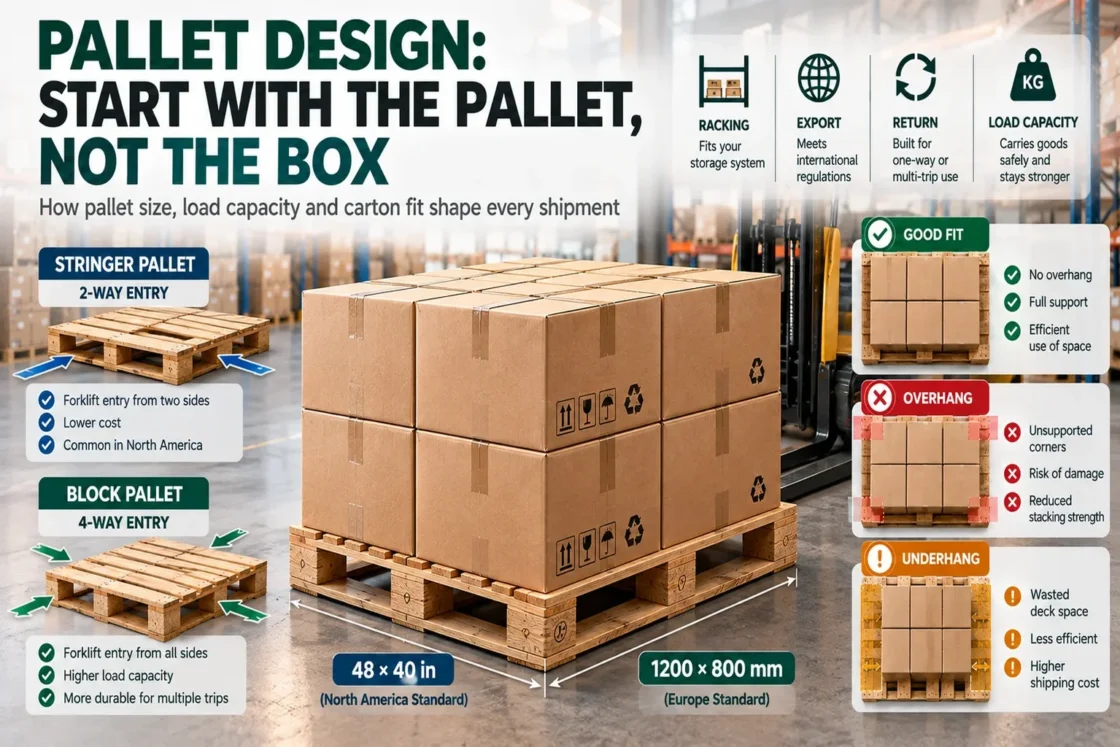
A pallet is a rigid platform, most often made of wood, that carries goods as a single unit so that machinery can move them. The most common size across North America measures 48 by 40 inches, while much of Europe works to a 1200 by 800 millimeter platform.
Decide your pallet first and design the carton to fit it neatly. A carton that leaves large gaps on the pallet wastes space on every single load. A carton that hangs over the edge loses a serious share of its stacking strength.
What a pallet is made of
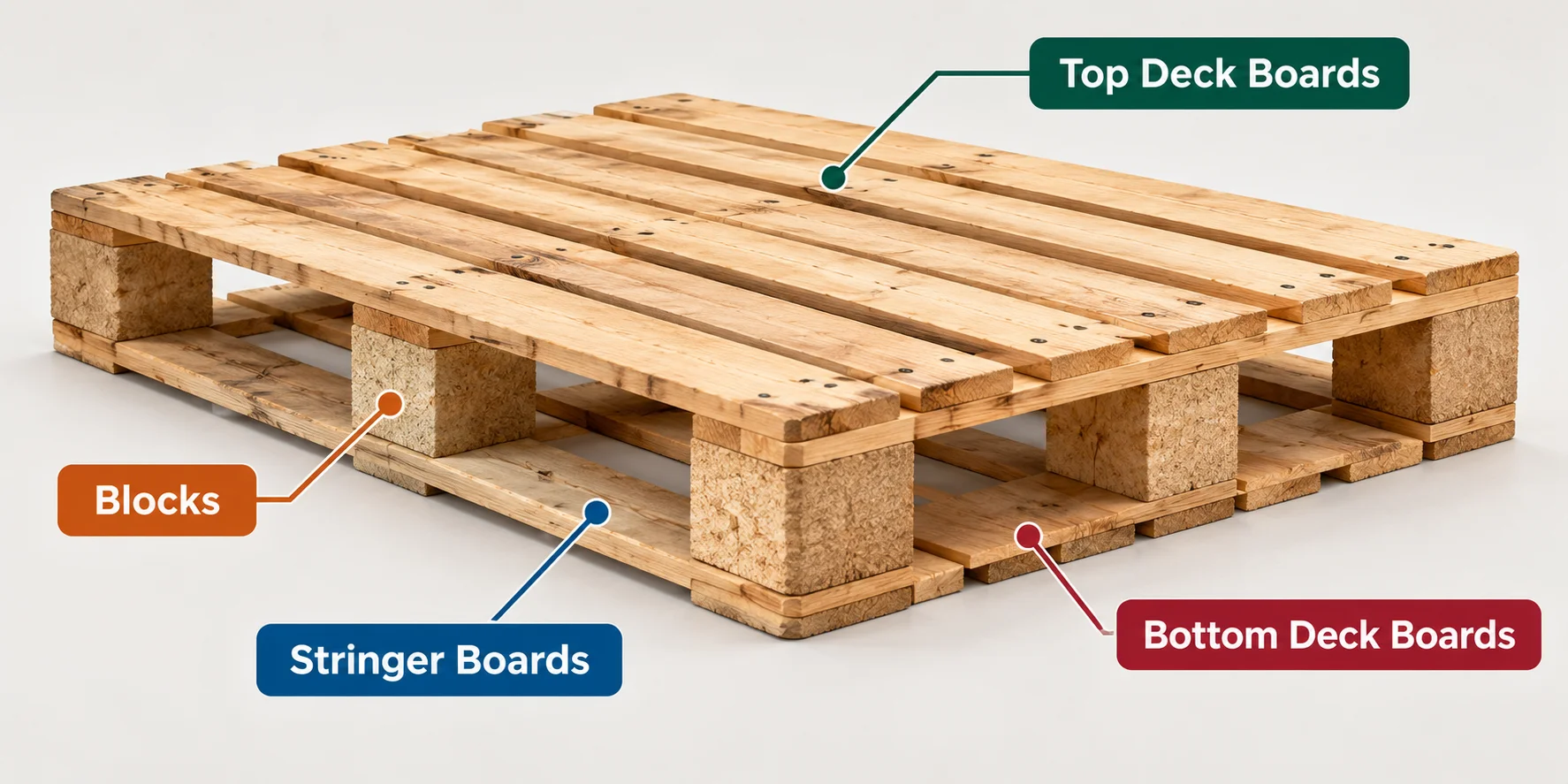
Every pallet does the same job, which is to raise a load off the floor so that the forks of a lift truck can slide underneath it. The parts that achieve this have names, and those names turn up constantly once you start talking to suppliers.
- Top deck boards
- These are the flat boards that your goods actually sit on. More boards, or wider boards, give better support to small cases and cost a little more.
- Bottom deck boards
- These run underneath and spread the load onto the floor or onto a rack beam. A pallet with no bottom deck is called a skid and it behaves quite differently in storage.
- Stringers or blocks
- These sit between the top and bottom decks and create the gap that the forks enter. The choice between them decides how many sides the pallet can be lifted from.
- Deck opening
- This is the gap that the forks slide into when the pallet is lifted. Its height and width have to suit the equipment used at every point in your supply chain, not only at your own warehouse.
None of this detail seems important until the day that something goes wrong. A driver who cannot get forks in from the direction the trailer allows will either damage the load or refuse it. Both of those outcomes cost you far more than the pallet itself ever did.
The two main construction types
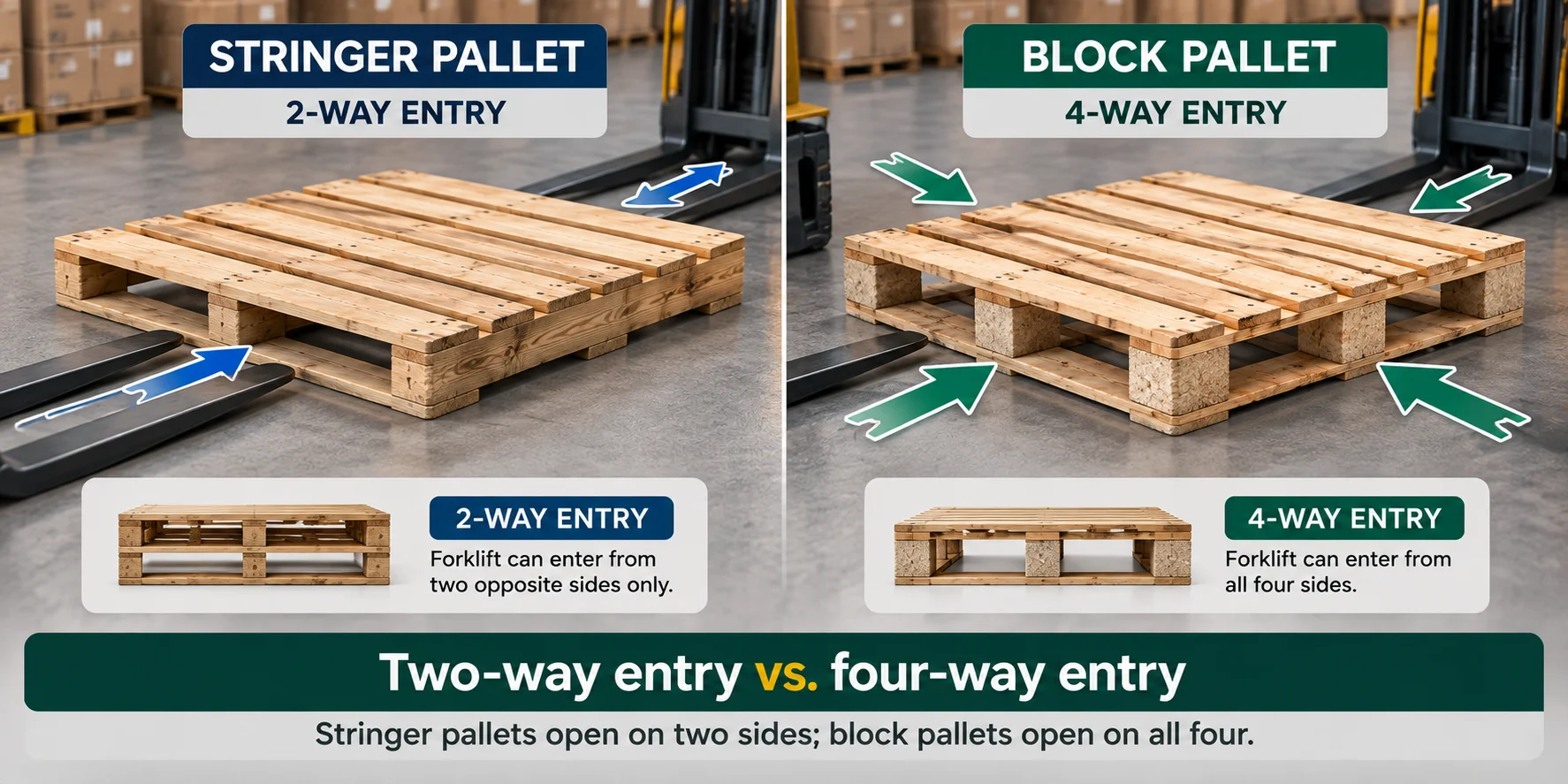
Almost every wooden pallet you meet will be one of two designs. They look similar from above and they behave differently in ways that matter during handling.
Stringer pallets
A stringer pallet uses three long boards running the full length of the pallet, and the maker nails the deck boards across them. The stringers create a continuous gap along two sides, which means forks can enter from those two directions.
Many stringer pallets have notches cut into the outer stringers so that forks can also enter from the other two sides. The trade calls this partial four way entry, because a pallet jack can reach the notches while a full width fork cannot always use them properly.
Stringer designs cost less to build and they are the common choice across North America. The limitation is that the notched sides carry less strength than the open sides, which becomes relevant when loads are heavy.
Block pallets
A block pallet replaces the long stringers with nine separate blocks arranged in a three by three pattern. Boards then run between those blocks in both directions, which leaves a genuine opening on all four sides.
The result is true four way entry, and it makes handling faster because the operator never has to reposition the load. Block pallets also tend to carry more weight and survive more trips, which matters a great deal in a pooled system where the same pallet circulates for years.
The trade off is cost, because a block pallet uses more material and more labor to build. Over a single one way shipment you cannot justify that extra cost, and over dozens of trips it pays for itself.
What pallets are made from
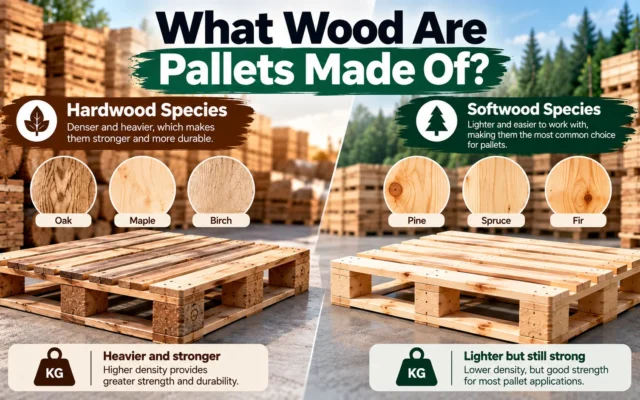
Wood dominates the market, and it is nowhere near the only material you can choose. Each material suits a different situation, and the right choice depends far more on the journey than on the price tag. Our guide to what wood pallets are made of covers the individual species in full, along with the treated wood question people ask before reusing one.
| Material | Main advantage | Main drawback | Best suited to |
|---|---|---|---|
| Softwood | Low cost, easy to repair, and available almost everywhere | Absorbs moisture, splinters, and needs treatment for export | General distribution and most one way shipments |
| Hardwood | Higher strength and a longer service life | Heavier and more expensive than softwood | Heavy goods and pallets that will make many trips |
| Plastic | Washable, dimensionally stable, and free of export treatment rules | High purchase price and difficult to repair once cracked | Food, pharmaceutical and closed loop systems |
| Pressed wood | Nestable, light, and usually exempt from export treatment | Lower load capacity and poor performance when wet | Air freight and export where weight is the priority |
| Corrugated | Very light, fully recyclable, and cheap to dispose of | Modest load rating and no tolerance for moisture at all | Light goods and single trips inside a dry chain |
| Metal | Extremely durable and suited to harsh conditions | Heavy, costly, and often needing its own handling rules | Industrial closed loops and specialist applications |
Most buyers overlook two points almost every time this comparison comes up in a quote. The first is weight, because a heavy pallet eats into the payload you are paying to move and does so on every single load. The second is what happens at the far end, since a pallet your customer has to dispose of is a cost you handed them without asking.
New, used and the grading system
A large secondary market trades used pallets, and a used one is often the sensible purchase. Understanding the grades keeps you from paying for more pallet than the journey requires.
A pallet described as new has never carried a load and every board is sound. A grade A pallet has seen use and repair, keeps all its boards and shows no visible damage, which suits most of the distribution work you are likely to do. Grade B carries heavier repairs and often shows plugged or replaced boards, and it still performs for many non critical loads.
Below those grades sit pallets sold for one final trip before they go for recycling. They have a place in the market and they are the wrong choice for anything valuable or anything that has to be racked.
Buying a used pallet raises one question you should always put to the seller directly. Find out what the pallet carried before you bought it, because its history travels with it. A platform that soaked up a chemical spill, or that sat outdoors in the rain, should never go near food or pharmaceutical goods.
Export and the heat treatment rule
Rules govern wooden packaging that crosses an international border, because untreated timber carries insects and disease between countries. The framework that governs this is an international standard normally referred to as ISPM 15.
Under that standard the wood has to go through a treatment that kills any pests inside it. Heat treatment is the usual method, and it requires the timber to reach a specified core temperature and hold it for a set period. Once treated, the treatment facility stamps the pallet with a mark that includes a wheat symbol, a country code and the identifier of the treatment facility.
Three practical consequences follow from this and they catch exporters out regularly. Border officials can refuse a pallet without that stamp, and the entire load may be held, treated at your cost or sent back. A stamp also has to remain legible, so a pallet with a damaged or painted over mark can cause the same problem.
Plastic, metal and pressed wood pallets fall outside the rule because they are not solid timber. That exemption is one of the practical reasons exporters often move away from ordinary wooden pallets despite the higher purchase price.
Requirements do change over time, and you will find enforcement varies noticeably between one country and the next. Confirm the current position for your destination market with your freight forwarder rather than relying on what was true for a previous shipment.
How much weight a pallet carries
Suppliers quote load capacity in three different ways, and a supplier who gives you a single number has not told you enough. Each figure describes a different situation, and you should never treat them as equal.
- Static load
- The weight the pallet can hold while sitting still on a solid floor. This is always the largest of the three figures and it is the least useful one in practice.
- Dynamic load
- The weight the pallet can hold while it is being lifted and moved by equipment. Movement introduces flexing and shock, so this figure comes out well below the static one.
- Racking load
- The weight the pallet can hold while supported only at the two ends inside a rack. This is the smallest figure by a wide margin and it is the one that decides whether a pallet is safe in a warehouse.
Confusing these three figures with one another will cost you something real inside a warehouse. A pallet quoted at a comfortable static figure can sag or fail once it sits in a rack with nothing under the middle. An unsupported span is a far harder test than resting on concrete.
Always ask a supplier which of the three figures a quoted number refers to. If your goods will be racked at any point in the chain, the racking figure is the only one that matters to your decision.
Why the pallet decides the box
This is the part that saves money, and it is the reason a pallet article belongs on a packaging site at all. The pallet is a fixed platform and the carton is the flexible item, so the sensible design order runs from the pallet inward.
Cube utilization
Cube utilization describes how much of the available pallet area your cartons actually cover. A pattern that covers most of the deck is efficient, while one that leaves a wide strip of bare wood has you paying to ship empty space.
Working out the arithmetic makes the waste visible in a way that looking never does. A pallet layer that reaches only eighty percent coverage is carrying a fifth of nothing. That same fifth travels on every truck and fills a rack position for the life of the product.
The fix is almost always to adjust the carton rather than the pallet. Changing a box by ten or fifteen millimeters is free before tooling exists, and it can be the difference between eight cases per layer and nine.
Overhang and underhang
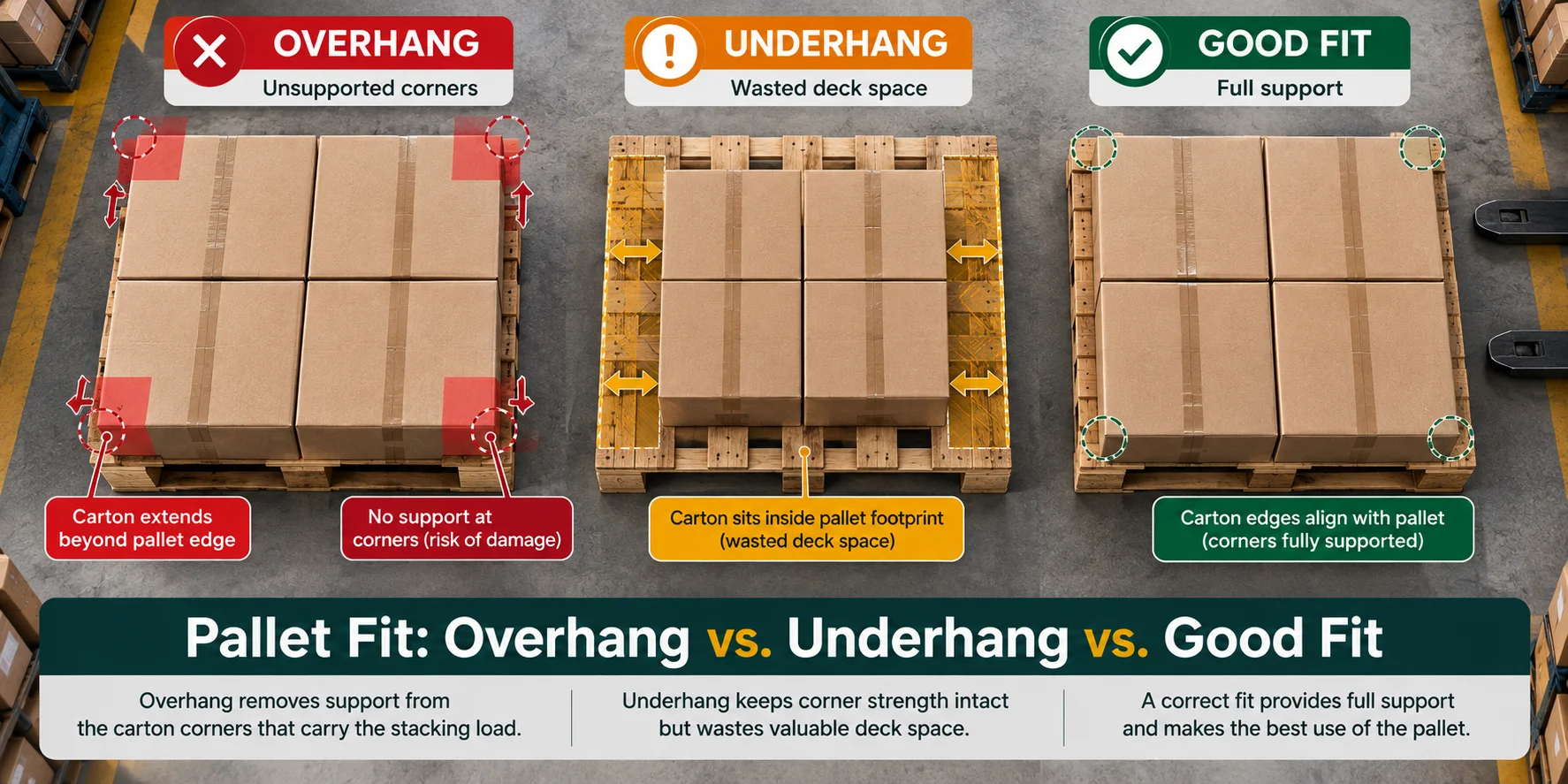
Overhang happens when the cartons extend past the edge of the pallet. It looks like a small thing to you and it is one of the more expensive mistakes in distribution.
Corrugated cartons carry their stacking strength in the vertical corners rather than in the panels. When a corner hangs over the edge of the pallet with nothing beneath it, that corner loses its support and the whole stack weakens noticeably. Warehouse teams see the result as crushed bottom layers, and the cause traces back to a carton that ran a little too large.
Underhang is the opposite problem and it does less damage than overhang does. Cartons that sit well inside the pallet edge waste deck space, and they also leave the load vulnerable because nothing protects it from a passing forklift.
Aim for cartons that reach the pallet edge as closely as the pattern allows without crossing it. That is the point where strength and space efficiency both sit at their best.
How cartons are arranged on a pallet
The way cases are laid out in each layer affects both how much fits and how stable the finished load is. Two patterns cover most of the situations you will meet, and each one trades something away.
Column stacking
In a column stack every carton sits directly above the one below it, so the vertical corners line up all the way to the top. This gives the strongest possible stack because each corner post carries load straight down into the corner beneath it.
The weakness of this particular pattern is stability rather than raw strength. Nothing ties the layers together, so a column stacked load relies on stretch wrap or strapping to stop it from sliding apart during transport.
Interlocking
An interlocked pattern rotates alternate layers so that cartons bridge across the ones underneath. The layers grip each other, so the load holds together far better while it moves.
The cost is compression strength, because corners no longer sit above corners. A carton sitting with another carton panel beneath its corner gets far less support than one resting corner on corner. The stack as a whole then carries less weight before it starts to crush.
Many operations settle on a compromise and use column stacking for strength with one interlocked layer at the top. Others rely on good stretch wrapping to hold a column stack together. Discuss the choice with whoever handles your warehousing, because they will know which failures they actually see.
Working out how many cases fit on a layer
This calculation takes two minutes and it is worth doing before you approve any box. You need only three numbers in order to do the calculation properly.
- Write down the pallet deck size, using the same unit throughout to avoid any conversion error.
- Write down the outside length and outside width of your carton, remembering that board thickness is included in those figures.
- Divide the pallet length by the carton length and note how many whole cartons fit, then repeat with the widths.
- Multiply the two whole numbers together to get the count for a simple grid pattern.
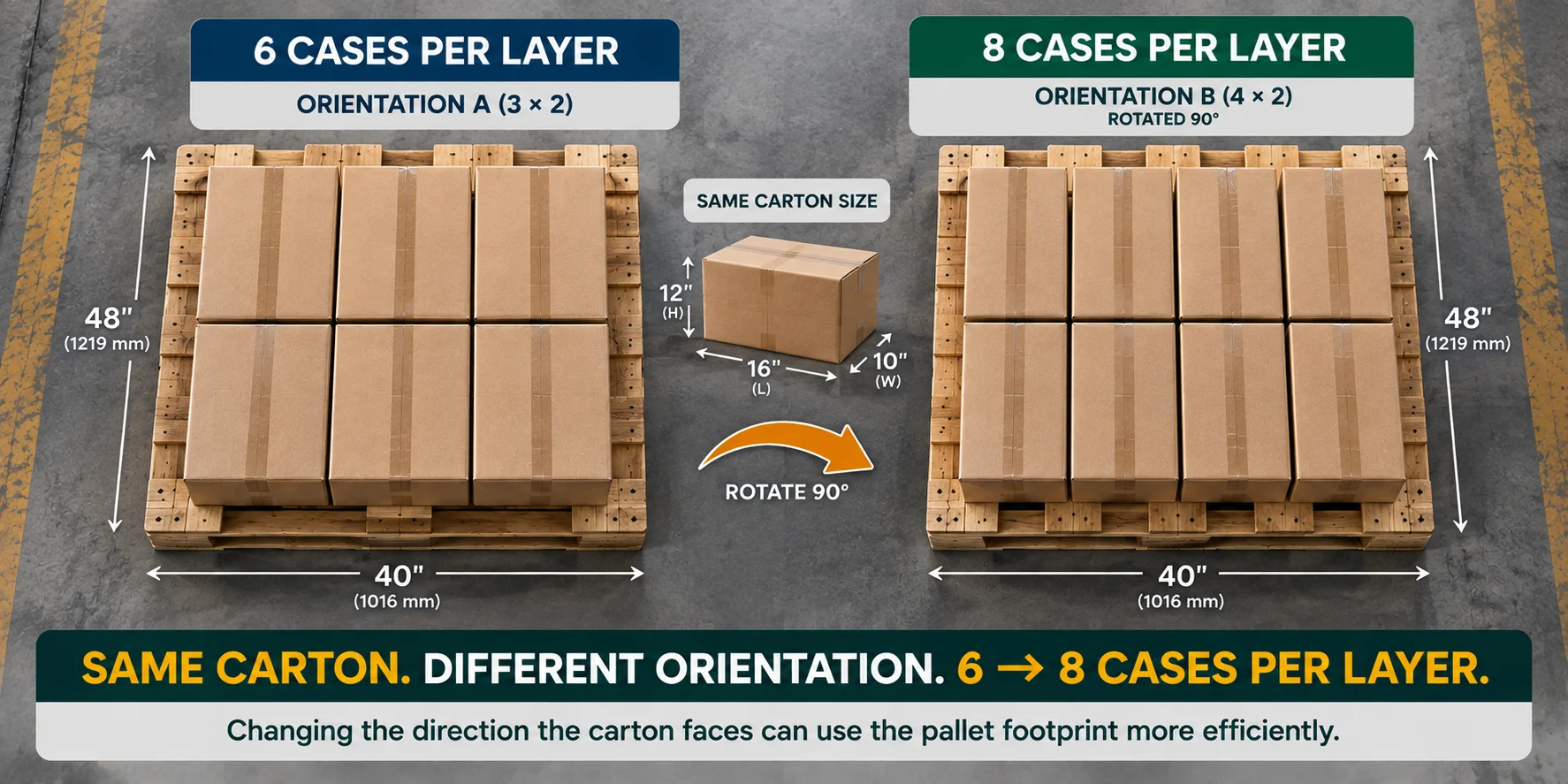
- Repeat the whole exercise with the carton turned ninety degrees, because the rotated arrangement often fits more.
- Try a mixed pattern where some cartons run lengthways and others run crossways, since that arrangement frequently beats both simple grids.
Working through an example shows exactly why the rotation step matters so much. A pallet measuring 1200 by 800 millimeters and a carton measuring 400 by 300 gives three along the length and two across the width, which comes to six cases. Turn the carton so that it runs 300 by 400 and you get four along the length and two across the width, which comes to eight cases. The carton never changed and the layer count rose by a third.
Software exists that does this automatically and tests hundreds of arrangements in seconds. Doing the arithmetic by hand once is still worthwhile, because it teaches you where the slack in your own numbers sits.
Holding the load together once it is stacked
A perfectly built pallet pattern still has to survive a truck that brakes hard and a forklift that turns quickly. Whatever holds the load together is doing as much work as the pallet underneath it.
Stretch wrap
Stretch wrap is the plastic film wound around the outside of the load to bind the cases to each other and to the pallet. How well it works depends far more on how your team applies it than on which film you bought.
Two details in the way your team applies it decide the result more than anything else. Your wrapper has to stretch the film properly as it goes on, because unstretched film simply lies against the load without gripping anything. It also has to wrap down onto the pallet itself for several turns, since a load tied only to itself will slide straight off the deck.
Strapping and corner boards
Strapping runs bands around or over the load and pulls it down onto the pallet. It holds far more firmly than film and it concentrates pressure wherever the band crosses a carton edge.
Corner boards are lengths of rigid board placed on the vertical corners before strapping goes on. They spread the pressure of the strap so that it does not cut into the cartons, and they add useful stacking strength at the same time. On heavy loads they often pay for themselves by preventing crush damage in the bottom layer.
What to look for on a returned load
The damage pattern on a returned load tells you which part of the system failed. Cartons crushed only at the bottom point you at stacking strength or overhang. A load that arrived leaning or collapsed sideways points instead at how somebody secured it. Photograph any load that comes back damaged, because the pattern in those photographs is what leads you to the real cause.
Buying outright or joining a pool
Two models exist for getting pallets under your goods and they suit very different businesses. Choosing the wrong one quietly adds cost to your operation that never appears as a single line item.
Buying your own
You buy the pallets outright, load them, and they leave the building with the goods. This is simple to administer and it works well when the pallet is not expected to come back.
The catch is that you buy a new pallet for every outbound load, and the receiving customer inherits the disposal problem. Some large retailers now charge suppliers for handling pallets they did not want, which turns a saving into a charge.
Pooling
A pooling company owns the pallets and rents them to you for each journey. They collect, inspect and repair the pallets afterward, which keeps quality consistent and removes disposal from your list of problems.
Pooled pallets are usually higher specification block pallets, so they handle better and rack more safely. You pay per trip rather than per pallet, and you also accept the administration of tracking where the pallets went.
The choice usually comes down to whether your goods travel to a small number of regular destinations or scatter widely. Regular lanes suit pooling well, and if you ship to hundreds of one off addresses you will find buying simpler.
The sustainability side of pallets
Pallets rarely appear in a sustainability discussion, which is strange given how much material moves through them. A single pallet weighs far more than the cartons it carries, so the choices here have real weight behind them.
Wooden pallets have one genuine advantage that plastic cannot match, which is that they can be repaired many times with a hammer and a few new boards. A pallet that makes forty trips instead of one spreads its whole footprint across forty of your shipments.
That single fact points straight at the practical conclusion worth remembering here. The most sustainable pallet is almost always the one that gets used again rather than the one made from a particular material. Pooling systems perform well on this measure because repair and reuse sit at the center of how they operate.
Plastic makes sense where hygiene rules demand washing or where a closed loop guarantees the pallet comes back. Outside those situations a plastic pallet that only makes a handful of trips is difficult to justify on any measure.
One smaller point is worth adding before we leave the subject of sustainability. Right sizing your cartons so that they fill the pallet properly cuts the number of trucks you need for the same goods. Transport is a larger share of the footprint than the pallet itself.
Questions to ask before you commit
Take these into the conversation with your supplier or your warehouse team. The answers to these will shape the carton that you end up ordering.
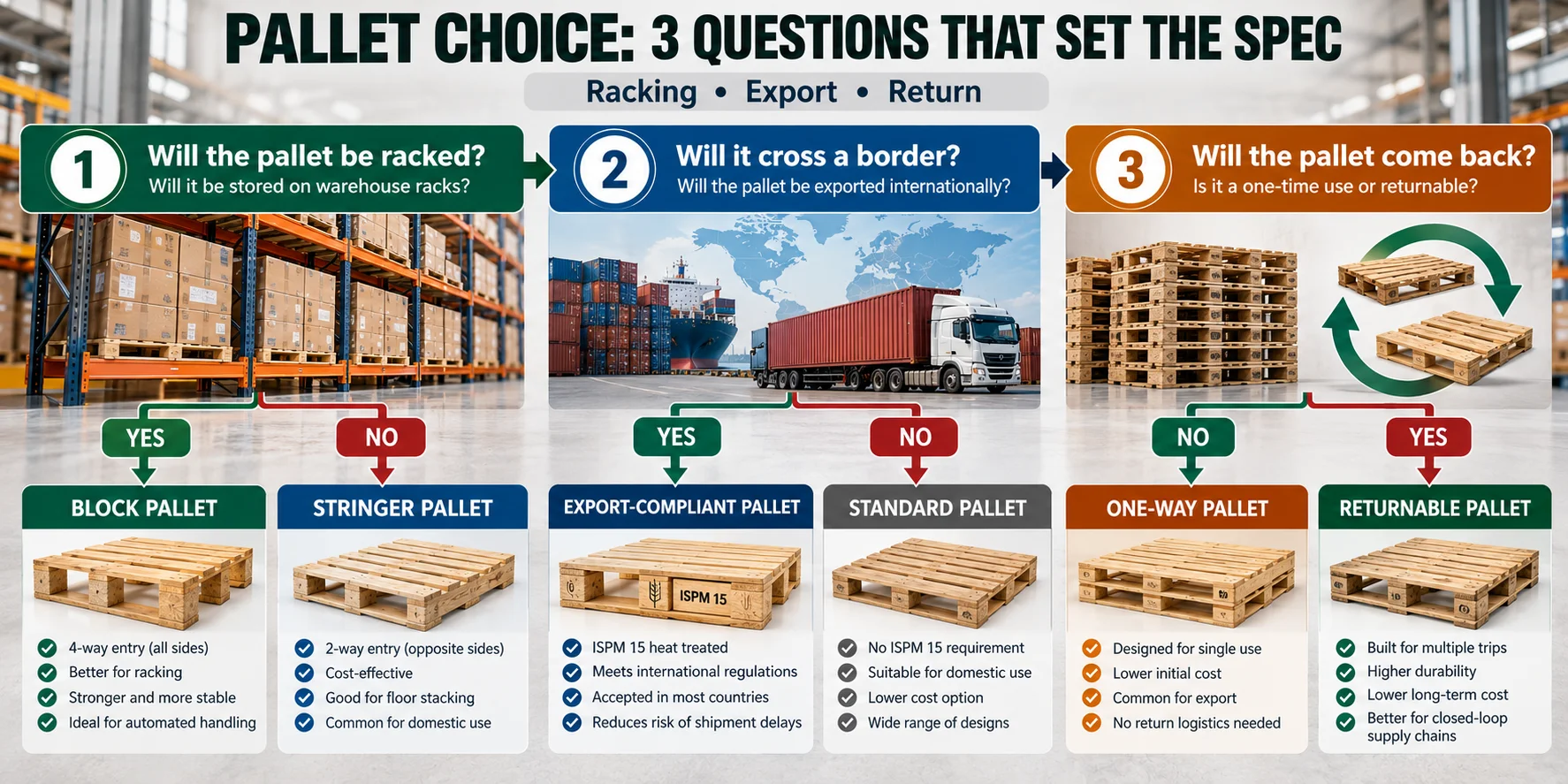
- Which pallet size is standard in every market this product will be sold into?
- Will these goods be racked at any point, and if so what racking load rating do we need?
- Does the load need four way entry, or will two way entry work everywhere it goes?
- Is this shipment crossing an international border, and does the wood need treatment?
- How many cases fit per layer with our current carton, and does rotating it improve that number?
- Does any carton overhang the edge of the pallet in the pattern being proposed?
- Who takes the pallet away at the receiving end, and does that cost anything?
Five mistakes that keep repeating
Designing the carton before checking the pallet is the most common of all, and it locks in wasted space for the entire life of the product. Changing a box after tooling exists costs far more than a two minute check beforehand.
Accepting overhang because it looks small removes support from the carton corners that carry the whole stack. The damage appears later as crushed bottom layers, and by then the cause is hard to trace.
Using the static load figure when the goods will be racked gives a false sense of safety. Racking is a much harder test and the racking figure is always considerably lower.
Forgetting export treatment holds loads at borders and creates costs nobody budgeted for. Confirm the requirement before the shipment leaves rather than after it stops.
Ignoring what happens at the far end hands your customer a disposal problem you never discussed. Ask the question during negotiation while it is still easy to solve.
Questions people ask about pallets
What is the standard pallet size?
There is no single global standard, which surprises people who assume such a basic item must have one settled answer. North America works mainly to 48 by 40 inches while much of Europe uses 1200 by 800 millimeters. Our guide to standard pallet dimensions by region lays out the full set alongside the situations where each one applies.
How much does a pallet weigh?
A standard wooden pallet generally falls somewhere between fifteen and thirty kilograms depending on size, timber and moisture content. Wood absorbs water from the air, so the same pallet weighs noticeably more after sitting in a damp warehouse. The article on pallet weight and what freight quotes use covers this properly.
What is the difference between a pallet and a skid?
A skid has no bottom deck, so it is simply a top platform sitting on stringers or legs. Skids slide more easily on a floor and they offer less support inside a rack, which is why most distribution now uses full pallets instead.
Can I reuse a pallet that arrived with goods?
Often yes, provided you inspect it properly before it carries anything again. Look for cracked stringers, missing boards, protruding nails and any sign of contamination. Anything heading into food or pharmaceutical use deserves a stricter check than general goods.
How high can I stack a pallet load?
The limit comes from three separate things and the lowest of them wins. Your cartons have a compression strength, your racking has a height and weight limit, and your trailer or container has a usable internal height. Work out all three of those limits and design to whichever one is most restrictive.
Do plastic pallets need heat treatment for export?
They do not, because the treatment rule applies to solid wood packaging rather than to plastic. That exemption removes an administrative step and it is one of the reasons exporters consider plastic despite the higher price.
Where to go from here
The pallet is the fixed point that everything else has to work around, which is why it belongs at the start of a packaging decision rather than the end. Settle the pallet size first, then design the carton to fill it, and the savings arrive quietly on every shipment afterward.
Once you know your pallet, the next step is getting the carton dimensions right. Our guide to how to measure a box explains the inside and outside convention that decides whether your pattern works in practice. If you are shipping ecommerce orders where case sizes vary, the piece on multi depth corrugated boxes shows how one carton can cover several product sizes.