Most pallets are made from low grade hardwood or softwood, with oak and southern yellow pine covering the largest share of what you will actually meet. The species matters far more than most buyers expect. It drives the weight of every load you ship, the strength your platform carries, and whether that pallet can legally cross a border.
This guide walks through the woods that end up under your goods and why each one gets used. You will see which species belong to which family, how a sawmill decides that a board becomes a pallet rather than furniture, and what the grading system actually measures. After that you will find out what heat treatment does to the timber. You will also get a straight answer to the question people ask most often, which is whether pallet wood carries chemicals.
The short version
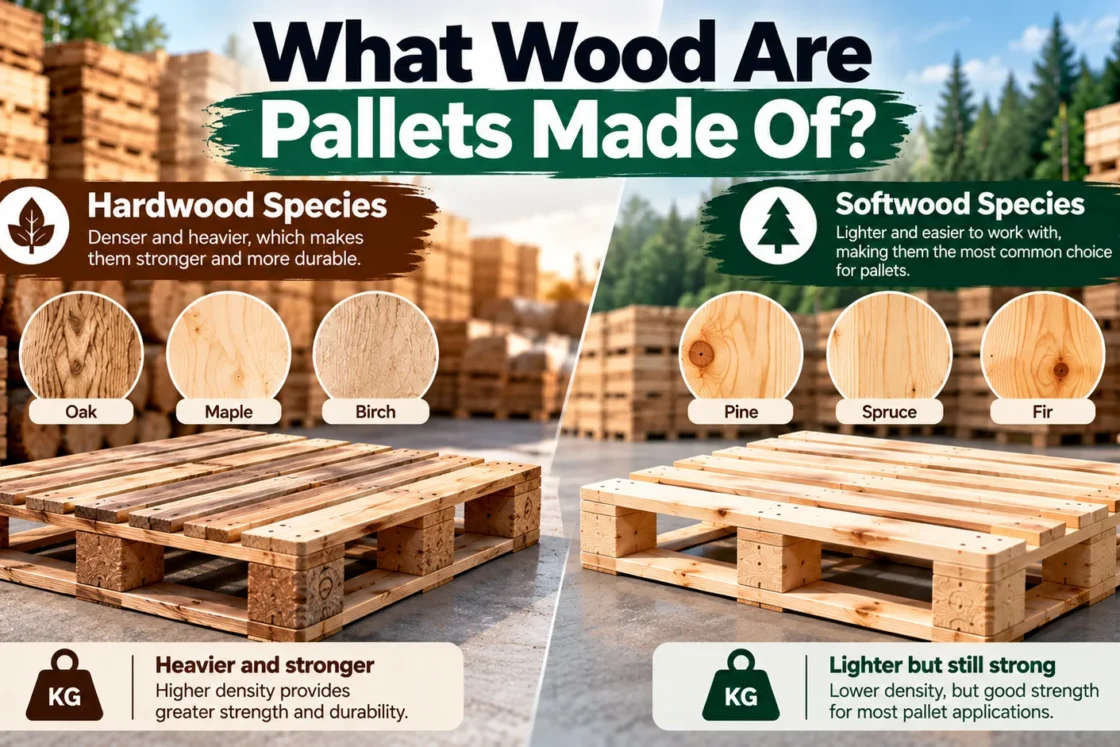
Hardwood pallets, usually oak, carry more weight and cost more. Softwood pallets, usually pine, weigh noticeably less and cost you noticeably less. Roughly speaking the market splits between the two, with hardwood holding the larger share in North America.
Almost every pallet you will handle uses the lowest commercial grade of timber, because a pallet only has to hold a load rather than look good. That single fact explains the price, the knots, the rough surface and the variation you see between two pallets of the same size.
The two families, and what separates them
All pallet timber falls into one of two groups, and the names of those groups mislead almost everybody who meets them for the first time. Hardwood and softwood have nothing to do with how hard the finished board feels under your hand.
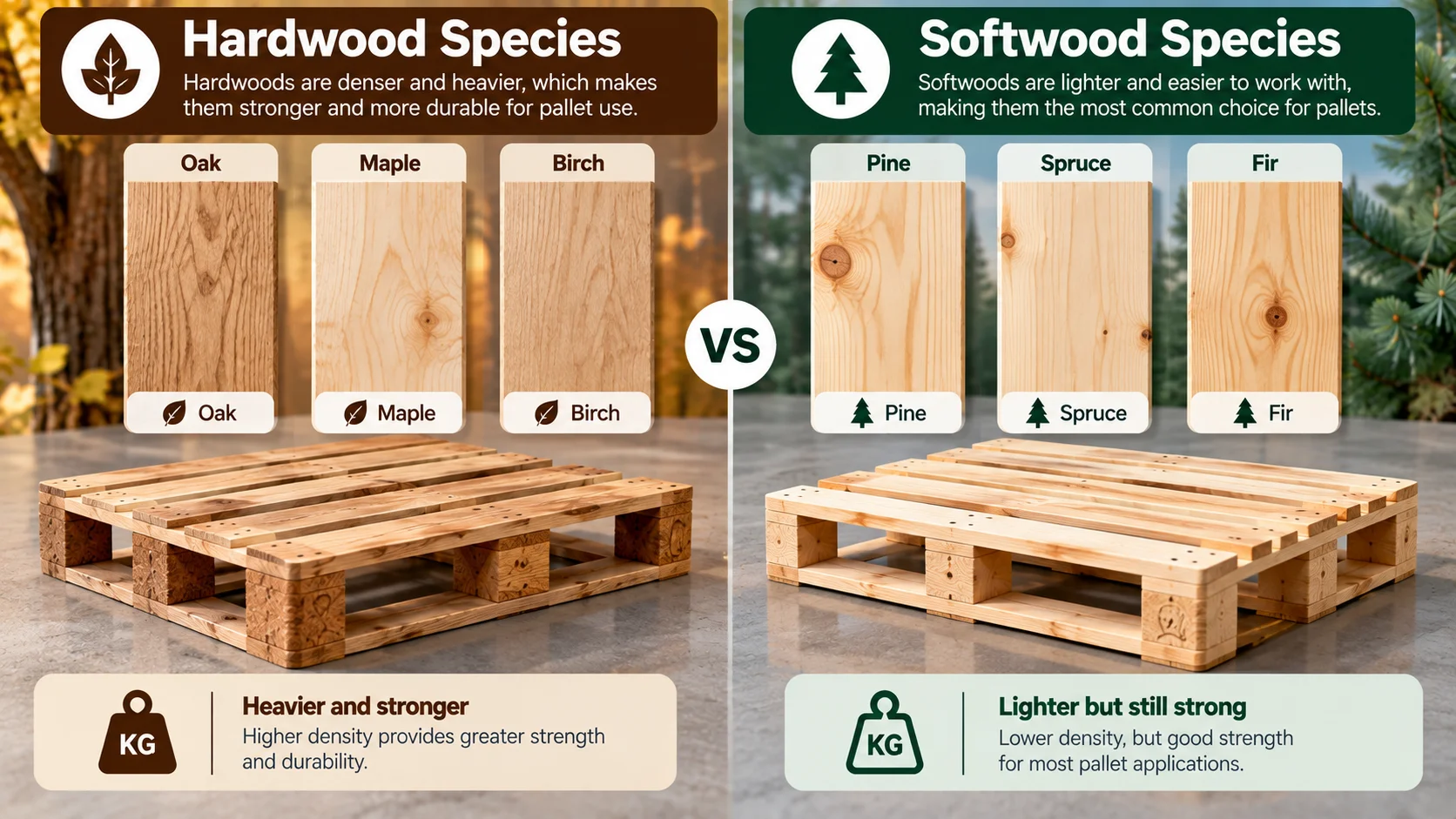
The split between the two families is botanical rather than physical, and it starts with the tree. Hardwood comes from broadleaf trees that drop their leaves each year, such as oak and maple. Softwood comes from conifers, the trees that carry needles and cones, such as pine and spruce.
That distinction lines up with density most of the time, and it never lines up perfectly. Balsa counts as a hardwood and you can dent it with a fingernail, while southern yellow pine counts as a softwood and it carries serious load. Treat the family as a useful starting point rather than as a promise about strength.
What the difference means for your pallet
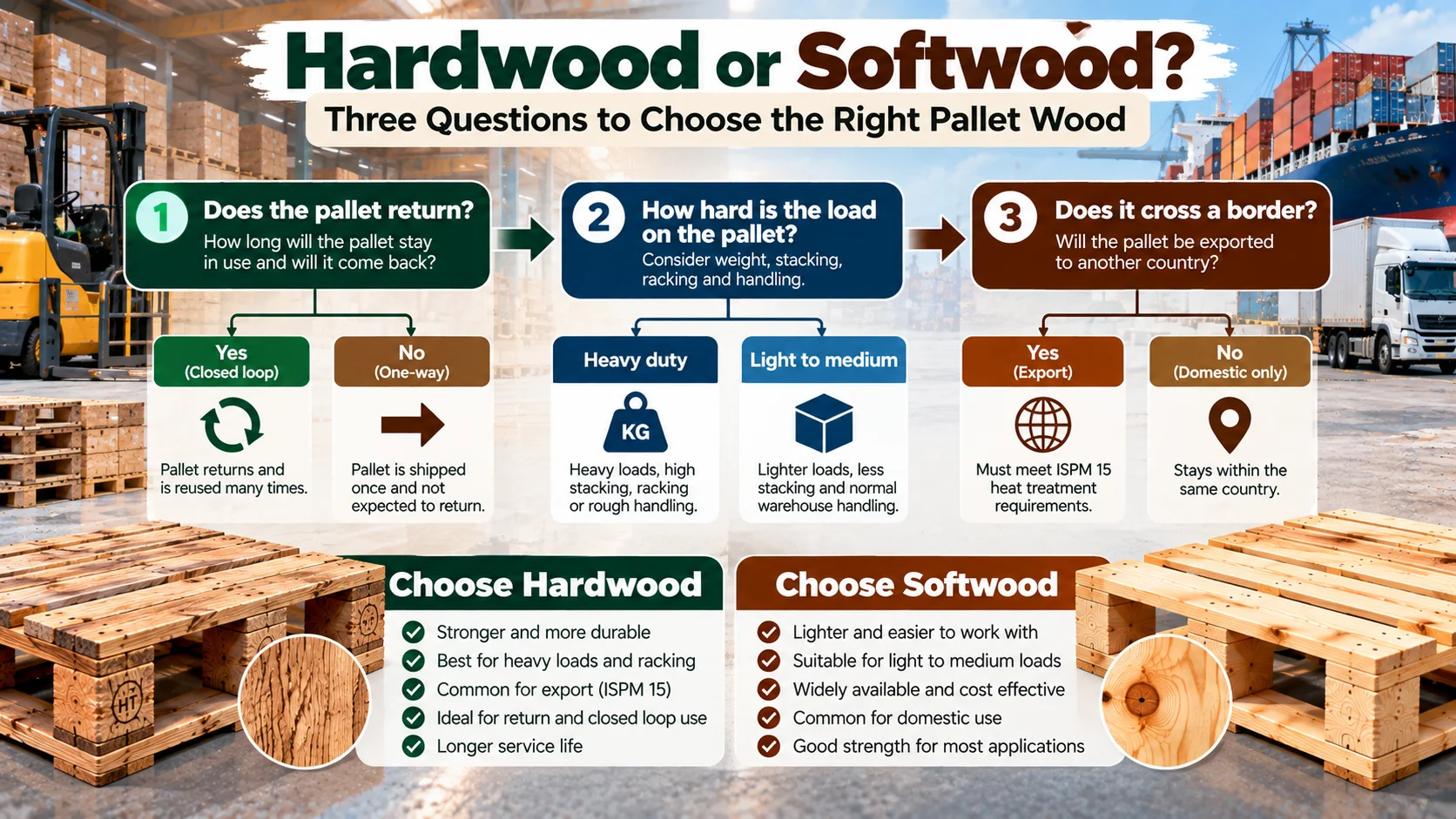
Hardwood gives you a heavier platform that carries more weight and survives more trips. The extra density resists the crushing that happens where a fork tine meets a deck board, which is exactly where a tired pallet starts to fail.
Softwood gives you a lighter platform that costs less and that suits a one way journey. On an export shipment that never comes back, paying for hardwood strength you will never use again makes very little sense.
Neither one of the two families is simply better than the other for your purposes. The right answer depends on the weight you are carrying and on whether that pallet comes home to you afterward.
With the two families clear, the next question is which individual species you will actually see under your goods.
The species you will actually meet
A handful of species cover the overwhelming majority of pallets in circulation. Knowing them by name helps you read a quote and helps you ask a supplier a sharper question.
Oak, the workhorse hardwood
Oak dominates hardwood pallet production across North America, and you will meet both red oak and white oak. It is dense, it holds a nail well, and it resists the splitting that ruins a deck board when somebody drives a fork into it carelessly.
The density that makes oak strong also makes it heavy, which is the trade you accept. An oak pallet weighs a good deal more than a pine one of identical size, and you carry that difference on every truck.
Southern yellow pine, the workhorse softwood
Southern yellow pine is the softwood you will meet most often, and it is unusually strong for a conifer. It grows fast, it is widely available, and it takes heat treatment cleanly, which matters enormously for export work.
Pine gives you a noticeably lighter pallet at a lower price per unit. It also dents more easily, so a pine pallet in a demanding closed loop will show wear sooner than an oak one would.
Poplar and the secondary hardwoods
Poplar sits in an odd middle position, because it is botanically a hardwood while being lighter and softer than oak. It shows up in pallets a great deal, often mixed into the same platform as other species.
Maple, gum, beech and ash all appear as well, because a regional sawmill happened to have them that week. Your pallet is rarely built from one carefully chosen species, and that is the point most buyers miss.
Spruce, fir and the northern softwoods
Spruce and fir turn up far more in European pallets than in North American ones, and the Euro pallet specification leans on them. They are light, straight and consistent, which suits a pallet built to a tight standard.
These northern species carry less load than southern yellow pine does, which is worth knowing. That is one reason a Euro pallet and a North American pallet of similar size quote very different load ratings.
Knowing the species names is only half of what you need here. The more useful question is why a sawmill sends any of this timber to a pallet plant in the first place.
Why pallet wood is the wood nobody else wanted
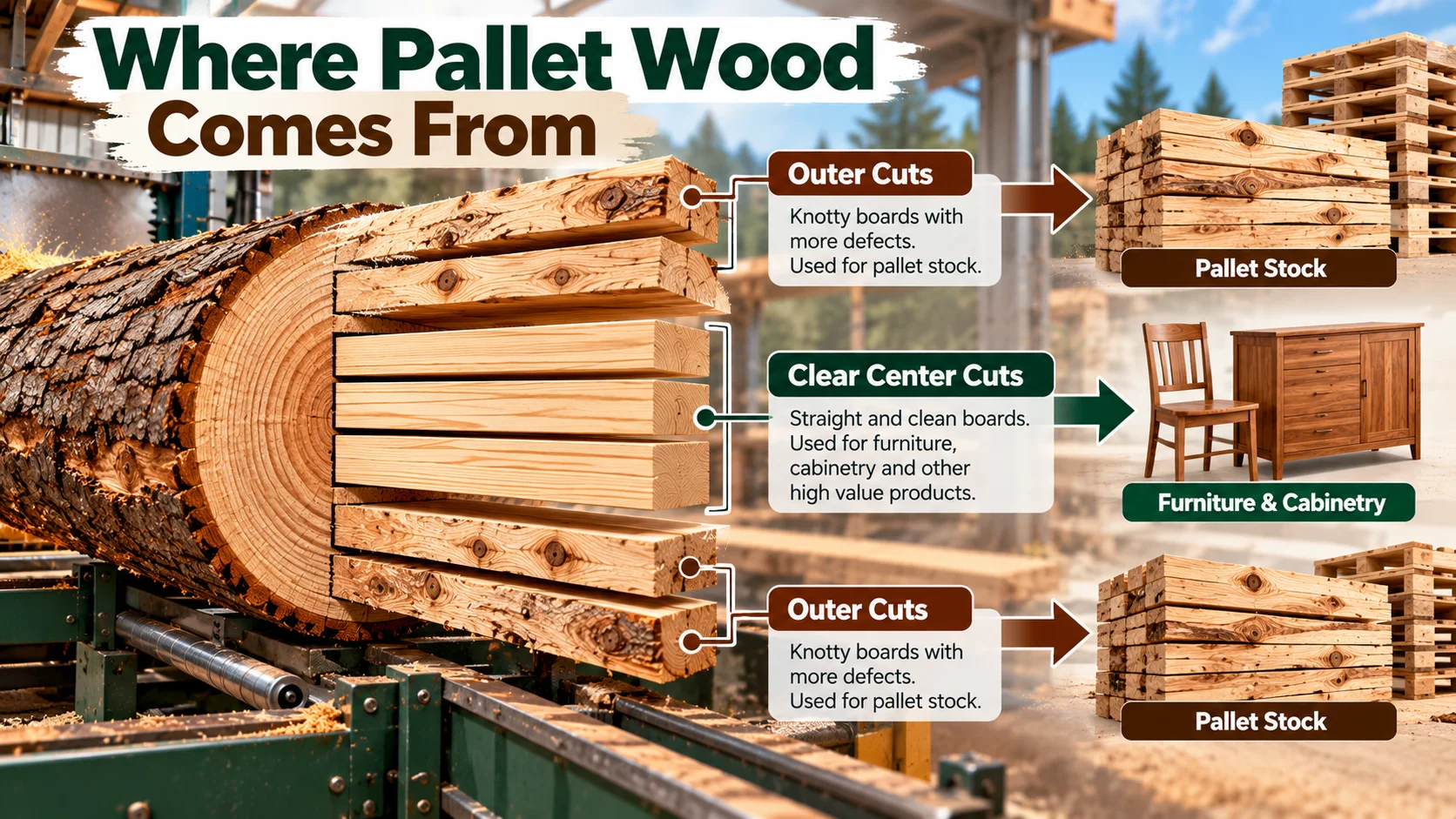
No sawmill anywhere grows trees for the purpose of making pallets out of them. It cuts a log for the highest value it can extract, and pallet stock is what remains once every better use has taken its share.
The clear center cuts, free of knots and straight in the grain, go to furniture, joinery and flooring, because those buyers pay the most. Construction lumber then takes the next tier of value down from that one. What falls out at the very end is knotty, short, oddly shaped or simply ugly, and that is the material a pallet plant buys.
What that means when you look at a pallet
That single economic fact explains nearly everything you find surprising about pallet timber. The knots are there because a knot ruins a furniture board and does almost nothing to a deck board that only has to span a few inches.
The rough surface is there because planing costs money and a pallet gains nothing from a smooth face. The color varies between boards because the plant used whatever came in that week.
Two pallets ordered on the same specification can look quite different from each other, and both can be entirely correct. You are buying a structure that holds your load rather than buying a particular material.
The recycled stream underneath all of this
A very large share of the pallets you handle are not new at all. They have been repaired, rebuilt from parts of other pallets, or simply used again as they are.
A repaired pallet carries boards from several species at once, because the repair yard used whatever matched the size. That mixture is normal and it is also the reason a repaired pallet weighs more than the original specification says.
The question that follows naturally is how anybody grades material this varied, which is where the pallet grading system comes in.
How the wood gets graded
Pallet timber has its own grading language, and it measures something quite different from the grading applied to furniture lumber.
What the grades actually measure
Furniture grading measures appearance, counting how much clear face a board gives you. Pallet grading measures whether the board will hold up under load, which is a completely different question.
A board full of knots grades perfectly well for pallet use, provided those knots sit away from the points carrying stress. A beautiful clear board with a split running through it fails, even though it looks far better.
That inversion catches out almost everybody meeting pallet grades for the first time. In pallet timber, ugly and sound beats pretty and cracked every time.
Green, air dried and kiln dried
Timber arrives at a pallet plant in one of three moisture states, and the difference shows up in the weight of every pallet you receive.
| State | Roughly how wet | What it means for you |
|---|---|---|
| Green | Above thirty percent moisture | Heaviest, cheapest, and it will lose weight and shrink as it dries in your warehouse. |
| Air dried | Around twenty percent | The common middle ground, and the state most ordinary pallets arrive in. |
| Kiln dried | Around nineteen percent or below | Lightest and most stable, costs more, and it is what you want near food or pharmaceutical goods. |
That table explains a complaint your warehouse team will raise sooner or later. A pallet weighed on delivery in a wet month can read several kilograms heavier than the same pallet weighed in a dry one, and nothing has gone wrong.
Our guide to pallet weight and what freight quotes use covers how much that swing actually costs you across a year of shipments.
Moisture is one thing that changes the timber after it leaves the sawmill. Heat treatment is the other, and it is the one that carries legal weight.
What heat treatment does to the wood
Any wooden pallet crossing an international border has to be treated, because untreated timber carries insects and fungus between countries. The rule that governs this is ISPM 15, and it applies to the wood rather than to the pallet as a product.
The treatment itself
Heat treatment means raising the core of every board to a set temperature and holding it there long enough to kill anything living inside the timber. A chamber does the work, and the plant records the run so that it can prove the pallet was treated.
The process changes the wood in two ways that you can actually see. Treated timber comes out lighter, because the heat drives moisture out along with the pests. It also comes out more stable in its dimensions for exactly the same reason.
It does not change the species, the strength or the appearance in any dramatic way. A heat treated oak pallet is still an oak pallet in every way that matters.
Reading the stamp
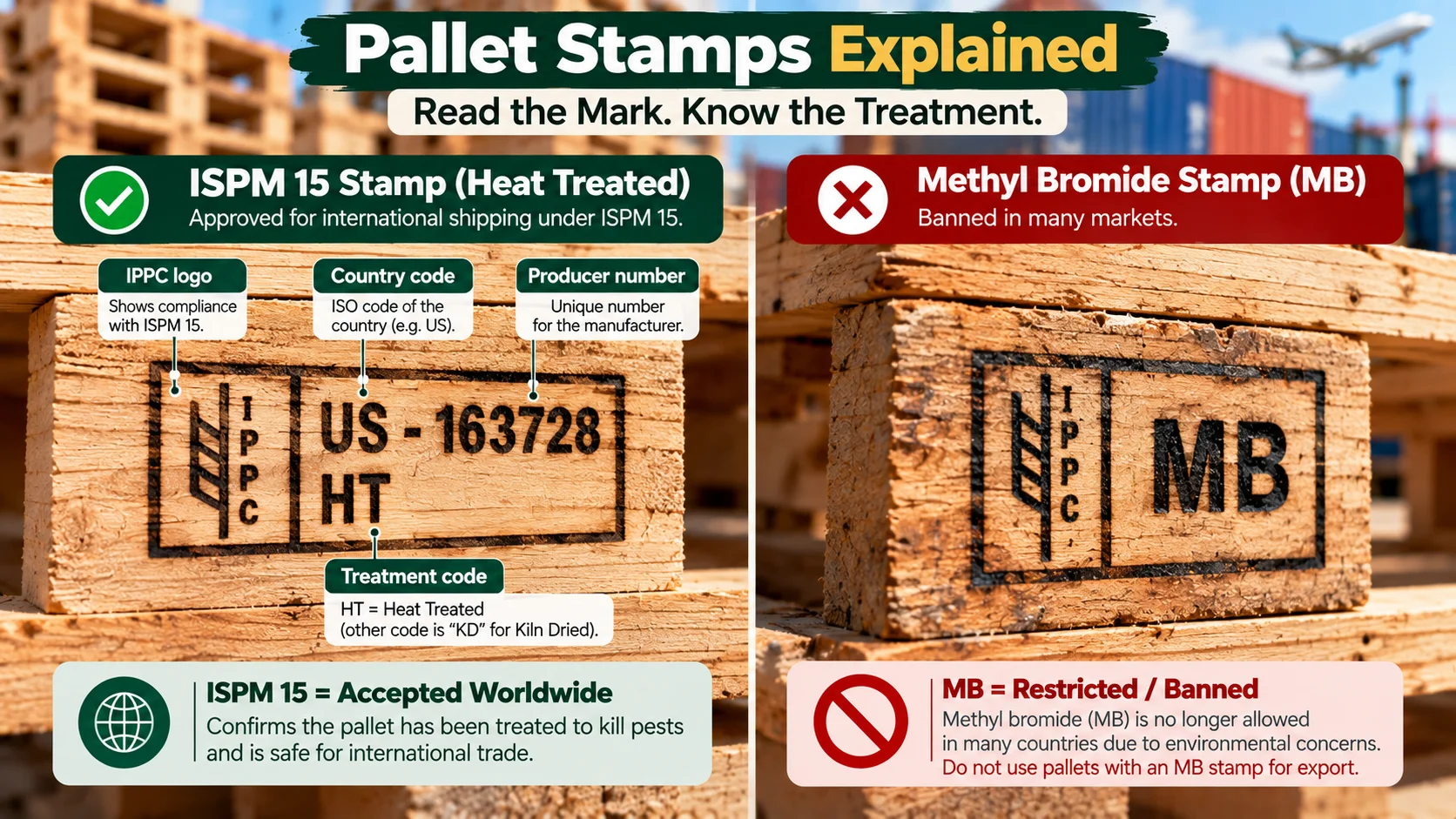
A treated pallet carries a stamp, and that stamp is the only proof that travels with the platform. It shows a wheat symbol, a country code, the identifier of the treatment facility, and the letters HT for heat treatment.
Learn to read that stamp yourself, because the border officials at the far end certainly will. A pallet without that stamp can be refused, and the load can be held, treated at your cost or turned back.
Our guide to export pallets and the ISPM 15 rule goes through the stamp and the border process in full.
There is a second treatment people worry about, and it is the one that generates the most questions of all.
Are pallets made of treated wood, and is that a problem
This question comes up constantly, usually from somebody about to build something out of a pallet or about to put food near one. The question deserves a proper answer from us rather than a reassuring one.
The two meanings of treated
People use the word treated to mean two completely different things, and the confusion between them causes real worry.
Heat treatment, which the stamp marks as HT, uses nothing at all but heat. It leaves no residue of any kind, and a heat treated pallet is chemically the same wood it was before it went into the chamber.
Chemical treatment is the other thing that the word can mean, and it is the one people worry about. The chemical historically used on pallets was methyl bromide, marked MB on the stamp, and many markets have now banned or heavily restricted it.
How to tell which one you are holding
Read the stamp on the pallet and look closely at the letters. The letters HT mean heat and nothing else whatsoever, so that pallet is safe. MB means methyl bromide, and a pallet carrying those letters should stay away from food, from living space and from anything you plan to cut up.
A pallet carrying no stamp at all tells you nothing useful either way. It might be a domestic pallet that never needed treatment, and it might equally be something you should not take chances with.
The risk nobody stamps
There is a second risk on a used pallet, and no stamp will warn you about it. A platform that has carried a chemical spill, or that has sat outdoors in the rain for a season, has absorbed whatever it was sitting in.
Ask what the pallet previously carried before you put it anywhere near food or pharmaceutical goods. The honest answer from a seller is worth more than any marking on the wood.
Beyond safety, the species you end up with has one more consequence that shows up on every freight invoice you pay.
How the wood choice changes what you pay to ship
The species under your goods is not a detail that stays in the warehouse. It rides on every truck you load and it appears on every bill you pay.
Weight goes straight onto the invoice
A carrier bills on total weight, and the pallet forms part of that total even though nobody pays to receive a pallet. Every kilogram of timber you ship is a kilogram of product revenue you did not earn.
Swap an oak pallet for a pine one and you take real weight off each shipment. Across hundreds of loads a year that difference becomes a number your finance team would notice.
Where the heavier wood earns its keep
None of that makes pine the automatic answer for your own operation. A pallet going into a racking system, or carrying a genuinely heavy load, needs the strength that density buys.
A pallet that fails in a rack costs far more than the freight it saved. Match the species to the job in front of you rather than to the invoice.
| Your situation | Lean toward | Why |
|---|---|---|
| One way export shipment | Softwood | The pallet never returns, so paying for durability you will not use makes no sense. |
| Closed loop, many trips | Hardwood | Density survives repeated handling and the cost spreads across every trip it makes. |
| Heavy or racked load | Hardwood | Racking puts the deck under an unsupported span, which is the hardest test a pallet faces. |
| Light goods, high volume | Softwood | Freight weight matters more than durability when the goods themselves are light. |
| Air freight | Softwood, or another material entirely | Airlines price aggressively on weight, so every kilogram of platform costs real money. |
Wood covers most of the market, and it is not the only material available to you.
What else a pallet gets made from
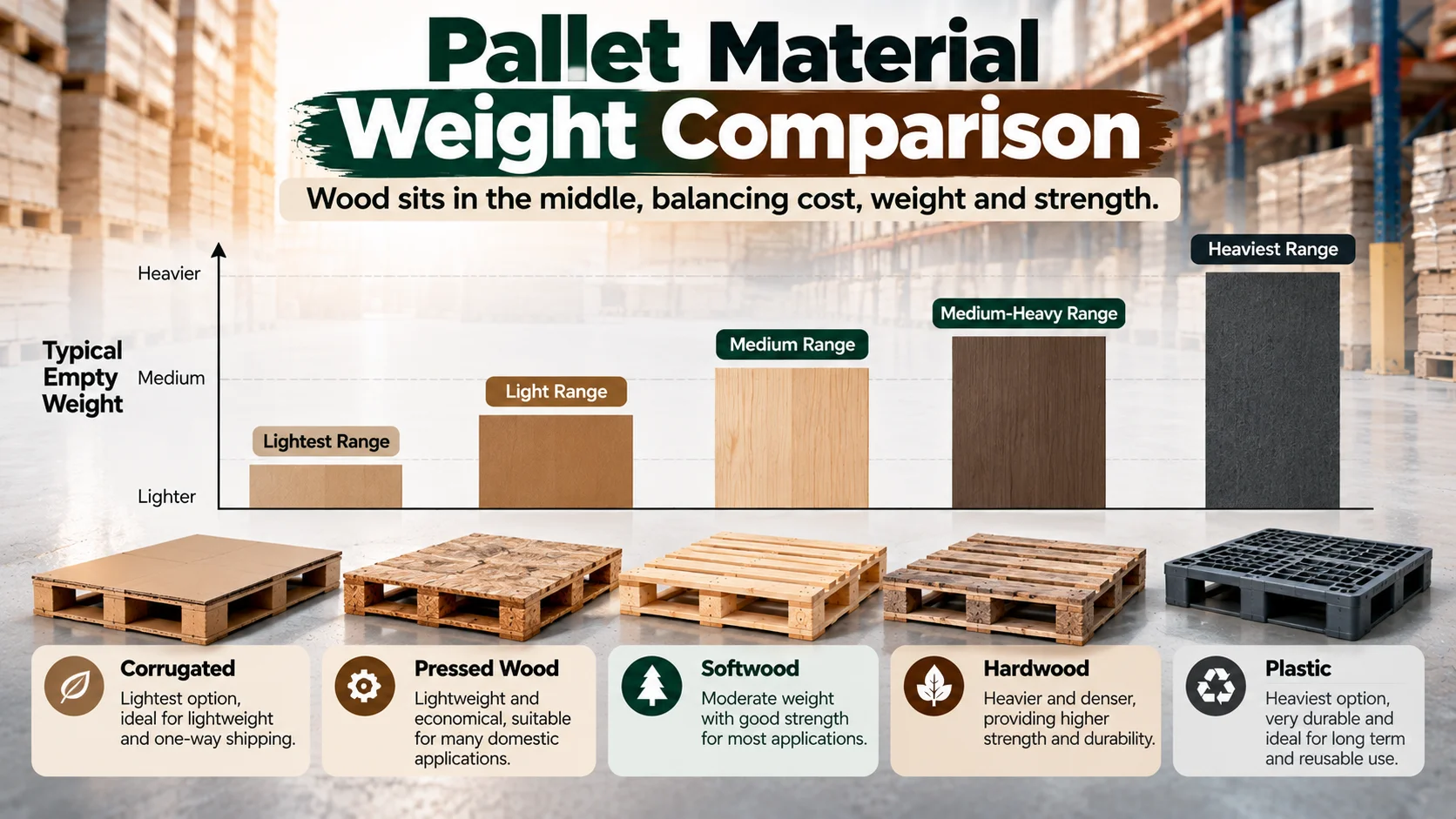
Wood holds the largest share of the market by a wide margin, and four other materials take the remainder. Each of those four materials solves a problem that wood handles rather badly.
Plastic
Plastic pallets wash clean, resist moisture completely and need no heat treatment for export, which removes a whole compliance headache from your desk. They also cost you several times over what a wooden pallet would cost.
They earn that price back only in a closed loop where the platform comes home and goes out again many times. In a one way shipment a plastic pallet is expensive to give away.
Pressed wood
Pressed wood pallets are molded from wood fibre and resin under heat and pressure. That heat counts as treatment, so they cross borders without a stamp and without a chamber.
They nest inside each other, which saves you a great deal of storage space. They carry less weight than a solid timber platform does, so check the rating before switching.
Corrugated
Corrugated pallets are the lightest option available to you, and they suit light goods travelling one way. They cost almost nothing to dispose of, since the receiving site recycles them alongside the cartons.
Moisture ends them quickly and they carry the least weight of any option here. They remain a specialist answer for you rather than a general purpose one.
Metal
Metal pallets handle extreme conditions, heavy industrial loads and any environment where hygiene rules run strict. They are heavy, expensive and usually confined to a closed industrial loop.
Our guide to the types of pallets and when each one is right compares all five materials against the journeys they suit.
Whichever material you settle on, a handful of mistakes come up again and again when buyers specify the wood.
How to tell what your own pallet is made from
You will not always get a species on the paperwork, and sometimes you need to know anyway. A few checks tell you most of what you need without any equipment at all.
Weight in the hand
Pick up an empty pallet and the difference between the families announces itself immediately. An oak platform feels dense and slightly unwieldy, while a pine one of the same size feels like you could carry it under one arm.
That rough test settles the family for you in about two seconds. It will not name the species, and the family is usually the part that matters for your decision.
The grain and the pores
Look closely at the cut end of a deck board, where the grain shows most clearly. Oak carries large open pores that run along the grain like tiny straws, and you can see them without any magnification at all.
Pine by contrast shows you no such open pores at all. Instead it gives a clear contrast between pale early wood and darker late wood, which produces the striped pattern people picture when they think of pine.
Color and knots
Red oak runs pink to reddish brown, white oak runs more olive and tan, and poplar shows a greenish or gray cast that nothing else does. Southern yellow pine runs anywhere from pale cream through to a warm amber.
The knots on a board tell you something useful as well. Large round knots spaced regularly along a board point at a conifer, while the scattered irregular knots of a hardwood look quite different once you have seen both.
The stamp, when there is one
An ISPM 15 stamp will not name the species for you, and it does tell you the pallet went through a treatment chamber. Combined with the weight test, that is enough to decide whether a platform suits the job you have in mind.
Those four checks together cover the practical side of identifying any pallet. The mistakes below cover what goes wrong when nobody bothers to make them.
Five mistakes people make about pallet wood
Each of these turns up regularly, and each one is easy to avoid once you know it exists.
1. Assuming hardwood always means stronger
The hardwood and softwood labels describe the tree rather than the timber, and southern yellow pine outperforms several hardwoods on load. Ask your supplier for the load rating instead of reasoning from the family name.
2. Reading HT and MB as the same thing
Heat treatment leaves nothing behind, while methyl bromide is a chemical fumigant that many markets have banned. Those two letters on the stamp carry a very different meaning, and confusing them is the most consequential mistake on this list.
3. Expecting every pallet to look the same
A pallet plant buys whatever the mills have available, so species and color vary between deliveries. Variation is normal and it tells you nothing about whether the pallet meets your specification.
4. Weighing a pallet once and trusting the number
Timber gains and loses moisture with the weather, so a figure taken in a wet month will overstate a summer shipment. Weigh several pallets across different months before you build a freight model on the result.
5. Reusing a pallet without asking what it carried
No stamp records a chemical spill or a season spent outdoors in the rain. Ask the seller directly what the platform carried before it reached you, particularly if food or pharmaceutical goods are involved.
Questions people ask about pallet wood
What wood are pallets made of?
Most pallets use low grade hardwood or softwood, with oak leading the hardwoods and southern yellow pine leading the softwoods. Poplar, maple, spruce and fir all appear regularly as well, and a single pallet often mixes more than one species.
Are pallets made of treated wood?
Many of them are, and the word treated carries two very different meanings here. Heat treatment marked HT uses nothing but heat and leaves no residue, while methyl bromide marked MB is a chemical fumigant that many markets now restrict.
Is pallet wood safe to reuse?
A heat treated pallet that carried ordinary dry goods is generally fine to reuse. The real risk is what the platform carried before, because a chemical spill or a season outdoors leaves no mark on the stamp and plenty inside the timber.
Why is pallet wood so rough and full of knots?
Pallet stock is what a sawmill has left once the clear, valuable cuts have gone to furniture and construction. Knots ruin a furniture board and barely affect a deck board, so the pallet industry buys exactly the material nobody else wanted.
Which is better for pallets, hardwood or softwood?
Hardwood suits heavy loads, racking and closed loops where the pallet comes back and earns its cost across many trips. Softwood suits one way shipments and lighter goods, where saving freight weight matters more than surviving another journey.
Does the wood species change how much a pallet weighs?
The species changes it considerably, and that difference rides on every shipment you send. A dense hardwood platform can weigh a good deal more than a softwood one of the same size, which a carrier bills you for on every load.
Where to go from here
The species under your goods connects to almost every other decision you make about shipping them. It sets the weight a carrier bills you for, the load the platform can carry, and whether the pallet can cross a border at all.
Our guide to what a pallet is and how it decides your box size covers the construction and the load ratings that sit alongside the material choice. If the freight side is what you are working on, pallet weight and what freight quotes use shows how to establish a figure you can build a cost model on.