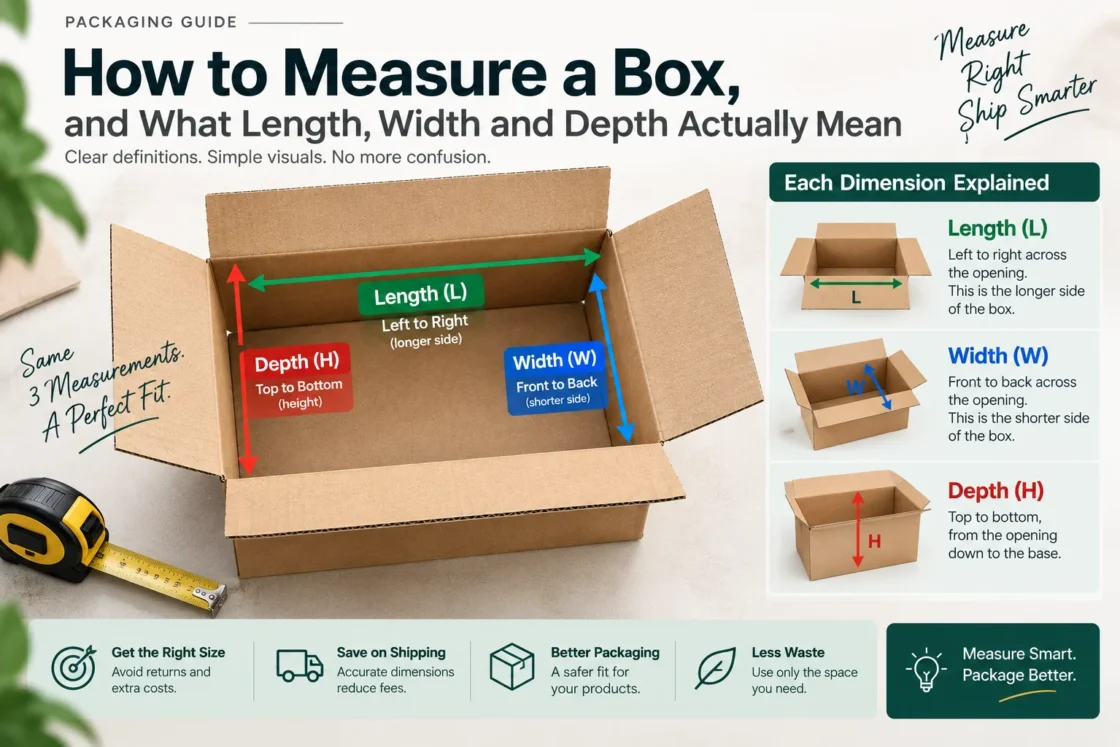
A box is measured in the order length by width by depth, and in packaging those three numbers almost always describe the inside of the box rather than the outside. Getting that second part wrong is the single most common reason a production run arrives and does not fit the product it was made for.
This guide walks through the whole thing slowly, because the subject looks simpler than it is. You will learn what each of the three dimensions actually refers to and why the trade measures the inside instead of the outside.
After that you will see how to measure a box you already have, and how to work out dimensions for a box that does not exist yet. Along the way you will also see the mistakes that cost people money, so that you can avoid making them yourself.
The short version
Write dimensions as length by width by depth, in that order, and say clearly whether they are inside or outside measurements. Length is the longer side of the opening, width is the shorter side of the opening, and depth runs from the opening down to the bottom of the box.
Unless you say otherwise, a packaging supplier will read your numbers as inside dimensions. That is what they need in order to make a box that holds your product, and it is what sits behind almost every quote you will receive.
Why the order matters before the numbers do
Three numbers written in the wrong order describe a completely different box. A pack listed as 300 by 200 by 100 is nothing like a pack listed as 100 by 200 by 300, even though the same three figures appear in both. The convention exists so that nobody has to guess which number belongs to which side of the box.
In packaging the order runs length first, then width, and then depth at the end. Every converter you deal with reads your numbers in that order unless you tell them otherwise, and quoting software works the same way. Following the convention costs you nothing and removes a whole class of confusion.
How each of the three is defined
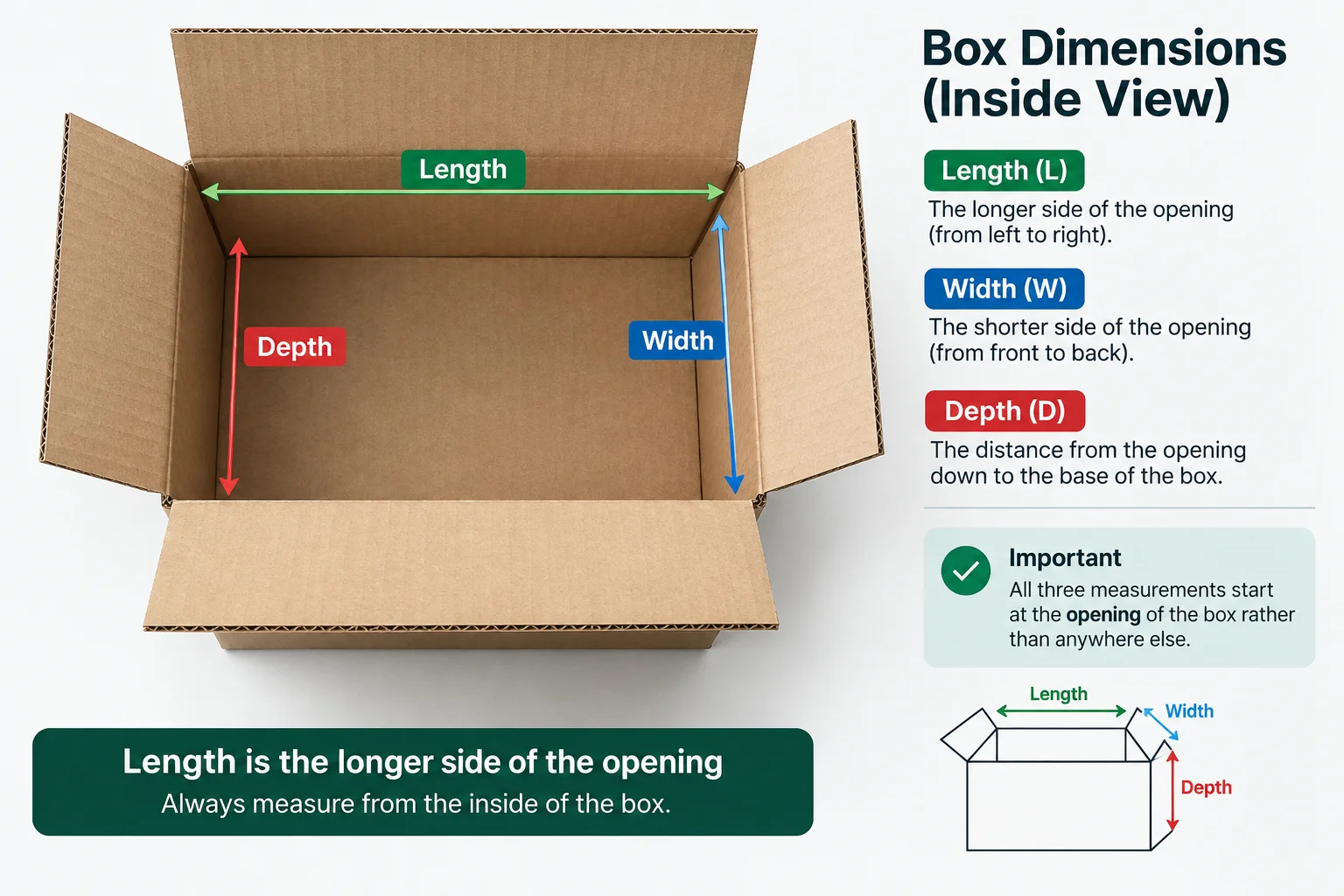
All three dimensions are measured from the opening of the box, which is the part you fill and then close. On a standard shipping carton the opening is the top face where the flaps meet, and that single fact anchors everything else.
- Length
- This is the longer of the two sides that form the opening. If you look down into an open box, the length is the longer edge of the rectangle you are looking at.
- Width
- This is the shorter of the two sides that form the opening. It sits at a right angle to the length and completes the rectangle you see when you look down into the box.
- Depth
- The distance from the opening straight down to the bottom of the box. This is the only one of the three that is measured in the direction you would drop a product in.
One small habit will save you from a surprising amount of confusion. Look down into an open box and check whether the two sides of the opening are equal. If they are, the box has a square footprint and either side can serve as the length. In every other case the longer side is always the length, no matter how the box happens to be sitting in front of you.
The height problem
Plenty of people write height instead of depth, and you will hear both words in one conversation without anybody noticing. The trade prefers depth, and there is a solid reason for that.
Height describes how tall something stands, which depends entirely on how you set it down. Depth describes how far it is from the opening to the bottom, which stays true no matter which way up the box is sitting. A box lying on its side has a different height every time you move it, while the depth never changes at all.
You do not have to police the word choice with your supplier. What matters is that the third number always means the distance from the opening to the base, and that both of you read it the same way.
With the order settled, the next question is the one that costs people real money. It is whether those three numbers describe the inside of the box or the outside of it.
Inside and outside dimensions, and why the difference is expensive
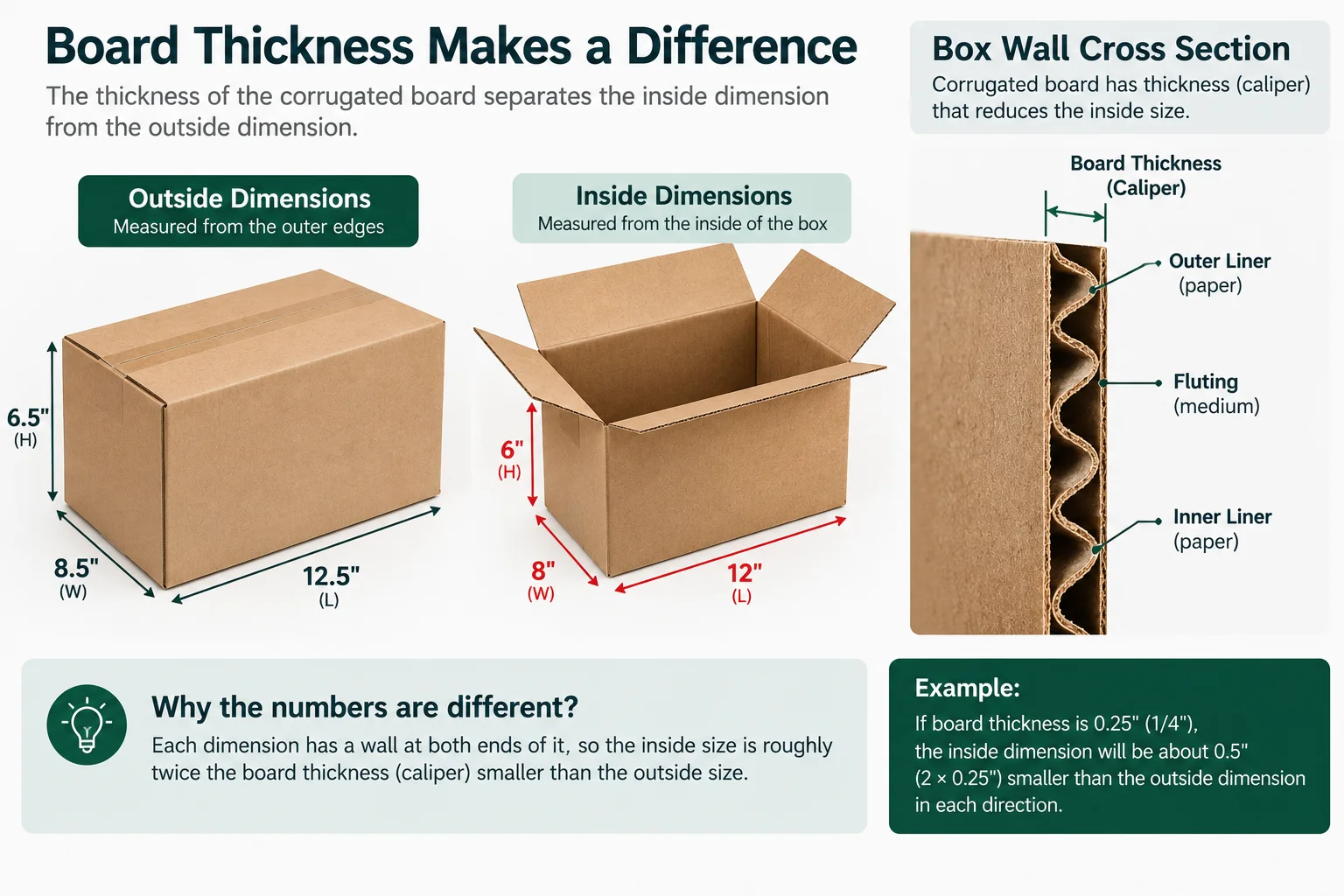
This is the part that causes real damage, and it is worth reading twice. Corrugated board has thickness, and that thickness sits between the inside of the box and the outside of it. The difference is small on any single wall and it adds up faster than people expect.
Inside dimensions describe the space that your product will actually occupy once the box is filled. Outside dimensions describe the space that the finished box will occupy on a pallet or inside a truck. Both numbers are useful in their own way and they answer two completely different questions.
Why converters work in inside dimensions
A converter builds a box around a product, so the number that matters to them is the space inside. Suppose you give them an inside measurement of 300 by 200 by 100 millimeters. They will cut and score the board so that the finished box holds exactly that volume, which leaves the outside slightly larger than the numbers you wrote.
The extra millimeters come from the board itself rather than from anything the converter has added. Every wall adds its own thickness to the outside of the box, and each dimension has a wall at both ends of it. A single wall board therefore adds roughly twice its own caliper to each of the three outside dimensions.
Here is the mistake that keeps happening in real sourcing talks every week. Somebody measures the outside of an existing box with a tape and sends those numbers straight to a converter. What comes back is a box that is very slightly smaller inside than the one they were trying to copy. On a single loosely packed item that gap might never cause trouble. On a product that fits snugly, or on a box that has to hold a fixed count of retail units, the same gap matters a great deal.
How much thickness each flute adds
Flute is the wavy layer of paper sandwiched between the flat liners, and the size of that wave decides how thick the board is. Different flutes exist because different products need different amounts of cushioning and stacking strength.
| Flute | Approximate caliper | Added to each outside dimension | Where it is normally used |
|---|---|---|---|
| F flute | About 0.8 mm | About 1.6 mm | Small retail cartons where print quality matters more than strength |
| E flute | About 1.6 mm | About 3.2 mm | Retail packaging and lightweight ecommerce mailers |
| B flute | About 3.2 mm | About 6.4 mm | General purpose shippers and inner packaging |
| C flute | About 4.0 mm | About 8.0 mm | The most common shipping carton board across most markets |
| A flute | About 4.8 mm | About 9.6 mm | Products that need cushioning more than they need a flat surface |
| BC double wall | About 7.0 mm | About 14.0 mm | Heavy goods and anything that has to stack high in a warehouse |
Treat every figure in that table as a typical value rather than a guaranteed one. Board is made from paper and paper varies between mills, so your converter can give you the exact caliper of the grade they intend to run. Ask for that number whenever the fit is tight enough that a couple of millimeters would matter.
Working through one example makes the point clearer than any explanation can. A box with inside dimensions of 300 by 200 by 150 made from C flute will measure roughly 308 by 208 by 158 on the outside. Those extra eight millimeters on each dimension look trivial on a single box, and they decide whether the box fits your shelf or your pallet pattern.
Now that you know which number a converter wants, you can go and take that number off a box properly.
How to measure a box you already have
Most measuring jobs start with a box sitting in front of you, either because you want more of the same or because you want something similar. The process takes about a minute once you know what you are aiming at.
What you need
A steel tape measure works for anything larger than about ten centimeters. For smaller boxes a ruler gives you a cleaner reading, because the hook on a tape measure introduces its own small error at short distances. A pair of calipers is worth having if you regularly work with retail cartons where the tolerances are tighter.
The steps
- Open the box fully and set it down with the opening facing up, so that you are looking straight into it.
- Measure the longer side of the opening from one inside wall to the opposite inside wall, and write that number down as the length.
- Measure the shorter side of the opening the same way, again from inside wall to inside wall, and record it as the width.
- Measure from the inside of the bottom panel up to the top edge where the opening sits, and record that as the depth.
- Write the three numbers in that order and add the words inside dimensions beside them, so that nobody has to guess later.
Take each reading at the middle of the panel rather than close to a corner. Folding and shipping compress the corners, and a reading you take there will sit a millimeter or two short of the truth.
Two situations make that routine awkward, and both of them come up often enough to cover properly.
How to measure a flat or knocked down box
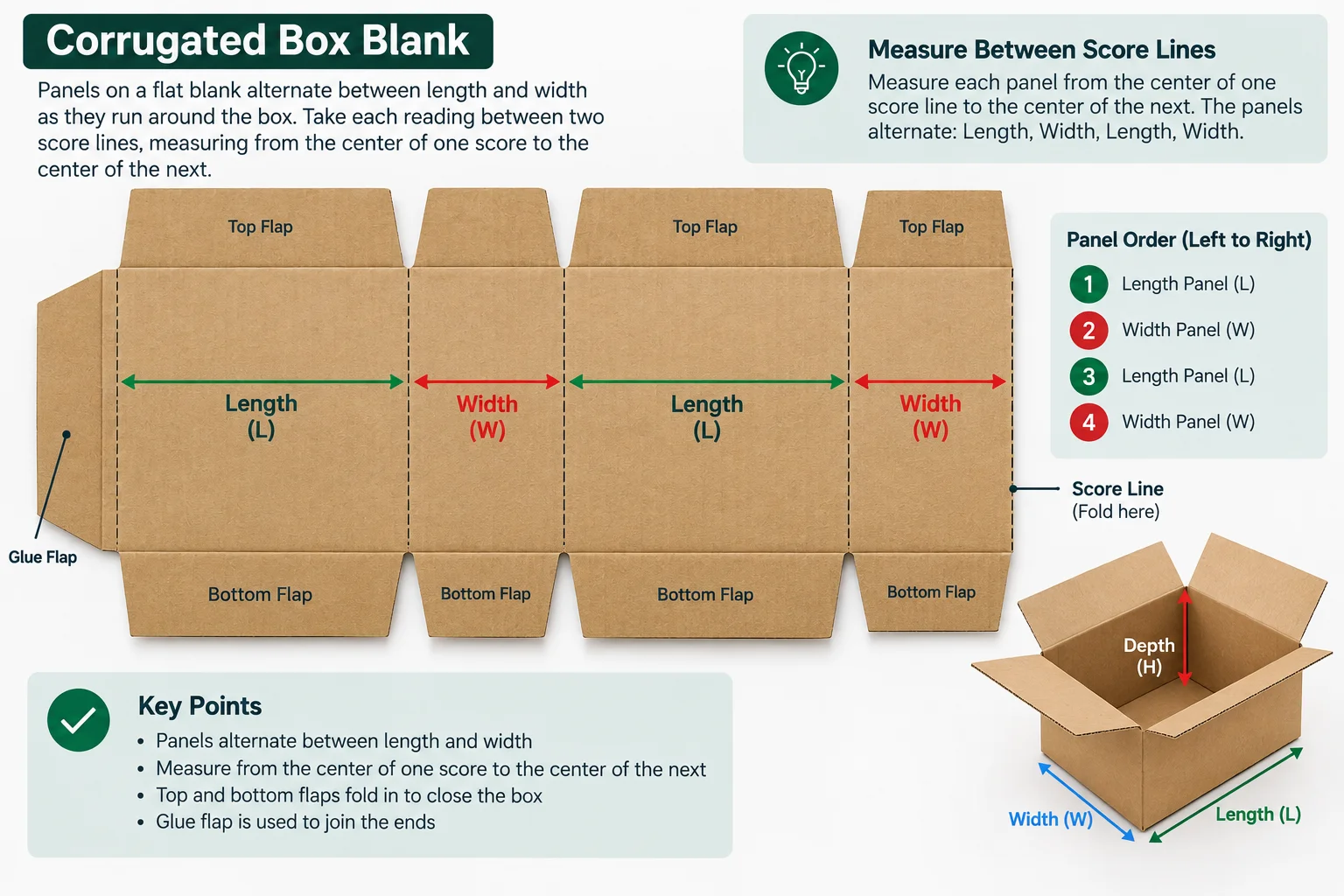
Boxes arrive knocked down and it is often easier to measure them in that state. Lay the blank flat with the printed side down and look at the score lines, which are the creases that become the corners once you build the box up.
The panels between those score lines alternate around the box in the pattern length, width, length, width. Measure the distance between two adjacent score lines to get one panel, and repeat for the neighboring panel to get the other. The flaps at the top and bottom will each measure roughly half the width, because they are designed to meet in the middle when folded.
One caution applies whenever you measure a box in its flat state. A score line has a small width of its own rather than being a perfect line. Measuring from the center of one score to the center of the next therefore gives you a truer figure than measuring edge to edge. The difference between those two readings is small and it is real.
When the box is full
Sometimes you cannot empty the box, either because it is sealed or because the contents belong to somebody else. In that case measure the outside carefully, then subtract twice the board caliper from each of the three dimensions to estimate the inside.
Label that estimate clearly as an estimate when you pass it on. A converter can work from it, and they will want to know that it came from an outside measurement rather than a direct reading of the inside.
Copying a box you already own is the easy half of the job. Starting from a product with no box around it yet asks a different set of questions.
Working out dimensions for a box that does not exist yet
Designing a new box from scratch runs in the opposite direction from everything above. Instead of starting with a box you start with the product, and every decision follows from how that product behaves.
Start by measuring the product
Measure the product at its widest point in each of the three directions, and include anything that sticks out. Handles, spouts, caps and labels all count, because the box has to contain the real shape rather than the shape you wish the product had.
If you are packing more than one unit into a box, decide the arrangement first and then measure the whole block. Four bottles standing in a two by two pattern occupy a different footprint from the same four bottles in a single row, and each arrangement leads to a different box.
Add clearance, but only as much as you need
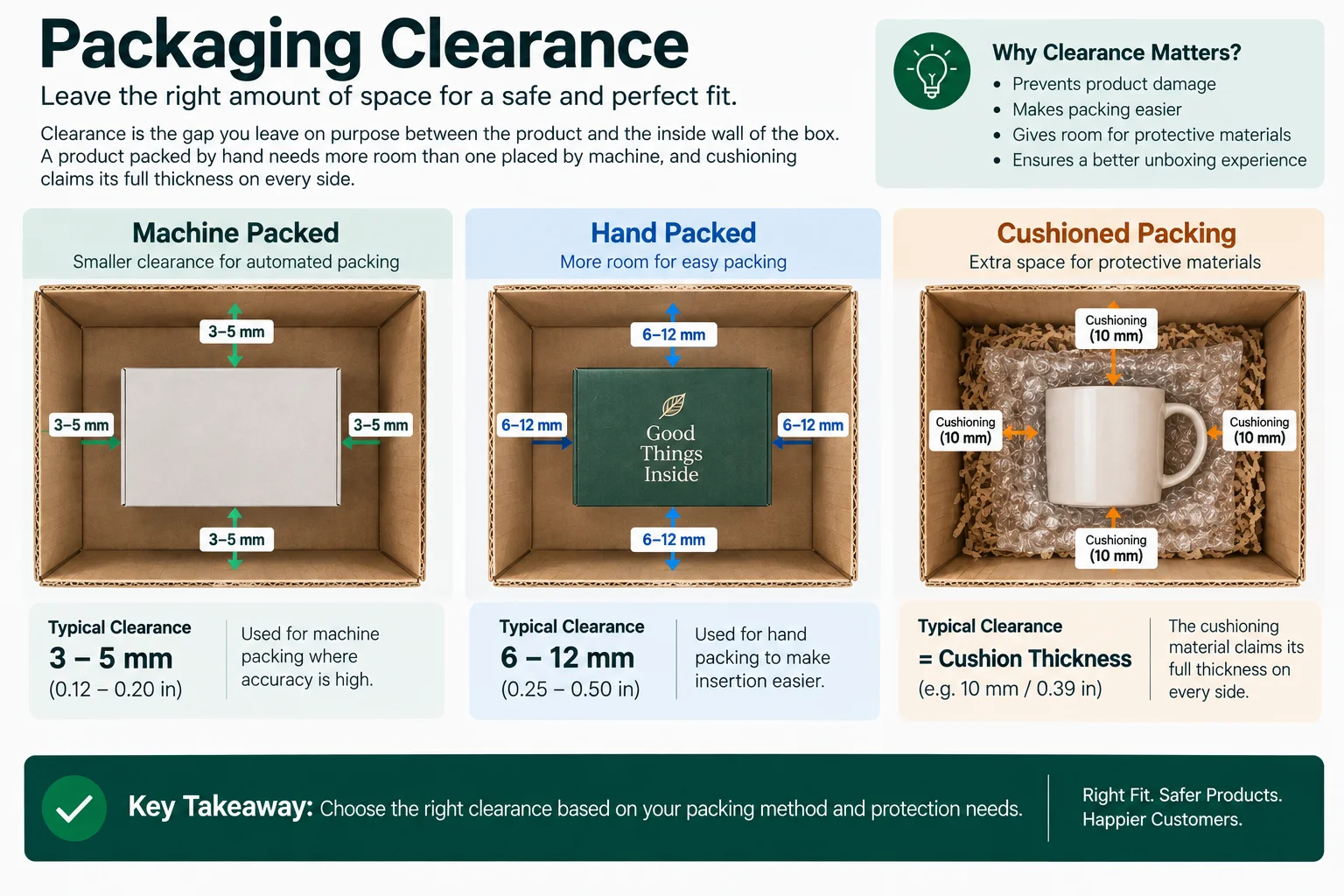
A box built to the exact size of the product will be almost impossible to pack. There is no room for a hand, and no room for the small variation that exists in every manufactured item. Clearance is the gap you deliberately leave between the product and the inside wall.
| Situation | Typical clearance per dimension | Why |
|---|---|---|
| Rigid product, packed by machine | 3 to 5 mm total | The machine places the product accurately, so the gap only has to absorb product tolerance. |
| Rigid product, packed by hand | 5 to 10 mm total | A person needs enough room to get fingers around the item and drop it in cleanly. |
| Soft or compressible product | Often none, or negative | You can squeeze the product slightly, and a snug box holds its shape better. |
| Fragile product needing cushioning | Thickness of the cushioning on every side | The protective material takes up space, and you have to design that space in from the start. |
| Product with a tolerance range | Enough to cover the largest unit | Designing for the average size guarantees that the biggest units will not fit. |
That last row deserves a moment of attention because it catches experienced people. Manufactured products vary within a stated tolerance, and your box has to accept every unit that falls inside that range. Ask your production team for the upper limit rather than the nominal size, and design around the upper limit.
Think about the pallet before you finalize anything
The most expensive dimension mistake has nothing to do with the product at all. A box that fits the product perfectly and fits the pallet badly will waste money on every single shipment for as long as you keep using it.
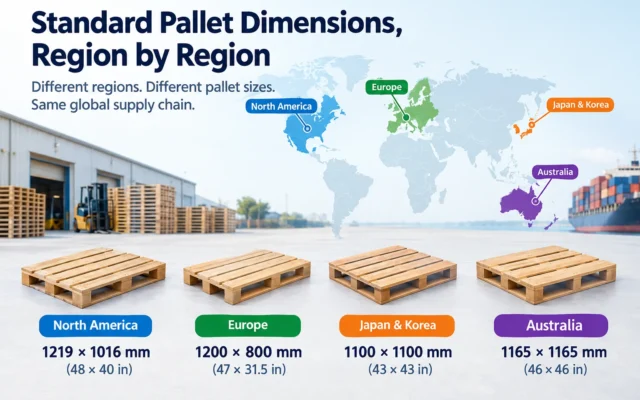
Pallets come in fixed sizes that you cannot change, which makes the pallet a hard constraint and the box a flexible one. Work out how many of your cartons fit on a layer before you sign off the dimensions, and adjust the box if the pattern leaves large gaps. Our guide to what a pallet is and how it decides your box size covers that calculation properly.
One more thing stands between your drawing and the box that turns up on the dock. No carton comes out at exactly the number you wrote on the order.
Tolerances, and what a converter can actually hold
No box comes out exactly at the dimension written on the order, because corrugated board is a paper product that responds to moisture and handling. Knowing the normal range stops you from raising a complaint about a box that is perfectly fine.
Converters commonly quote a tolerance of plus or minus 1.6 millimeters on each dimension, and tighter figures exist when your job truly needs them. Ask what tolerance your converter works to rather than assuming a number, because the answer varies with equipment and with board grade.
Two practical things follow from that normal range, and both of them are worth acting on. If a millimeter either way would break your pack, the design is too tight and needs more clearance rather than a tighter tolerance. And if you are testing a sample, measure several boxes rather than one, because a single sample tells you very little about where the whole run will sit.
Humidity affects all of this as well, and it explains some confusing results. Board absorbs moisture from the air and expands slightly, which means a box measured in a humid warehouse can read differently from the same box measured in a dry one. The effect stays small, and it is enough to explain a reading that puzzles you.
Where outside dimensions suddenly matter more
Everything so far has pushed you toward inside dimensions, and there are three situations where the outside number becomes the one that decides things.
Shipping cost
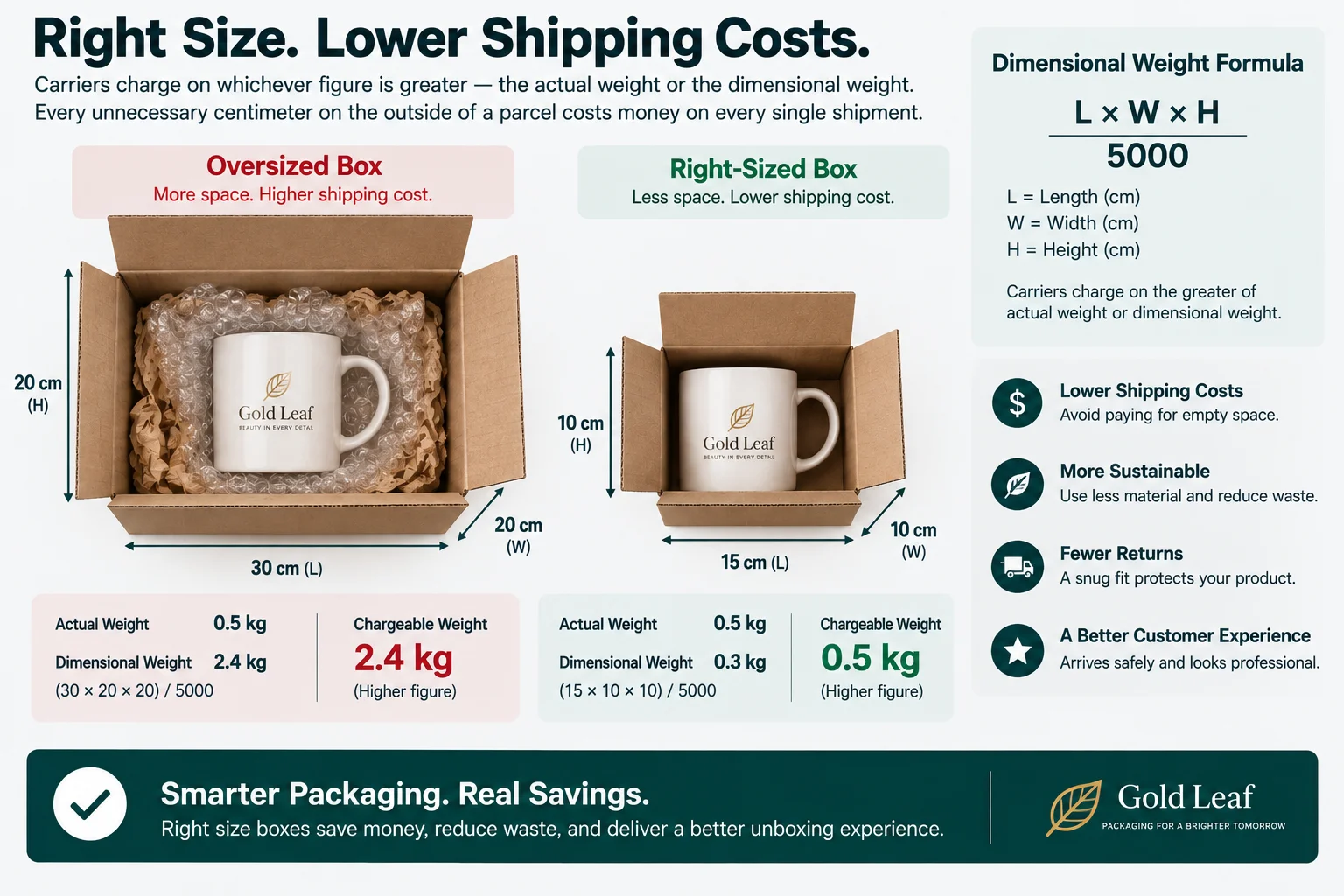
Carriers charge on whichever is greater, the actual weight of a parcel or its dimensional weight. You work out dimensional weight from the outside measurements rather than the inside ones. Multiply length, width and height together, then divide the result by a figure the carrier sets.
That divisor varies between carriers and between service levels, and carriers revise it from time to time. Confirm the current figure with your own carrier rather than working from a number you found somewhere, because using an outdated divisor will make your cost model quietly wrong.
The lesson stays simple for you even though the math varies between carriers. Every extra centimeter on the outside of a parcel costs you money on every single shipment. That is why an oversized box stuffed with void fill turns out so expensive across a year.
Pallet and truck fit
A warehouse stacks cases on pallets by their outside dimensions, and a pallet layer either works cleanly or it does not. A carton that is a few millimeters too large can drop the count per layer by one. Losing a single case on every layer across a whole year of shipments adds up to a serious number.
Retail shelf space
Retailers hand out shelf space in fixed slots, and they measure what they can see, which is the outside of the pack. A buyer will either refuse a carton that runs too deep for the shelf or shelve it awkwardly, and neither outcome helps the product sell.
Special cases where the normal rules bend
The length by width by depth convention covers most of what you will meet, and a handful of pack types follow their own habits. Knowing about these in advance stops a quote from surprising you later on.
Rigid boxes
Rigid boxes are the sturdy lidded boxes you see around premium goods, and their makers often quote outside dimensions rather than inside ones. The reason behind that habit is easy to see once you picture the process. A maker builds a rigid box up around a former, so the outside is the part they control most directly.
This is the most important exception in the whole subject, and it catches people who have learned the inside dimension rule everywhere else. Always ask a rigid box supplier which convention their quote uses, and get that answer in writing before anybody cuts tooling.
Folding cartons
Folding cartons made from paperboard follow the same inside dimension convention that corrugated uses. Paperboard is thin enough that the gap between inside and outside usually comes to a fraction of a millimeter. The convention still matters when the carton has to slot into a shipper somebody sized precisely.
Mailers and ecommerce boxes
Suppliers quote mailer style boxes in inside dimensions, exactly as they do any other corrugated pack. The point to watch on this style is depth rather than the other two dimensions. A mailer with a hinged lid loses a little usable depth once the lid is closed and the side flaps are tucked in.
Tubes and cylinders
A cylindrical pack uses diameter and length rather than the usual three dimensions. A supplier can quote that diameter as either inside or outside, exactly as with a box, so you have to ask the same question here too.
Telescoping and two piece boxes
A two piece box has a base and a separate lid that slides over it. Dimensions normally describe the base, and the maker builds the lid slightly larger so that it slides over the outside of that base. Ask which part a quoted dimension refers to whenever you are looking at this style.
Those five styles are the exceptions that catch people out. The mistakes below are the everyday rule instead, because they turn up in ordinary jobs with ordinary boxes.
Five mistakes that cost real money
Every one of these turns up regularly, and a single sentence of clarification prevents each one.
Sending outside dimensions without saying so is the most common mistake of all, because running a tape around the outside of a box is the natural thing to do. The converter then reads those numbers as inside dimensions and builds a box slightly too small for whatever you were copying.
Writing the three numbers in a different order gives you a box with the right volume and the wrong shape. A pack that should arrive shallow and wide turns up tall and narrow, and your product will not sit in it the way you planned.
Designing for the nominal product size rather than the upper tolerance means the largest units in every batch refuse to fit. This one surfaces weeks after launch, when a batch at the top of the tolerance range reaches the packing line.
Ignoring the pallet until the box is approved locks you into a footprint that wastes space on every shipment. Changing a box after the converter has cut tooling costs far more than checking a pallet pattern first.
Forgetting that cushioning needs its own space leaves you with a box where the product fits and its protection does not. You have to design cushioning into the dimensions from the start rather than squeeze it in at the end.
How dimensions appear on a quote and a specification sheet
Once you send your numbers to a supplier, those numbers come back to you inside a document. Learning to read that document properly is the last piece of the puzzle, because a quote uses shorthand that nobody ever explains to a newcomer.
The abbreviations you will see
Most quotes shorten the three dimensions to single letters, and the letters vary between suppliers. You will commonly see L, W and D for length, width and depth, and you will also see L, W and H where the third letter stands for height. Both mean the same thing in practice, and the third number always runs from the opening to the base.
Alongside those you will often find the letters ID or OD, which stand for inside dimension and outside dimension. When you see either of those on a quote, the supplier has told you exactly which convention they used, and you should read the numbers accordingly.
Style codes
A quote will usually name the box style with a code rather than a description. RSC stands for regular slotted container, which is the ordinary shipping carton where all the flaps are the same length and the two outer ones meet in the middle. FOL stands for full overlap, where the outer flaps overlap each other completely for extra strength.
The style you choose affects how the dimensions behave once the box is made. A full overlap box uses more board than a regular slotted container of the same inside size. The same three numbers therefore give you a different price and a slightly bigger outside measurement.
What to check before you approve
Read the quote back against what you sent and confirm three things every single time. Check first that the three numbers appear in the order you actually intended. Confirm next that the convention matches the one you asked for, and that the unit on the page is the unit you were working in. Those three checks take under a minute and they catch most of what goes wrong.
Questions people ask about measuring boxes
Does length always come first?
In packaging the order is length, then width, then depth, and that holds across almost every supplier you will deal with. Other industries order their dimensions differently, which is one reason the confusion spreads so easily. State the convention on anything you send and the question stops mattering.
Is depth the same as height?
For a box the two words point at the same measurement, which runs from the opening down to the bottom. Depth is the term the trade tends to prefer because it stays true regardless of how the box is standing. Height can change meaning every time somebody puts the box down a different way.
Should I measure in millimeters or inches?
Use whichever unit your supplier works in, and write the unit beside every number you send. Millimeters work in finer steps than fractional inches, and they remove the risk of somebody misreading a fraction. Mixing units inside one spec is the dangerous move, rather than choosing either one of them.
How do I measure a box that has an irregular shape?
Measure the largest extent in each of the three directions and treat that as your working dimension. An irregular pack still has to fit a rectangular space on a pallet and inside a truck. The widest point in each direction is therefore the number that governs everything after it.
Why does my new box feel smaller than the old one?
The most likely reason is that somebody sent outside dimensions and the converter read them as inside dimensions. The next most likely reason is a change in board grade, because a thicker flute eats more space out of the inside while the outside stays the same. Ask your supplier for both the inside figure and the board caliper and the answer will usually be obvious.
How much clearance should I leave around my product?
There is no single correct figure, because the right amount depends on how you pack the box and how much the product varies. A rigid item placed by hand usually needs somewhere between five and ten millimeters in total across each dimension. Anything fragile needs the full thickness of its cushioning designed in on every side.
A checklist before you send dimensions to anybody
Run through these six points and you will avoid nearly every problem described above.
- The three numbers are written in the order length, then width, then depth.
- The words inside dimensions or outside dimensions appear right next to the numbers.
- The unit is stated, because millimeters and inches look similar in a hurried email.
- You measured the largest unit in the tolerance range rather than an average one.
- You added clearance on purpose, with a reason you could explain out loud.
- Somebody has checked how the finished carton lands on a pallet layer.
None of this takes more than a few minutes, and every minute spent here saves hours later. Dimensions are the foundation that every other packaging decision sits on, which is why a mistake at this stage is so expensive to fix once tooling exists.
Where to go from here
Once the dimensions are settled you can move on to the material question. Our guide to what cardboard actually means in the trade explains how board grade and flute choice affect both cost and strength. If you are shipping ecommerce orders, the piece on multi depth corrugated boxes shows how one carton can sometimes replace three.