You already know packaging needs to change. The harder question is: where do you actually start?
There are a hundred articles out there telling you to ‘use less plastic’ or ‘choose eco-friendly materials.’ That’s not useful. You can’t brief a supplier on ‘use less plastic.’ You need specifics.
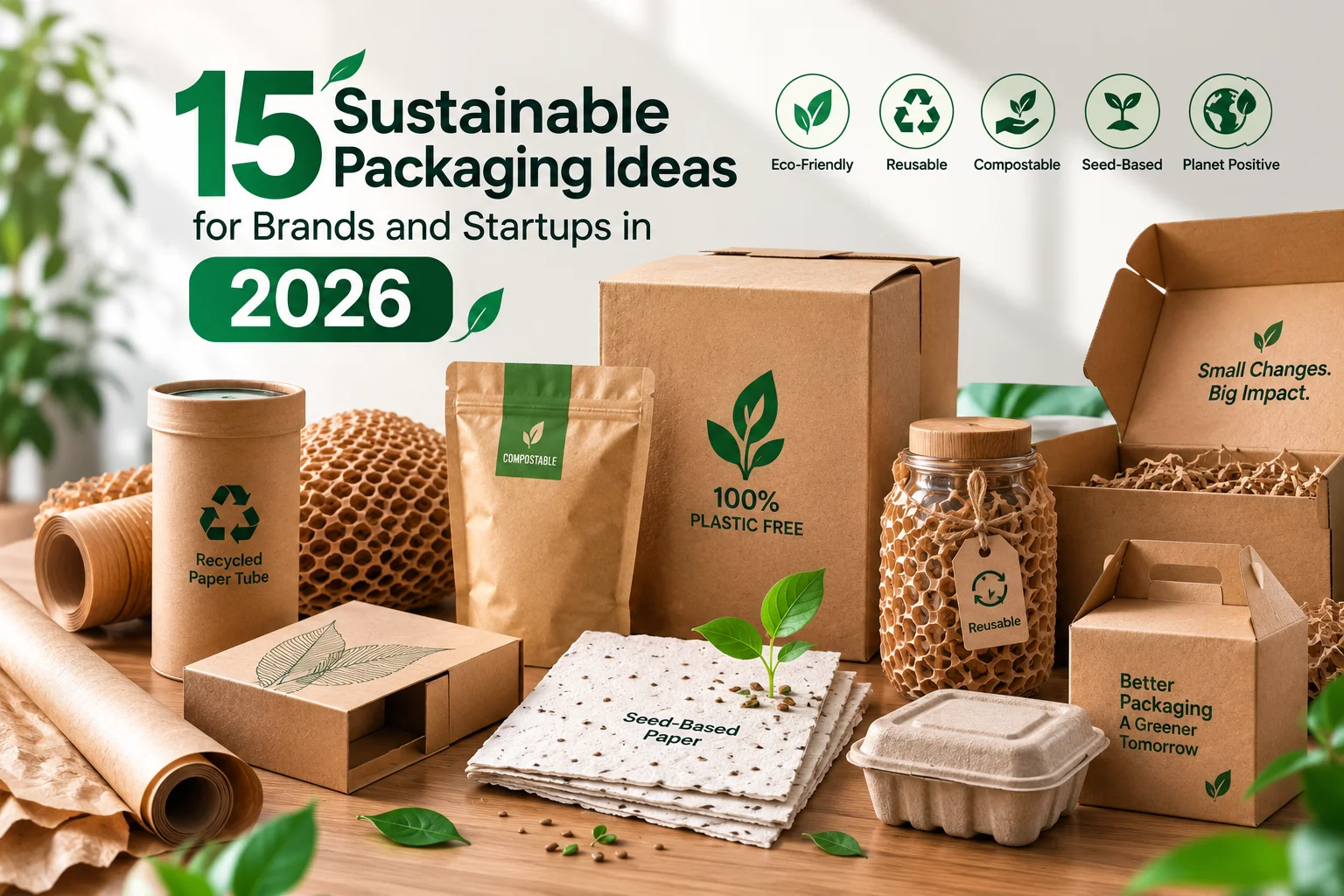
This list is specifics. Fifteen ideas you can take straight to a supplier conversation, a packaging review meeting, or a brief. Sorted from the easiest to implement to the most ambitious, so you can start wherever your budget and complexity allow.
The Quick Wins and Ideas That Cost Nothing or Save Money
1. Remove the Plastic Window from Your Carton
This is the most underused quick win in retail packaging. A lot of brands use cartons with a clear PET window so consumers can see the product inside. It looks premium. The problem is that PET window, glued to a paperboard carton, makes the entire pack non-recyclable. The adhesive bond between materials can’t be separated in standard paper recycling streams.
The fix is simple: remove the window entirely and replace it with a die-cut or laser-cut open panel. Consumers can still see the product. The pack is now fully recyclable with paper. And because you’re removing a component rather than adding one, the cost often goes down, not up.
One snack brand we worked with saved £0.03 per unit by removing a PET window from their carton. At 200,000 units per year, that’s £6,000 back in the budget and a recyclable pack.
2. Right Size Your Shipping Box
Open your top five shipping boxes. Now put your products in them and look at how much empty space is left. If any dimension has more than 20mm of air between the product and the box wall, you have a right sizing problem.
Oversized boxes waste material. They increase the amount of void fill needed. They add shipping weight. They reduce how many boxes fit on a pallet. All of that costs money and none of it delivers any benefit to the customer.
Right sizing your shipping boxes is the sustainable packaging change with the clearest, fastest return on investment. Lower material cost, lower freight cost, better pallet fill, less void fill. It’s almost always cost-neutral or cost-positive within the first order cycle.
3. Add a Clear, Accurate Recycling Label
‘Please recycle’ is not a recycling instruction. Consumers genuinely want to do the right thing with packaging but most of them don’t know whether a given pack goes in the blue bin or the black bin. Vague labels don’t help.
A clear, specific recycling label ‘Recycle with card’ or ‘Recycle at store drop-off points’ measurably increases actual recycling rates. And using an accredited scheme like How2Recycle (US), OPRL (UK), or the Green Dot (Europe) gives your claim legal defensibility in markets where greenwashing is now regulated.
This costs almost nothing. It’s a label design change. And it’s one of the highest-impact things most brands haven’t done yet.
4. Replace Bubble Wrap with Paper Void Fill
Bubble wrap is LDPE plastic film. It’s not recyclable at kerbside in most markets. It’s increasingly restricted by major retailers in their packaging sustainability requirements. And it costs about the same as paper alternatives.
Crumpled paper, honeycomb kraft wrap, and paper pads all perform comparably to bubble wrap for protecting non-fragile products in transit. For fragile items, moulded pulp inserts offer better protection than bubble wrap anyway.
This is a like-for-like swap with no performance trade-off for most product categories. The cost difference is minimal. There’s no reason not to do it.
The Material Switches Upgrading What Your Packaging Is Made Of
5. Switch to Mono-Material Flexible Pouches
If you use stand-up pouches, flow-wrap films, or flexible sachets, you’re almost certainly using a multi-layer laminate a structure that bonds together PET, aluminium, and PE layers to achieve the barrier properties you need. It works brilliantly. It’s completely non-recyclable.
Mono-material PE pouches use a single polymer family throughout. They achieve barrier performance using thin EVOH layers within an all-PE structure. They’re recyclable at flexible film drop-off points in most supermarkets.
The cost premium is real typically 20–35% per unit at comparable volumes. But mono-material pouches attract lower EPR fees, and many major retailers are now requiring them. Run the three-year total cost before you decide it’s too expensive.
6. Switch to Recycled Content Board
For any packaging that uses paperboard for retail cartons, gift boxes, mailer boxes, shipper cases and switching from virgin SBS (solid bleached sulphate) board to recycled content board is one of the easiest sustainable upgrades available.
Recycled content board typically 70–100% post-consumer recycled (PCR) fibre, performs comparably to virgin board in most applications. Print quality is slightly different on uncoated grades, but with good color management the difference is minimal. The cost premium is typically 5–15%.
This is a change most suppliers can accommodate on your next order. There’s no new tooling, no format change, no consumer communication required.
7. Use FSC-Certified Paper and Board
FSC certification Forest Stewardship Council guarantees that the paper or board in your packaging comes from forests managed to environmental and social standards. It doesn’t make your packaging more recyclable, but it addresses the sourcing question that retailers and B2B buyers increasingly ask about.
The cost premium is usually 5–10%. Many suppliers already have FSC-certified stock available and the switch is a question of specifying it, not sourcing it. For brands selling to major grocery retailers, FSC certification is increasingly appearing in supplier sustainability questionnaires.
8. Switch Your Mailers to 50% PCR Poly or Paper
For e-commerce brands still using virgin poly mailers, two simple upgrades are available right now.
50% PCR poly mailers are made with half recycled content. Performance is identical to virgin poly. They’re recyclable at store drop-off points the same way virgin poly is. The cost premium is 15–25%. This is the lowest-friction sustainable upgrade for any e-commerce brand.
Paper mailers padded kraft paper envelopes are fully kerbside recyclable. They are increasingly popular with fashion and beauty brands because the unboxing experience is strong and the sustainability story is clean. The premium over poly is 20–40% depending on volume, but the positioning benefit can justify it.
The Design Changes How You Design Makes the Difference
9. Eliminate Secondary Packaging That Serves No Function
Do an honest audit of everything inside your packaging. Tissue paper that exists purely for aesthetics. An inner plastic tray that could be replaced by a structural cardboard insert. A ribbon pull. Individual wrappers on products that don’t need individual wrapping.
Ask, for each component: does this protect the product, extend shelf life, or deliver a consumer experience that genuinely drives loyalty? If the answer to all three is no, it probably doesn’t need to be there.
Brands that do this exercise honestly almost always find 10–20% cost reduction opportunities alongside the sustainability improvements. It’s the same question with two good answers.
10. Use Water-Based Inks and Coatings
Conventional printing inks and many surface coatings use solvent-based formulations that can contaminate recycling streams. Water-based alternatives are now available for most printing applications flexo, gravure, digital and perform comparably for standard retail and e-commerce packaging.
The cost impact is minimal often neutral. The recyclability improvement is significant, because ink and coating choice affects whether the underlying material (paper, board, film) can be accepted in recycling streams.
11. Design for Disassembly
If your packaging has multiple components, a tray and a lid, a bottle and a pump, a box with a plastic inner, design them so the consumers can separate them in under ten seconds without tools.
Mixed-material packs that can’t be separated are recycled at dramatically lower rates than single-material packs, even when the individual components are perfectly recyclable. A paper box with a non-detachable plastic base goes in the wrong bin by most consumers most of the time.
Test your own pack. Time it. If it takes more than ten seconds to separate the components, or if it requires scissors, it needs redesigning.
The Bigger Moves Higher Investment, Bigger Impact
12. Introduce Reusable Packaging for DTC Brands
For brands selling direct to consumer, a reusable packaging programme where customers return packaging in exchange for a discount or deposit credit can dramatically reduce per-unit packaging waste over a product’s lifetime.
This works best in high-frequency replenishment categories: coffee, supplements, cleaning products, personal care. The infrastructure requirement is significant you need a reverse logistics system and a cleaning or inspection process but the lifecycle impact is the strongest of any format.
13. Use Mushroom (Mycelium) Packaging for Fragile Products
If you’re currently using expanded polystyrene (EPS) foam for fragile product protection in electronics, gifts, or premium goods mycelium packaging is the most promising sustainable alternative.
Grown from agricultural waste and fungal networks, mycelium packaging is home-compostable within 30–45 days and offers comparable protective properties to EPS. It’s currently 2–3x the cost of EPS, which makes it most viable for premium products where the sustainability story adds brand value.
14. Switch to Soy or Vegetable-Based Inks
For packaging with high print coverage deep background colors, full-bleed photography, soy-based or vegetable-oil-based inks offer comparable colour performance to petroleum-based inks with a more sustainable raw material base.
They are particularly relevant for paper and board packaging because they’re compatible with the paper recycling deinking process, meaning the printed packaging can be more effectively recycled at end of life.
15. Brief Your Supplier with a Sustainability Specification Sheet
This is the most impactful thing on this list. Not a material switch. Not a format change. A document.
A one-page sustainability specification that defines before any design or supplier conversation starts the materials you will and won’t accept, the certifications you require, the recyclability standards your packaging must meet, and the claims you will and won’t make on-pack.
Without this document, suppliers default to whatever is cheapest and easiest to source. With it, you’re specifying sustainability requirements the same way you specify dimensions or print colors as a non-negotiable part of the brief.
The brands that are furthest ahead on sustainable packaging are not the ones with the biggest budgets. They’re the ones that started writing specifications.
Where to Start
If you’re a startup with a limited budget: ideas 1, 2, 3, and 4 are cost-neutral or cost-positive. Start there. Today.
If you’re a growing brand with an established supplier: ideas 5, 6, 7, and 8 are direct material switches you can brief on your next order cycle.
If you’re a packaging professional advising clients: idea 15 is the structural change that makes everything else systematic.
Key Takeaways
- The easiest sustainable packaging wins are often free or cheaper than what they replace with right-sizing, removing components, and adding recycling labels cost nothing
- Mono-material flexible packaging and recycled content board are the two highest-impact material switches for most brands right now
- A sustainability specification document is the highest-leverage action most brands haven’t taken it makes every subsequent packaging decision better
- Avoid vague claims like ‘eco-friendly’ and use certified schemes (FSC, How2Recycle, OPRL) and be specific about what you mean
- Run every change through a total cost analysis that includes EPR savings, not just per-unit material cost