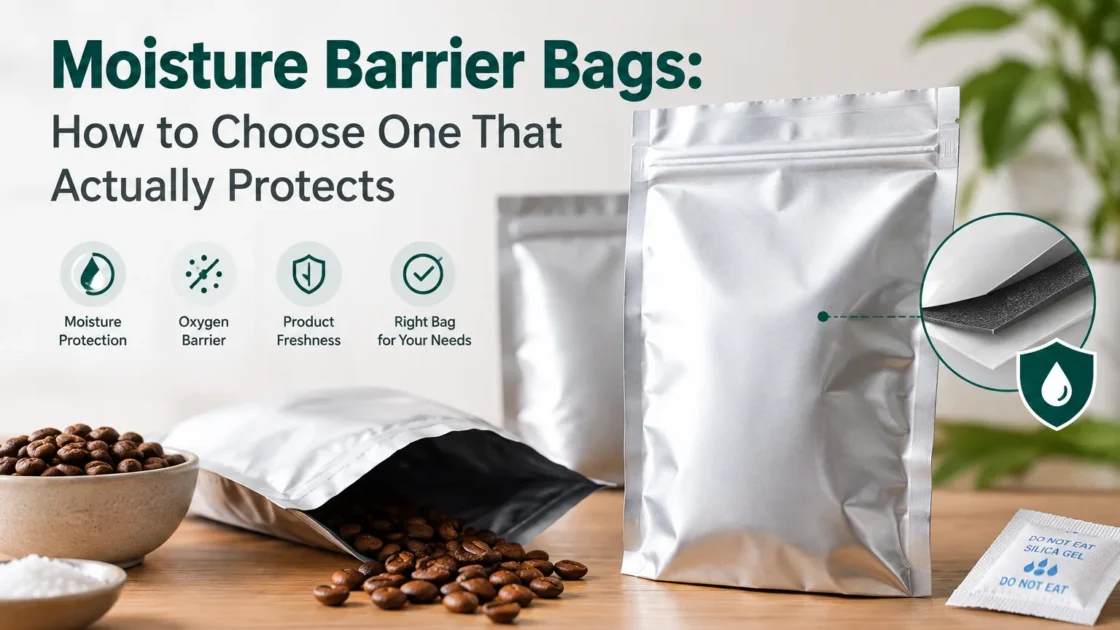
A moisture barrier bag is a multi layer flexible pouch built to slow down how fast water vapor moves from the air into your product. The number that decides whether a bag works for you is the water vapor transmission rate, and most suppliers will give you that number only if you ask for it directly.
If you are sourcing packaging for a dry food, a supplement, an electronic component or anything else that goes soft or stale when it picks up moisture, this guide gives you the decision in full. You will learn what the barrier rating means and how to work out the level your own product needs. You will also see what each film structure costs and where these bags usually fail in real production.
Most buyers pick a bag by looking at it and then asking for a price. That approach fails because two bags that look identical can differ in barrier performance by a factor of a thousand, and the whole difference sits inside the laminate where nobody can see it.
The short answer
Ask every supplier for the water vapor transmission rate of the exact laminate they are quoting, stated in grams per square meter per 24 hours, along with the temperature and humidity the test was run at. A foil based laminate gives you the lowest number available and blocks light completely. A metallized film costs less and performs well for most dry goods with a shelf life under a year.
A clear high barrier film lets the customer see the product but carries a weaker rating than either of the other two. Choose based on the shelf life you need and the moisture sensitivity of the product, and never on the appearance of the bag alone.
What a moisture barrier bag actually is
A moisture barrier bag is a pouch made from several thin layers bonded together into a single web of material. Each layer has one job, and no single plastic film on the market can do all of those jobs at once.
The outer layer is usually polyester, which people in the trade call PET. It carries the printing and it resists scuffing and puncture while the bag moves through distribution. The middle layer is the one that actually provides the barrier, and it is either aluminum foil, a vapor deposited metal coating or a specialized polymer.
The inner layer is almost always polyethylene, because polyethylene seals to itself cleanly under heat and it is approved for direct food contact. That inner layer is what forms the closure when the bag is filled and sealed on your line.
People often use the term moisture barrier bag loosely, and that causes real confusion during sourcing. The term first came into common use through defense and electronics packaging, where the specification MIL PRF 81705 Type II defines bags used to protect static sensitive components from humidity. Food and consumer brands borrowed the phrase later, and today it covers everything from a coffee pouch to a pharmaceutical sachet.
That looseness matters a great deal once you start requesting quotes from more than one converter. If you simply ask a converter for a moisture barrier bag, you will receive whatever that particular converter happens to run most often. You have to state the barrier level you need, otherwise the quote you get back is not comparable to the quote from anyone else.
How barrier performance is measured
Two numbers describe almost everything you need to know about a barrier bag. Both are transmission rates, which means they measure how much of something passes through a given area of film in a given time.
Water vapor transmission rate
The water vapor transmission rate tells you how many grams of water vapor pass through one square meter of the film in 24 hours. The industry shortens it to WVTR, and some suppliers call the same thing MVTR for moisture vapor transmission rate. Both abbreviations describe the identical measurement, so do not let the different letters confuse you during a quote comparison.
The number on its own means nothing without the test conditions attached to it. Water vapor moves faster when the air is warmer and more humid, so the same film will produce very different results depending on how the test was run. The most common condition you will see quoted is 38 degrees Celsius at 90 percent relative humidity, and the standard test method is ASTM F1249.
When a supplier gives you a WVTR figure with no conditions attached, that figure is not usable. Ask them to send the film datasheet rather than a number typed into an email.
Oxygen transmission rate
The oxygen transmission rate measures how much oxygen passes through the same area in the same time, and it is usually written as OTR. The standard test method is ASTM D3985, and results are normally given in cubic centimeters per square meter per 24 hours.
Many buyers ignore OTR because they came looking for a moisture solution. That is a mistake for any product containing fat, because oxygen drives the rancidity that makes nuts, seeds, milk powder and snack foods taste stale. A bag that blocks moisture well and oxygen poorly will still lose you the shelf life you were trying to buy.
One detail in that chemistry catches a lot of buyers out and it is worth understanding before you approve any structure. The polymers that provide the best oxygen barrier are hygroscopic, which means they absorb moisture from the air, and their oxygen performance degrades as they do. This is exactly why well designed laminates place the oxygen barrier layer in the middle of the structure with moisture barrier layers on either side of it.
Barrier film explained: what sits inside the laminate
Barrier film is the general term for any film engineered to slow the passage of moisture, oxygen, light or aroma. Every moisture barrier bag is built from one, and the type of barrier film chosen is the single biggest factor in both performance and price.
Three families of barrier film cover almost all of the commercial packaging you are ever likely to be quoted. Each one solves the same problem in a different way, and each carries a different set of trade offs that you need to understand before you approve a structure.
Foil laminates
A foil laminate contains a genuine layer of aluminum foil, usually between 7 and 12 microns thick, sandwiched between the printed outer layer and the sealant layer. Aluminum is not permeable to water vapor at all, so the only moisture that enters a foil bag comes through microscopic flaws in the foil or through the seals.
This structure gives you the lowest transmission rates available in flexible packaging, and it blocks light completely as well. For products that degrade under light, such as vitamins, ground spices and some oils, that light barrier is worth as much as the moisture barrier.
The trade offs are real and you should know them in advance. Foil laminates cost the most, they cannot be recycled in any standard stream, and the foil layer can crack if the bag is flexed repeatedly during shipping. That cracking is called flex cracking, and it is the reason foil bags sometimes fail in distribution despite testing perfectly at the converter.
Metallized films
A metallized film carries a layer of aluminum so thin that it is measured in nanometers rather than microns, deposited onto a plastic film inside a vacuum chamber. The result looks like foil to the eye but behaves very differently in the hand and on the machine.
Metallized polyester gives you a large share of the barrier performance of real foil at a significantly lower cost. It also flexes without cracking, which makes it more reliable through rough distribution than a true foil laminate.
The metallized layer is fragile in a different way, because it can be scratched or abraded during converting and filling. Any damage to that layer shows up as a local loss of barrier that no test on a flat sample will reveal. This is why the way your converter handles the web matters as much as the film specification itself.
Transparent high barrier films
Transparent high barrier films achieve their performance without any metal at all. Two approaches dominate the market, and they work in completely different ways.
The first uses a polymer called ethylene vinyl alcohol, known as EVOH, buried as a thin layer inside the structure. EVOH is an outstanding oxygen barrier and a poor moisture barrier, which is why it always sits protected between polyethylene layers rather than facing the outside world.
The second approach coats a plastic film with an extremely thin layer of aluminum oxide or silicon oxide, usually written as AlOx and SiOx. These coatings are ceramic rather than metallic, so the film stays clear and it does not interfere with metal detection on your production line.
Clear barrier films let the customer see the product, which is worth real money in some retail categories. They cost more than metallized film for less barrier performance, so you are paying a premium for visibility rather than for protection.
How the three families compare
| Structure | Moisture barrier | Light barrier | Relative cost | Best suited to |
|---|---|---|---|---|
| Foil laminate PET / aluminum foil / polyethylene | Highest available | Total | Highest | Long shelf life, light sensitive products, pharmaceutical and supplement goods |
| Metallized film PET / metallized PET / polyethylene | High | Near total | Medium | Coffee, snacks, powders and most dry goods with a shelf life under one year |
| Clear AlOx or SiOx PET with ceramic coating / polyethylene | Moderate to high | None | Medium to high | Products that need to be visible, and lines that use metal detection |
| EVOH structure Polyethylene / EVOH / polyethylene | Moderate | None | Medium | Oxygen sensitive products where recyclability is a priority |
| Plain polyethylene Single layer, no barrier component | Low | None | Lowest | Short term storage only, and not a moisture barrier bag in any real sense |
The gap between the top and the bottom of that table is far larger than most people expect. A well built foil laminate can outperform plain polyethylene by three orders of magnitude on moisture transmission, and both bags can look almost the same on a shelf.
Working out the barrier level your product needs
This is the part most sourcing conversations skip, and skipping it is how brands end up paying for barrier they do not need or buying barrier that falls short. The calculation is not complicated once you know which three inputs to gather.
Start with water activity, not moisture content
Water activity describes how available the water inside your product is, rather than how much water is present in total. It runs on a scale from 0 to 1, where pure water sits at 1 and a fully dried product sits near 0.
Water activity is what actually controls spoilage, texture change and microbial growth. Two products can hold the same percentage of moisture by weight and behave completely differently, because the water in one is chemically bound and the water in the other is free.
Your product has a critical water activity above which it fails, and that number is the real target your packaging has to defend. A crisp snack loses crunch somewhere around 0.4, while microbial growth in most foods begins above 0.6. Your food technologist or your contract manufacturer can measure this for you with a water activity meter in under an hour.
The moisture gain calculation
Once you know the critical water activity, the rest follows from a straightforward relationship. The moisture your product picks up equals the transmission rate of the film multiplied by the surface area of the bag multiplied by the time on shelf.
Moisture gained = WVTR × bag surface area × days on shelf
Run this against the moisture your product can absorb before it crosses its critical water activity, and you have the shelf life that structure will actually deliver.
Three practical points come out of that relationship and each one saves money. Surface area matters as much as film choice, so a large thin bag lets in more moisture than a small thick one made from the identical laminate. Doubling the shelf life requirement roughly halves the transmission rate you can accept, which usually means stepping up a whole film family rather than making a small adjustment.
The third point is the one that surprises people most often during a sourcing conversation. Warehouse and retail conditions change the answer dramatically, because a bag stored in a humid coastal warehouse faces a far higher driving force than one stored in a dry climate. If you sell into several regions, design for the worst of them rather than the average.
Desiccants: when you need one and how much
A desiccant absorbs moisture inside the sealed bag, and it buys you protection that the film alone cannot provide. Most brands either skip desiccants entirely or throw in a sachet without any calculation behind it.
A desiccant handles two separate problems and understanding both of them is what makes the sizing work properly. It absorbs the moisture already present inside the headspace at the moment of sealing, and it absorbs the moisture that creeps through the film over the life of the pack.
Silica gel is the most common choice and it performs well across a wide humidity range. Molecular sieve absorbs more aggressively at low humidity and is the right choice when your product needs to stay extremely dry. Clay desiccant costs the least of the three options and it performs acceptably wherever conditions stay moderate.
Sizing a desiccant properly requires the same three inputs you already gathered. You need the transmission rate of the film, the surface area of the bag and the intended shelf life, and from those you can calculate the total moisture load the desiccant has to absorb. The defense standard MIL STD 2073 contains the classic method, and most desiccant suppliers will run the calculation for you if you give them those numbers.
One warning here is worth stating plainly, because this particular mistake appears again and again. A desiccant is not a substitute for a proper barrier film, because a sachet that saturates halfway through the shelf life leaves the product unprotected for the remainder. Fix the film first and use the desiccant to cover what the film cannot.
The seal is where most bags fail
Here is the thing that separates people who have run production from people who have only read specifications. In the large majority of real world failures, the film performed exactly as the datasheet promised and the seal is what let the moisture in.
A heat seal forms when the sealant layers on the two inner faces melt together under heat and pressure for a set period of time. Three variables control the result, and all three have to sit inside a fairly narrow window at the same time.
Temperature that runs too low produces a seal that looks closed but peels apart under stress. Temperature that runs too high burns through the sealant layer and can damage the barrier layer sitting directly behind it. Dwell time and pressure interact with temperature, which means a change to any one of them shifts the window for the other two.
Contamination in the seal area is the most common practical cause of failure. Product powder, oil or dust caught in the seal creates a channel that no amount of heat will close properly. Powder filling operations suffer from this constantly, and the fix usually involves changing how the product is dropped rather than changing the sealing settings.
Testing that the seal actually holds
Two standard tests cover most of what you need, and any competent converter will already run both. ASTM F88 measures seal strength by pulling the seal apart and recording the force required. ASTM F2096 is a bubble leak test that finds channels and pinholes by submerging an inflated pack and watching for escaping air.
Ask for results from both tests on production samples rather than on samples made by hand at the converter. A seal made carefully on a laboratory bench tells you very little about what your filling line will produce at full speed.
Features that quietly cost you barrier
Several popular bag features reduce barrier performance, and nobody mentions this during the quoting process. None of them are wrong choices, but you should make them knowing the cost.
Reclosable zippers are the largest single offender among these features, and the reason is structural rather than a question of quality. A zipper is normally made from polyethylene with no barrier component in it, and it runs across the full width of the bag. Once the customer opens the pack, the zipper becomes the primary route for moisture to enter, and the expensive laminate you specified is no longer doing the work.
Degassing valves on coffee bags let carbon dioxide escape while keeping oxygen out, and they are genuinely necessary for freshly roasted coffee. They are still a deliberate hole in an otherwise sealed pack, and valve quality varies widely between suppliers.
Tear notches and laser scoring create a weakened line in the film so that customers can open the pack. Laser scoring that cuts too deep goes through the barrier layer and creates a permanent leak path. Ask your converter what depth they are scoring to and whether they verify it in production.
Clear windows in an otherwise metallized bag look excellent in retail and they are a hole in your barrier by definition. The window carries the transmission rate of whatever film sits in it, so calculate using the window area rather than the total bag area if that window is large.
What all of this costs
Pricing for flexible packaging depends on so many variables that any single figure quoted online will mislead you. What stays consistent is the relationship between the options, and understanding that relationship lets you read a quote properly.
Plain polyethylene sits at the bottom of the range and provides no meaningful barrier. Metallized structures cost noticeably more than plain film and deliver most of the barrier that most products actually need. Foil laminates sit at the top, and clear high barrier films often cost close to foil while delivering less protection.
Three cost drivers matter more than the film itself, and buyers routinely underestimate all three.
Tooling and plates are a one time charge for the printing cylinders or plates that carry your artwork. That charge scales with the number of colors in the design, so a seven color print costs considerably more to set up than a three color print. The charge lands on your first order regardless of quantity, which means it hurts most on a small run.
Minimum order quantity is driven by the way film is manufactured rather than by supplier policy. A converter has to run a minimum length of material through the press to reach stable color, and that material is charged to you whether it becomes usable bags or not. This is why the price per bag drops so sharply between a small run and a medium run.
Bag format changes the cost more than most people expect when they first begin comparing quotes. A flat pouch uses the least material, a stand up pouch adds a gusset and additional sealing, and every added feature such as a zipper, valve or spout brings both a component cost and a slower line speed.
Compare quotes on total first year cost
Add the tooling charge to the unit price multiplied by your first year volume, then divide by that volume. A converter quoting a higher unit price with lower tooling frequently wins on the first order, and the ranking can reverse completely by the second year.
Recyclability and the mono material question
Everything that makes a moisture barrier bag work well also makes it difficult to recycle. That tension is genuine and no supplier has fully resolved it yet, so be skeptical of anyone who claims otherwise.
Recycling systems sort by material type, and a laminate made from polyester, aluminum and polyethylene cannot be separated back into those three materials at any realistic cost. The whole pack therefore goes to landfill or incineration in almost every jurisdiction.
Mono material structures are the industry response to this problem and they are worth understanding properly. A mono material bag is built entirely from one polymer family, normally polyethylene, with the barrier provided by a coating or by a compatible layer thin enough not to disrupt recycling.
These structures have improved substantially in recent years and they now suit a real range of dry goods. They still deliver less barrier than a foil laminate, so they work best where your calculation shows some headroom rather than where you are already at the limit.
Two practical cautions apply before you switch a live product across to one of these structures. Mono material films seal within a narrower temperature window than conventional laminates, which often means your existing equipment needs recalibration and occasionally needs replacement. Recyclability also depends entirely on local collection infrastructure, so a pack that is genuinely recyclable in Germany may have nowhere to go in another market.
Eight questions to ask before you approve a quote
Take these into your next supplier conversation. The quality of the answers will tell you more about the converter than any sample ever will.
- What is the water vapor transmission rate of this exact laminate, and at what temperature and humidity was it measured?
- What is the oxygen transmission rate for the same structure, and does my product need that protection?
- Can you send the film datasheet from the film producer rather than a figure typed into an email?
- What seal strength do you achieve on production equipment, and can I see ASTM F88 results from a real run?
- What is the sealing temperature window for this structure, and will my current equipment hold it?
- What does the tooling charge cover, how many colors does it include, and do I own those plates afterwards?
- What happens to the price per bag at double my current volume, and where is the next price break?
- If I add a zipper or a window, how much barrier performance am I giving up in exchange?
Five mistakes that cost brands real money
Buying barrier by appearance is the most common error of the five, because a shiny silver bag says nothing at all about what sits inside the laminate. Metallized film and foil laminate look nearly identical on a shelf while performing very differently in storage, so ask for the structure written out layer by layer.
Testing flat samples instead of finished packs hides every problem that actually matters, because performance measured on a flat sheet ignores seals and gussets and zippers entirely. Insist on testing filled and sealed packs taken from a genuine production run rather than samples built by hand.
Designing for average storage conditions leaves you exposed in the markets that matter most, because a product never experiences the average of a distribution network. It experiences the worst warehouse during the worst month of the year, so design for that case and everything easier looks after itself.
Adding a desiccant to rescue a weak film works for a while and then stops working without giving you any warning at all. Saturation usually arrives somewhere in the middle of the shelf life and leaves the remaining stock unprotected, so solve the barrier problem with the barrier itself.
Changing suppliers without revalidating catches out even experienced packaging teams, because two converters can quote what looks like an identical structure and still deliver different results. Sealing behavior and film sources and web handling all vary between plants, so treat any supplier change as a fresh qualification rather than a simple swap.
Where to go from here
The sequence that works is always the same, and it takes about a week of elapsed time rather than months. Measure the critical water activity of your product first, because every other decision depends on that number.
Decide the shelf life you actually need next, and be honest with yourself about how long stock really sits in the chain. Calculate the transmission rate that combination demands, then ask three converters to quote structures that meet it.
Test finished packs rather than film samples, and hold those packs in accelerated storage conditions before you commit to a large order. The cost of that testing is trivial against the cost of a recall or a year of customer complaints about stale product.
Keep reading
Choosing the right material for a dry product involves more than barrier alone, and our guide to dry food packaging materials covers the full decision.
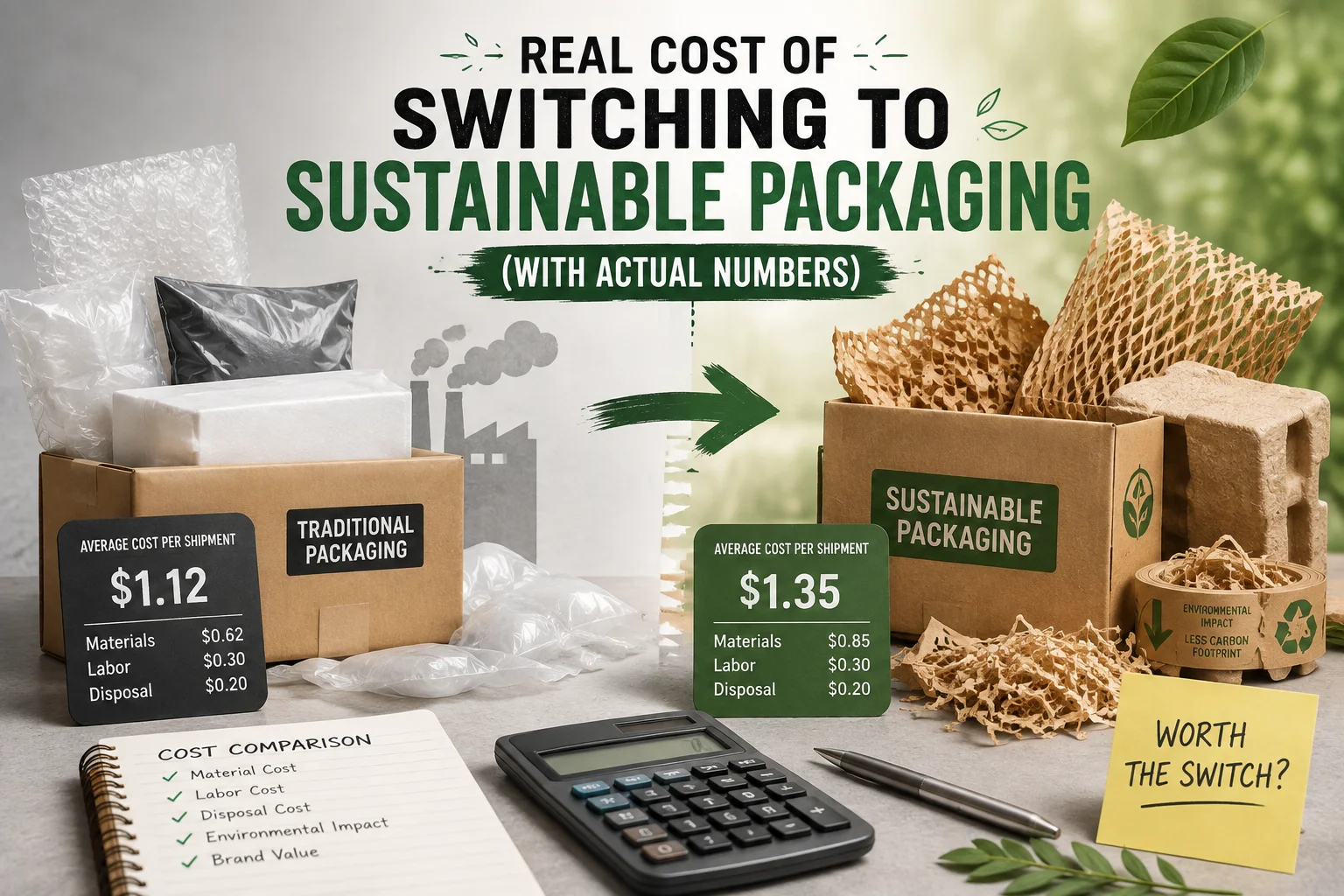
If recyclability is driving your specification, the numbers behind the real cost of switching to sustainable packaging will tell you what the change actually costs.
For a broader view of what is available today, look through our sustainable packaging ideas for brands and startups.