Every brand eventually asks the same question.
‘How much more will sustainable packaging actually cost us?’
And almost every supplier, consultant, or industry article gives the same frustrating answer: ‘It depends.’
You know what? That’s true. But ‘it depends’ is completely useless when you’re trying to build a business case, justify a budget increase, or explain to your CFO why next year’s packaging spend is going up.
So let’s stop being vague. Here are the real numbers — what sustainable packaging costs, why it costs that, where you’re probably overpaying, and where it can actually save you money.
First, Why Sustainable Packaging Costs More Per Unit
Let’s start with the honest part. Yes, most sustainable packaging materials cost more per unit than their conventional counterparts. Here’s why.
Conventional plastic packaging — your standard poly mailer, your multi-layer laminate pouch, your EPS foam — has been manufactured at massive global scale for decades. The machinery is paid off. The supply chains are mature. The cost is low because volume is enormous.
Sustainable alternatives are newer. Recycled content materials require additional processing steps to sort, clean, and reprocess post-consumer waste before it becomes a usable raw material again. Bio-based and compostable materials are often produced at smaller scale on newer equipment. Paper-based alternatives to plastic require investment in new barrier technologies.
All of that adds cost. It’s not a myth or a markup. It’s real.
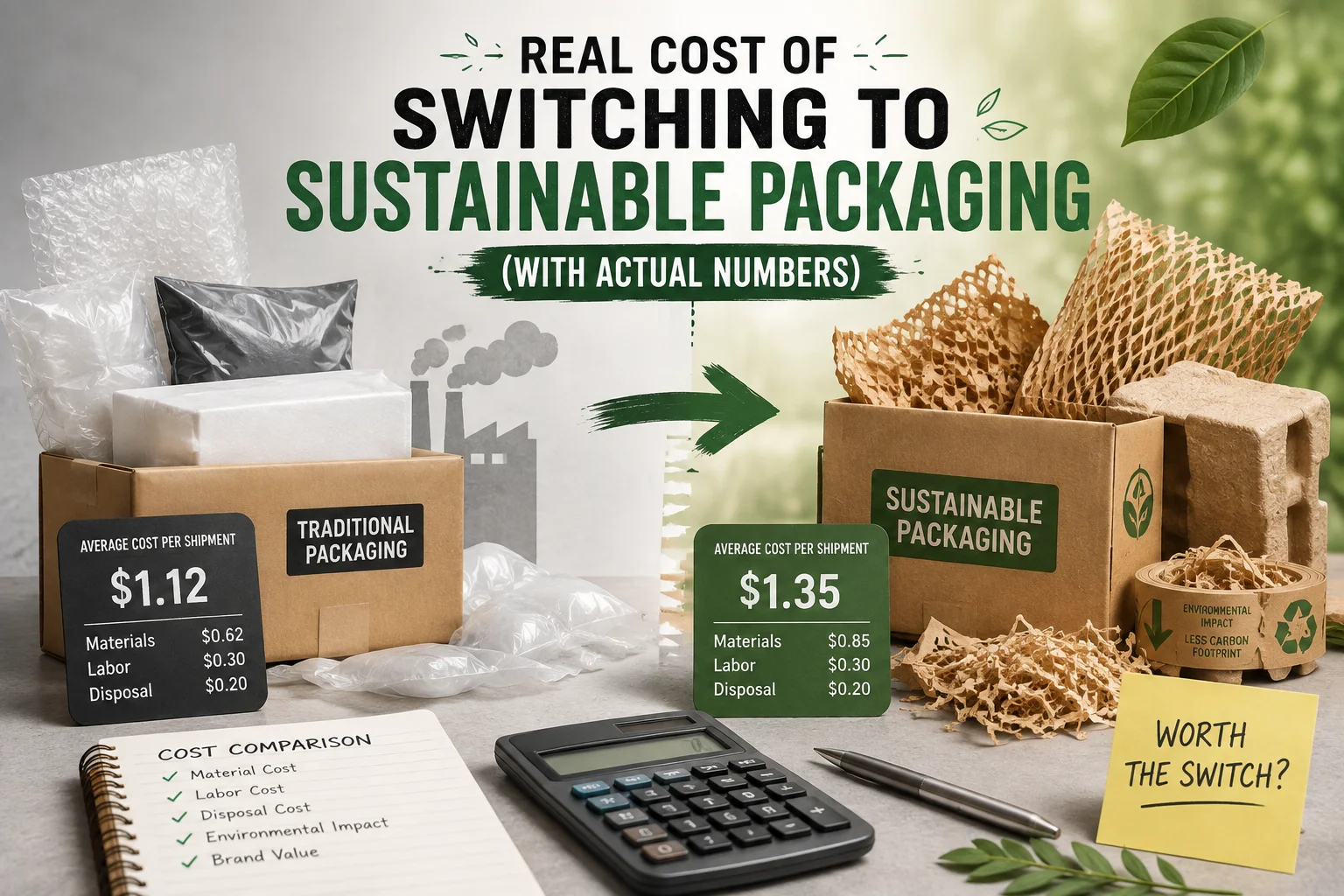
But here’s what most brands miss: the per-unit material cost is only one part of the total cost of your packaging decision. And for many brands, it’s not even the biggest part.
The Real Numbers: Material Cost by Format
Let’s look at what the actual price differences look like across the three most common food and consumer goods packaging formats.
Flexible Pouches — Stand-Up, 250g Food Product
This is the format where most brands feel the cost pressure most sharply. A stand-up pouch for coffee, snacks, or dried food in a conventional multi-layer laminate (PET/aluminium/PE) is one of the cheapest flexible formats available. Switching to something recyclable costs more. Here’s how much more:
| Format | Material | Cost per unit (USD) | Recyclable? |
| Conventional | Multi-layer laminate (PET/Al/PE) | $0.08 – $0.12 | No |
| Sustainable option 1 | Mono-material PE pouch | $0.11 – $0.16 | Store drop-off |
| Sustainable option 2 | Paper-based laminate + PE liner | $0.14 – $0.20 | Varies by market |
| Sustainable option 3 | Certified compostable film | $0.18 – $0.28 | Industrial compost |
At 100,000 units per year, switching from conventional laminate to mono-material PE costs you an extra £3,000–£4,000 annually. That’s the number people focus on. Keep reading — because there are numbers working in the opposite direction that most brands ignore.
E-commerce Mailers
For DTC brands and online retailers, the mailer is often the highest-volume packaging item. Here’s what the switch looks like:
| Format | Material | Cost per unit (USD) | Recyclable? |
| Conventional | Virgin poly mailer | $0.06 – $0.10 | Store drop-off |
| Sustainable option 1 | 50% PCR poly mailer | $0.08 – $0.12 | Store drop-off |
| Sustainable option 2 | Paper mailer (padded) | $0.12 – $0.18 | Kerbside |
| Sustainable option 3 | Certified compostable mailer | $0.16 – $0.24 | Industrial compost |
The 50% PCR poly mailer — the easiest, lowest-friction sustainable upgrade — costs only 15–25% more per unit than a virgin poly mailer. At 50,000 units per year, that’s roughly £1,000–£1,500 extra annually. For most e-commerce brands, that’s less than a single trade show stand.
Rigid Boxes — Retail, 100x100x50mm
| Format | Material | Cost per unit (USD) | Recyclable? |
| Conventional | Virgin SBS board, gloss laminate | $0.22 – $0.35 | No (laminate) |
| Sustainable option 1 | FSC-certified board, matte finish | $0.26 – $0.40 | Yes |
| Sustainable option 2 | 80% PCR recycled board | $0.28 – $0.42 | Yes |
| Sustainable option 3 | Uncoated recycled board, no laminate | $0.20 – $0.30 | Yes |
Here’s the one that surprises people: uncoated recycled board with no laminate — the most sustainable, most recyclable option — is often cheaper than the conventional gloss-laminated alternative. You’re removing a processing step, not adding one.
The Costs Nobody Puts in the Comparison
Most brands compare per-unit material costs and stop there. That’s the wrong analysis. Here are the costs that belong in the calculation that most brands leave out entirely.
EPR Fees — Extended Producer Responsibility
EPR schemes are now live in the UK, EU, and expanding rapidly across North America. The concept is simple: if you put packaging on the market, you pay fees based on what that packaging is made of and whether it can be recycled.
Non-recyclable packaging attracts the highest fees. Here’s a real example from the UK’s PRN (Packaging Recovery Note) system:
- A brand placing 10 tonnes of non-recyclable multi-layer flexible packaging on the UK market in 2025 is looking at £2,000–£8,000 in annual PRN obligations
- The same volume in recyclable mono-material PE? Significantly lower obligations — because the material has a functioning collection and recycling infrastructure
- PRN costs have risen year-on-year since 2022 and are projected to continue rising as governments ratchet up the financial pressure on non-recyclable packaging
When you subtract EPR savings from the per-unit premium for sustainable packaging, the net additional cost often shrinks by 30–60%.
Retailer Compliance Costs
This is the cost that hits brands hardest — and fastest.
Tesco, Lidl, Walmart, Target, and most major grocery retailers have published packaging sustainability roadmaps with supplier deadlines. Non-compliant suppliers face consequences: delisting warnings, reformulation demands, range review penalties.
Here’s the brutal truth about last-minute packaging changes: they cost two to three times more than planned transitions. New tooling on an emergency timeline, short-run printing premiums, expedited shipping for the first run, disruption to your production schedule — it adds up fast.
Brands that plan their sustainable packaging transition now spend significantly less than brands that get forced into it by a retailer deadline in 18 months.
Consumer Perception and Brand Risk
A 2024 Trivium Packaging study found that 74% of consumers said they would pay more for products in sustainable packaging. More importantly, brands that have been publicly associated with excessive or non-recyclable packaging face reputational damage that is extremely difficult to quantify but very real.
In 2025, packaging is part of brand trust in a way it wasn’t five years ago. The cost of not switching isn’t just regulatory — it’s the gradual erosion of consumer confidence in categories where sustainability is a meaningful purchase driver.
Where Sustainable Packaging Actually Saves Money
Not everything about the sustainable packaging transition costs more. Some parts of it — often the parts people overlook — actually reduce your costs immediately.
Lightweighting
Designing packaging that uses less material while maintaining performance is the single most effective cost reduction lever available to most brands — and it also improves your sustainability credentials simultaneously.
Lighter packaging means lower material cost, lower shipping weight, and less EPR liability. A brand that reduces average pack weight by 15% across their range typically sees packaging cost reductions of 8–12% — and that’s before any material switching at all.
Ask your supplier: what is the minimum material gauge or board weight that would still pass our drop, compression, and transit tests? Most brands discover they’re over-specified by 15–25%.
Removing Unnecessary Components
Many conventional packaging formats include elements that serve no functional purpose but add cost: tissue paper inserts that exist purely for aesthetics, plastic inner trays that could be replaced with structural board dividers, ribbon pulls and decorative ties that add labour and material cost.
A systematic review of every packaging component asking ‘does this need to be here?’ typically uncovers 10–20% cost reduction opportunities. And removing components almost always improves recyclability at the same time.
Supplier Consolidation
Sustainable packaging transitions are often an opportunity to rationalise your supplier base. Brands that were buying board from one supplier, film from another, and labels from a third frequently find that consolidating to one or two suppliers who can provide a sustainable unified solution unlocks volume pricing that offsets much of the material premium.
How to Build Your Business Case in Five Minutes
Here’s a simple framework for calculating the real net cost of a sustainable packaging switch:
| Cost category | Current packaging | Sustainable alternative |
| Material cost per unit × annual volume | Your current number | Sustainable material cost × volume |
| EPR / compliance fees (annual) | Your current PRN obligation | Reduced obligation for recyclable materials |
| Retailer compliance risk | Estimate 1–3% of revenue at risk | Zero if compliant |
| Lightweighting savings | Baseline | Deduct if redesign reduces weight |
| Component removal savings | Baseline | Deduct removed components |
| TOTAL NET COST DIFFERENCE | = | Sustainable total minus current total |
For most brands that run this calculation honestly, the net additional cost of switching to sustainable packaging is significantly lower than the raw per-unit premium suggests — and in some cases it’s cost-neutral or better within 12–18 months.
The Bottom Line
Sustainable packaging costs more per unit in most cases. That’s true and it’s not going to change immediately.
But the total cost of staying with conventional non-recyclable packaging — when EPR fees, retailer compliance risk, and the growing cost of consumer trust are included — is often higher than the total cost of switching.
The brands getting this right are not the ones with the biggest sustainability budgets. They’re the ones who ran the honest total-cost calculation and made the switch on business grounds, not just ethical ones.
Key Takeaways
- Sustainable packaging materials cost 15–40% more per unit on average — but per-unit material cost is not the full picture
- EPR fees, retailer compliance risk, and consumer brand perception all belong in the total cost calculation — most brands leave them out
- Uncoated recycled board with no laminate is often cheaper than conventional gloss-laminated board — you’re removing a processing step
- Lightweighting and component removal typically reduce packaging costs by 10–20% without any material switching at all
- Brands that plan their transition proactively spend significantly less than those forced into it by retailer deadlines